


Everything at a glance
-
SEO aligns your website with the guidelines of search engines so that it delivers high-quality content matching what users are searching for.
-
It covers on-page content, off-page backlink strategies and technical improvements such as faster loading times and mobile optimisation.
-
SEO drives organic, cost-efficient traffic, builds trust and supports sustainable growth.
-
SEO benefits a wide range of businesses, including B2B companies, retailers, e-commerce sites and local businesses.
-
Effective SEO starts with keyword research and a well-considered structure, with success measured through metrics such as traffic and keyword rankings.
“If your website is not found, it practically does not exist.”
That is not just a dramatic statement, it is reality. In 2025, 68 % of all online experiences begin with a search engine. And if you are not present there, your competitors certainly are. SEO, or search engine optimisation, is no longer a luxury. It is the foundation for sustainable digital growth.
Whether you are launching a brand new website or developing an already successful business, it is time to make SEO your secret weapon for long-term visibility, trust and conversions.
What is SEO?
SEO stands for search engine optimisation, in German Suchmaschinenoptimierung.
At its core, SEO is the art of fine-tuning your website so that search engines (yes, Google included) can easily understand its content and its relevance.
It is not about scattering keywords at random. It is about deliberately optimising the usability, the content, the internal and external links and the technical structure of a website.
Here are some key aspects of SEO:
- Technical SEO: loading time, mobile friendliness, clean website structure.
- On-page SEO: optimisation of content, headings, keywords, internal links, meta and SEO titles.
- Off-page SEO: building backlinks, in other words recommendations from other websites.
- Content SEO: creating relevant, helpful and well-structured content.
- User experience (UX): user-friendly design and good readability.
So if you implement SEO properly, it ensures that your website appears as high as possible in the unpaid search engine results, the so-called SERPs (search engine results pages).
In other words: “free clicks”. It is not entirely free though, because you invest work up front so that you are found organically later on. In the long run, however, this is a very profitable and cost-efficient marketing route.
In 2025, Google is still the leading search engine in almost every country. There are only a few exceptions in which other search engines are more popular. (No need to worry, classic SEO applies to all search engines, not only to Google.)
| Country | Market leader / strong alternative | Note |
|---|---|---|
| China | Baidu | Google is largely blocked (Great Firewall) |
| Russia | Yandex | Yandex holds a strong market position in Russia |
| South Korea | Naver | Local services are strongly preferred |
| Japan | Yahoo! Japan | Uses Google’s search technology, but dominates with its own front end |
| Czech Republic | Seznam | Popular locally, but Google is catching up |
Here is a picture of the worldwide comparison:
Source: StatCounter Global Stats – Search Engine Market Share
Expert tip: Classic SEO is also the key to being found in AI models such as ChatGPT. If your long-term goal is to be visible in those models, there is good news: around 80 % of the work is based on classic SEO and the basics. Only once you have built a strong foundation is it worth investing more time in generative engine optimisation (GEO).
Definition of SEO (according to Google and Wikipedia)
SEO, short for “search engine optimisation”, is about helping search engines understand your content. It also helps users find your website and decide whether they should visit it through a search engine. Google
Search engine optimisation (SEO) describes measures that serve to increase the visibility of a website and its content for users of a web search engine. The optimisation relates to improving the unpaid results in the organic search engine ranking (natural listings) and excludes direct traffic and the purchase of paid advertising. The optimisation can target various types of search, including image search, video search, news search or vertical search engines. Wikipedia
How does SEO work?
Think of SEO as the ultimate team sport for your website: every element plays its part so that you can score big online.
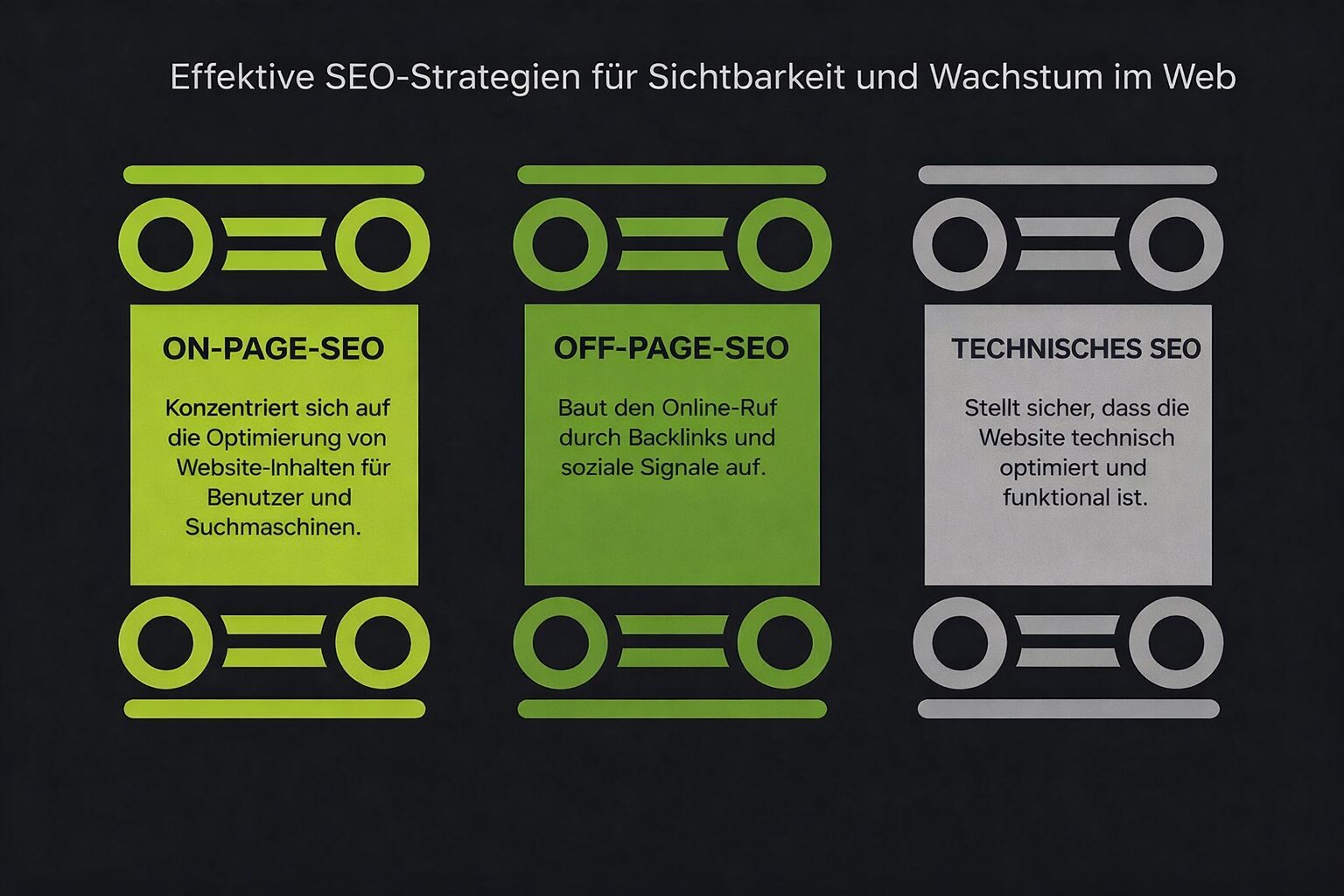
It is like a puzzle in which on-page optimisations, off-page strategies and technical magic work together to improve the performance of your site over time.
How do search engines work?
Picture search engines as extremely efficient librarians on a caffeine high. They comb through billions of pages to find the perfect answers to your query. This is how they work:
- Crawling: bots act as digital explorers that follow links to find new or updated pages.
- Indexing: the pages that are found are neatly organised in an enormous database, like a well-sorted digital library.
- Ranking: pages are assessed on content quality, user experience and relevance, and the best ones rise to the top.
Our approach works like a coach behind the scenes. We carry out detailed technical audits and optimise your content without interrupting the natural flow of your brand. That keeps your site current and lets it climb steadily in the search results.
On-page SEO
On-page SEO is about making your content crystal clear and inviting for visitors and search engines alike. This includes:
- Headings and structure: use H1, H2 and H3 tags correctly to keep everything clearly arranged.
- Keyword integration: place keywords strategically so that your content strikes the right tone.
- Content quality: create appealing, informative content that genuinely answers your target group’s questions.
We start with thorough keyword research to work out exactly what your target group is searching for. After that we create natural, reader-friendly content with the keywords woven in effortlessly, so that your pages are both enjoyable to read and search engine friendly.
Off-page SEO
Building your online reputation goes far beyond your website. Off-page SEO is like making influential friends in the digital world:
- Backlinks: receiving high-quality links from trustworthy sites shows search engines that your content is authentic.
- Digital PR: making contact with influencers and using social media to widen your reach.
- Social signals: an active presence on social media can give your SEO a solid boost by encouraging traffic and engagement.
Rather than relying on one-off case studies, we concentrate on sustainable, ethical methods that earn your site valuable backlinks naturally. In short: we create content so good that it practically makes friends on its own.
Technical SEO
Technical SEO is the behind-the-scenes wizardry that keeps your website in peak condition for search engines. It covers:
- Page speed: fast-loading pages that delight visitors and put a smile on search engines’ faces.
- Mobile optimisation: making sure your site runs smoothly on every device.
- Secure connections: using HTTPS to build trust and guarantee security.
Regular technical audits are the equivalent of routine check-ups: they identify and fix problems before they can hold back your progress. We implement scalable solutions that evolve with your site, so that everything runs like clockwork.
How does ranking work at search engines?
Google tries to present you with the best possible result for every search term, and for good reason.
Search engines live off people searching for information and finding suitable answers. The more specific the search, the better the result.
If you are wondering what actually gets you to number one:
Relevance and authority are the factors with the greatest influence on placement.
But how exactly does ranking work?
Search engines such as Google have their own set of rules and a very intelligent algorithm that is constantly evolving. The rulebook also exists so that everyone plays by the rules, but more on that later.
There is also the concept of E-A-T, which stands for experience, authority and trustworthiness. The concept comes from Google and is described in the so-called Search Quality Evaluator Guidelines. It strongly influences how Google assesses the quality of content, above all on sensitive topics such as health, finance or law.
How do search engines work?
Picture search engines as extremely efficient librarians on a caffeine high. They comb through billions of pages to find the perfect answers to your query. This is how they work:
- Crawling: bots act as digital explorers that follow links to find new or updated pages.
- Indexing: the pages that are found are neatly organised in an enormous database, like a well-sorted digital library.
- Ranking: pages are assessed on content quality, user experience and relevance, and the best ones rise to the top.
Our approach works like a coach behind the scenes. We carry out detailed technical audits and optimise your content without interrupting the natural flow of your brand. That keeps your site current and lets it climb steadily in the search results.
But be careful. If you slide into questionable territory with manipulative tactics (also known as search engine spamming or black hat SEO), you risk:
- Considerable ranking losses: your site could suddenly lose its shine.
- A complete ban: in the worst case, Google could throw your site out altogether.
To keep everything in the green, avoid these no-gos:
- Illegitimate link building:
- Building link farms or networks of expired domains.
- Buying links or taking part in questionable sponsored link schemes.
- Using automated methods such as blog comments or forum profiles to generate links.
- On-page manipulation:
- Hiding text or links where nobody is supposed to see them.
- Overloading your pages with too many keywords or low-quality, automatically generated content.
- Duplicating content or abusing rich snippet markup.
- Other dubious techniques:
- Setting up cloaking or misleading redirects.
- Taking part in affiliate programmes that offer little genuine added value.
You are risking manual penalties (also called manual actions), which are penalties imposed by real Google employees and not automatically by the algorithm. They push you considerably further down the rankings, or in the worst case remove you from the index completely. That does require a serious violation, though.
If you are unsure whether you have received one: you will be notified in the Google Search Console.
In most cases, however, Google penalties can be lifted again, provided the cause is removed and a so-called reconsideration request is submitted through the Google Search Console.
So stay clean, stick to the guidelines and let your high-quality content and authority shine. If you have any questions, feel free to get in touch with us and we will sort it out with you.
Search engine registration
In the early days of the internet, you had to tell search engines manually that a new website existed.
In practice that meant filling in a kind of “registration form” on the search engine’s website, or even sending a letter or an email to ask for your site to be added to the index.
Google was already more advanced: there you could submit your site through a form. Before Google there were search engines such as AltaVista, Lycos or Yahoo, and things were still fairly old school there.
Fortunately, it is simpler today. Search engines usually discover new pages automatically through links from other websites or through an XML sitemap, which you can submit in the Google Search Console, for example.
Even so, it is still a must-have to use webmaster tools such as Google Search Console or Bing Webmaster Tools. These practical platforms offer:
- Performance reports: get a detailed insight into how search engines perceive your site.
- Indexing warnings: receive notifications about any problems with your pages.
- Visibility tools: use features designed to strengthen your entire online presence.
Even though manual registration is no longer the focus, these tools can improve your SEO game considerably.
What is an SEO manager?
A search engine optimiser (or SEO manager) is the digital magician behind the success of your website.
These professionals combine technical know-how with a creative strategy to improve your site’s ranking and generate organic traffic. Their mission? Making sure your site gets the attention it deserves, entirely without magic tricks.
The main tasks include:
- Keyword research: finding out which words and phrases your target group is already searching for.
- Developing the SEO strategy: creating a plan to increase your site’s visibility.
- Competitor analysis: analysing what your top competitors are doing (and how you can outperform them).
- Technical SEO: optimising the structure, speed and mobile performance of your site to ensure smooth operation.
- On-page optimisation: reworking content, meta tags and internal links so that everything is right.
- Off-page optimisation: building high-quality backlinks and collecting external signals that say “this site is great”.
- Content strategy: creating and managing appealing content that not only attracts visitors but keeps bringing them back.
For an effective SEO strategy, however, a single SEO manager is no longer enough these days. You need a whole team with different competences to achieve genuinely visible results:
-
SEO strategist: develops the overall strategy and analyses the market, target groups and competitors.
-
Content creator: responsible for creating high-quality, search engine optimised content.
-
UX/UI designer: ensures a user-friendly design and structure for the website, an important ranking factor.
-
Web developer: implements technical SEO measures and ensures fast loading times and stable functionality.
-
PR manager / backlink builder: takes care of high-quality backlinks and thereby increases the authority of your website with Google.
Only when all these roles work together do you achieve sustainable visibility in search engines.
Steer clear of one-person operations: SEO is not an individual sport, it is a team effort.
Benefits of SEO
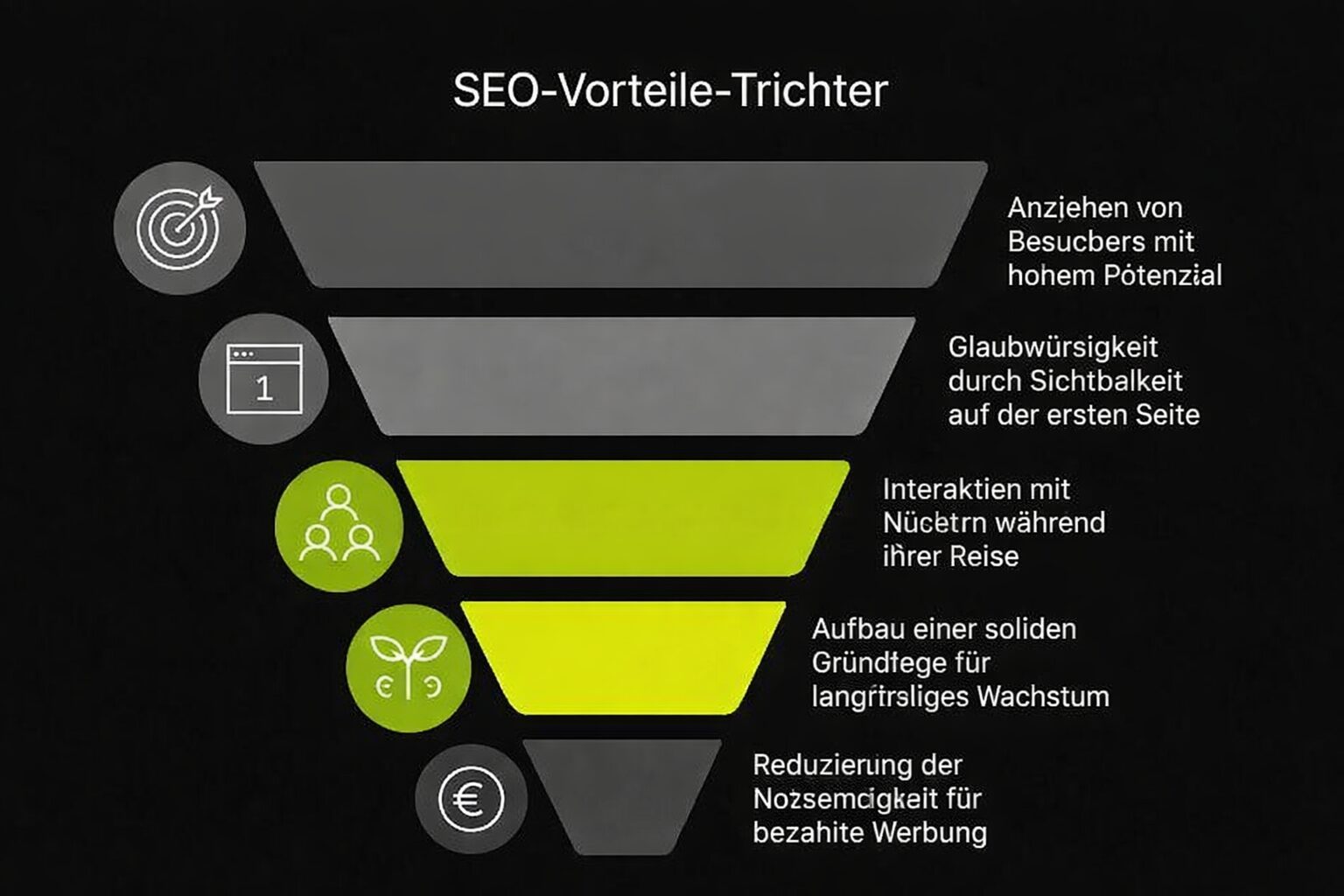
A well-optimised website works like a magnet that continuously attracts visitors over time. With continuous updates, your SEO efforts will bring you numerous benefits over a long period.
Organic search
SEO is the main ingredient for bringing tonnes of high-quality, organic traffic to your website. If you keep focusing on your key aspects such as specific keywords and creating content that genuinely speaks to your audience, you will find a large number of visitors who are interested in what you have to offer.
Organic traffic is particularly profitable and valuable because people are actively searching for your product, your service or a specific question. They already have a genuine interest, or even a concrete need, and want to engage with the topic deliberately. Unlike social media, where an algorithm suggests content, here the user finds their way to you on purpose. That is what makes organic traffic so powerful.
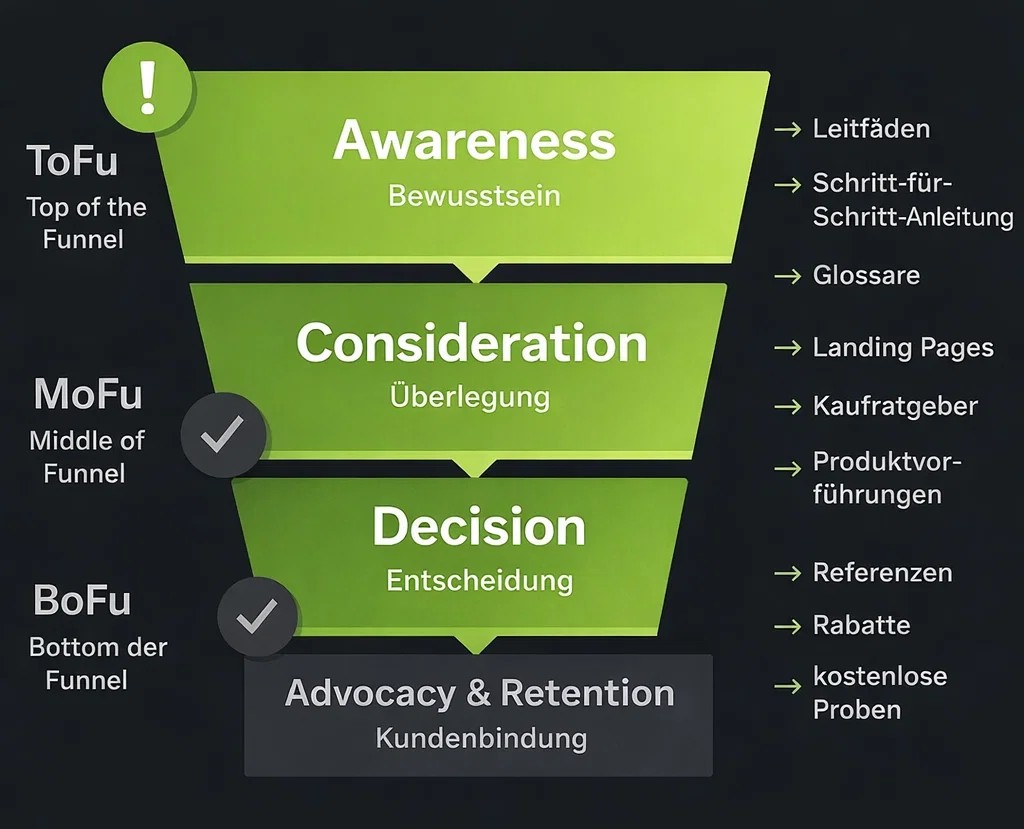
You can also accompany users along their entire customer journey, from ToFu through MoFu to BoFu.
Explanation from an SEO perspective:
-
ToFu (top of funnel): this is the entry phase. Here users are mostly looking for general information or answers to initial questions. SEO goal: become organically visible and build reach with informative blog articles, guides or explainer videos. Keywords: information-driven (“what is…”, “how does… work”).
-
MoFu (middle of funnel): the comparison phase. Users know the problem and are now looking for solutions, products or providers. SEO goal: build trust through case studies, white papers or product comparisons. Keywords: solution-oriented (“best tools for…”, “comparison…”).
-
BoFu (bottom of funnel): the decision phase. Now a purchase is made or an enquiry is submitted. SEO goal: conversion-optimised pages such as landing pages, testimonials or demos to provide the final impulse to act. Keywords: transaction-oriented (“offer”, “buy now”, “service provider in [location]”).
First-page trust
When you do SEO, your main goal is for your website to be ranked higher in the Google search results. Think of landing on the first page of the search results as receiving a digital seal of approval.
When your website appears among the top results (and it is not an advert), users automatically perceive it as trustworthy and authoritative.
This increased credibility leads to higher click-through rates, because people naturally gravitate towards sources they consider reliable.
User engagement
People tend to stay on your website longer when they are given appealing content that is not only informative but also captivating.
SEO helps you create an experience for your users that makes them stay on your website longer and even motivates them to come back. Think of it like holding a conversation so engaging that your audience feels drawn in and asks for more.
Sustainable results
While paid advertising might bring you quick wins, SEO builds a solid foundation for long-term growth. When you invest in SEO, you secure higher rankings for your website over the long run.
Once your website has achieved strong organic rankings, it continuously attracts visitors, even during periods when you invest less in SEO. That is exactly what makes SEO a smart and sustainable investment for the future.
Expert tip
When you start generating traffic and your revenue rises, that is not the moment to stop with SEO. It is the moment to really step on the gas.
Steady growth
Unlike short-term marketing tactics, SEO creates a steady, upward trend in traffic over time. As your site gains authority and relevance, more and more users discover it organically.
Think of it as a snowball rolling down a hill and gathering momentum. This constant growth drives sustained success and positions your business for the long-term future.
Cost efficiency
Investing in SEO is the equivalent of having a team that works tirelessly for your website without recurring costs for rankings.
As soon as your website starts to rank, it is only uphill with minimal effort. Compared with paid adverts, this strategy is extremely cost-effective.
It not only reduces marketing spend in the long run, it also delivers a higher return on investment over time.
Higher conversion rates
Because websites that rank through SEO have greater credibility, users are more likely to trust your site than an advert.
This trust helps them take the next step, whether that is a purchase, signing up for a newsletter or getting in touch for more information.
This smooth transition from visitor to customer underlines the true strength of a well-executed SEO strategy, in which increased trust translates directly into higher conversion rates.
Generative Engine Optimisation (GEO)
Are you thinking the whole time: “SEO is dead anyway, I just want to show up in LLMs like ChatGPT”?
Then here is the good news: classic SEO is still the key. Around 80 % of mentions in ChatGPT are based on exactly those SEO measures.
ChatGPT, for instance, uses data from Bing, a classic search engine. Websites that rank well on Bing are often mentioned in ChatGPT too, which shows a certain connection (according to Seer Interactive). Even so, the search results are not identical on both.
SEO vs. SEA vs. SEM
By now you probably know what SEO is. However, you may also have heard of further terms such as SEA (search engine advertising) and SEM (search engine marketing). So what is the difference between these three?
SEO focuses on improving organic search performance through content, technical improvements and user experience, while SEA uses paid adverts to gain immediate visibility. SEM combines both approaches, so that you achieve fast results and build long-term growth.
SEO vs. SEA
Search engine advertising (SEA) delivers fast, measurable results through paid adverts. With SEA you quickly gain visibility at the top of the search results and can easily test (if you know what you are doing) which keywords work best.
However, these SEA benefits only last as long as you pay for the adverts, and the cost per click can be high, especially in competitive niches. On top of that, the overall traffic potential of SEA is often lower compared with the long-term gains of SEO.
And as soon as your advertising budget is used up, it looks as if your site had never existed. That is why it is important to take a more balanced approach.
SEO requires considerable time, expertise and persistent effort, which can help your website to good rankings in the long term, sometimes even without consistent optimisation.
SEO vs. SEM
SEM, or search engine marketing, is a comprehensive strategy that covers all methods for increasing the visibility of your website in search engines.
Unlike SEO, which focuses on increasing organic traffic over time through content and technical improvements, SEM takes a broader approach by also including paid advertising strategies (SEA).
That means you can achieve quick visibility and measurable results through paid adverts while at the same time investing in organic methods that build long-term credibility and traffic.
By using SEM, you essentially combine the best of both worlds. Paid advertising can boost your online presence and give you immediate insights into which keywords and messages resonate with your audience, while continuous SEO measures maintain and expand your visibility over time.
In short, a successful SEM strategy integrates both SEO and SEA, so that you benefit from quick wins and from sustainable, long-term growth.
| Distinction | SEO | SEA | SEM |
|---|---|---|---|
| Definition | Organic optimisation through content, technology and links. | Paid adverts in search engines (PPC). | Combination of SEO and SEA to increase visibility. |
| Costs | Time-intensive, low direct costs. | Requires an advertising budget (PPC model). | Costs for SEO plus paid campaigns. |
| Results | Long-term, visible with a delay. | Immediate visibility through adverts. | Fast and long-term results combined. |
| Sustainability | Long-term effect when maintained. | Ends when the budget stops. | Sustainable with a good balance. |
| Control | Little influence on algorithms. | Full control over adverts. | Combined steering of both channels. |
| Trust | High trust in organic results. | Partly viewed with scepticism. | Depends on the mix. |
| Optimisation | Improve content and technology. | Test bids, keywords, adverts. | Optimise both for the best effect. |
Who is SEO suitable for?
While SEO is beneficial in most cases, it is also important to know that not every business needs it.
The following are some of the areas in which SEO works best.
-
Almost all online shops, including those operating in the B2B sector.
-
Local businesses (for example tax advisers, doctors, lawyers, tradespeople).
-
High-value services (for example consultancies, agencies).
-
Traditional B2B industries (for example manufacturing, mechanical engineering).
-
Modern B2B sectors (for example software as a service).
-
Tourism, although caution is advised with larger investments in most individual accommodation providers.
Before you dive deeper into SEO, you should check whether the results you want can realistically be achieved through a good SEO strategy at all.
At the beginning it is crucial to look at this: is there even enough search volume in your industry? And does the traffic actually generate revenue? Because there is one thing SEO cannot do: create demand. People actively search for solutions, but if nobody knows your product or searches for it, even the best placement will not help you. In such cases, social media or educational blog articles make more sense. With those you can first make the problem visible, and then offer your solution in a targeted way.
Also worthwhile: start with Google Ads to test which keywords actually produce conversions for you. That way you can see exactly which terms are worth it, and build your SEO strategy on that basis.
Expert tip
Combine Google Ads and SEO to test which keywords actually produce conversions for you. That way you can see exactly which terms are worth it, and build your SEO strategy on that basis.
Google Ads is not so simple, though, that you can just pick a keyword, link to any page you like and treat that as a test. You need good, convincing landing pages for that, and this is exactly where SEO comes in again.
Another important point: if you achieve conversions through Google Ads but the click prices for certain keywords are so high that you make no profit, then SEO is the more sensible long-term solution.
Traditional B2B companies
Up to 2020, the traditional B2B sector relied heavily on personal contact. Since the pandemic, however, online searches have also become a decisive part of the traditional B2B sector. Prospects first gather information before deciding whether or not they want to get in touch.
This is particularly common with complex products or larger transactions. That is also why the period for research and decision-making in the B2B sector is longer compared with B2C. SEO supports you in building a good reputation and trust online.
A strong online presence for a B2B company with important information that is easy to find, up to date and easy to understand is indispensable these days.
If your products or services are complex and require extensive research, a strong SEO strategy is essential in order to guide potential customers through every phase of their long decision-making journey.
Companies with a limited product range
Even if your SEO efforts are outstanding, a limited product range in the e-commerce sector can still hold you back.
If your competitors offer 1000 products in a category while you only have 10, for example, shoppers who are in the mood to explore different options could quickly switch to other sites. Category pages are particularly important for e-commerce websites in particular, because they account for the largest share of traffic and revenue.
They usually want the flexibility to compare different styles, features and prices, and a limited selection could signal that your shop cannot meet all of their needs.
This can lead to lower click-through rates and conversion rates despite high search rankings, because users feel that their user experience is restricted.
Companies with unique branding
Although a unique, creative brand is very important, it can sometimes lose focus if it spends too much time on its own ideas instead of listening to customers.
If you want to be successful in Google search, it is important to find a balance between your own creative vision and the needs of your target group.
That means understanding what your customers are searching for and making sure your website and content clearly meet those needs. By balancing originality with a user-centred approach, you can attract more visitors and improve your search rankings.
How does Google assess websites?
Being noticed by Google is like being the star of your own digital show: it requires a balanced performance across several key aspects. In 2025, four main factors steal the show. Let us break them down in an entertaining and easy-to-follow way:
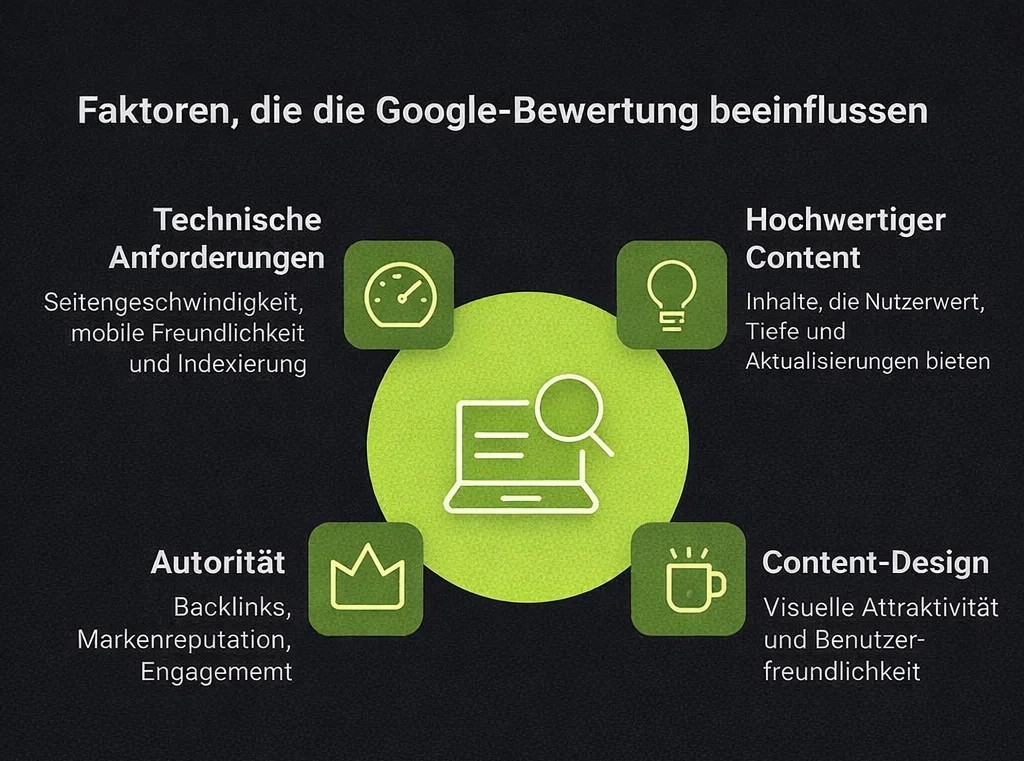
High-quality content
- User value: Google looks for content that answers questions clearly, stays interesting and genuinely helps the user, just like your favourite guide.
- Depth and originality: stand out from the crowd by offering in-depth analysis and fresh insights. See it as your own secret ingredient.
- Regular updates: keeping your content current signals to Google that you are active and on the ball, like a social media feed that never sleeps.
Content design
- Visual appeal: a clear, well-organised layout makes your content a pleasure to read. It is like the difference between a messy cupboard and a stylish, tidy wardrobe.
- User experience (UX): smooth navigation, a mobile-friendly design and an intuitive structure help both visitors and search engines find their way around your site without trouble.
- Accessibility: using clear headings, bullet points and short paragraphs makes your content easy to digest, so that everyone understands the message without extra effort.
Authority
- Backlinks: when respected sites link to you, it is like a thumbs up from the most trustworthy community on the internet. Google sees these links as proof that you are worth a look.
- Brand reputation: if you continuously deliver valuable, expert content, your standing as an authority in your niche rises. It is like being the go-to person at every party.
- Engagement: social shares, comments and active interactions show that people love what you do, and thereby cement your site’s credibility in Google’s eyes.
Basic technical requirements
- Page speed: fast-loading pages and a secure (HTTPS) connection are decisive. Remember that your digital shop window should always be inviting and safe.
- Mobile friendliness: as more and more people browse on their phones, a responsive design is a must. Nobody likes a website that cannot keep up.
- Indexing and structure: a clear, organised site structure and the correct use of sitemaps help search engines crawl and index your pages without trouble, so that nothing gets lost in the digital chaos.
When should you start with SEO?
The best time to jump on the SEO train is as early as possible, ideally when you launch your website or even during a comprehensive repositioning. SEO is not a sprint, it is a marathon.
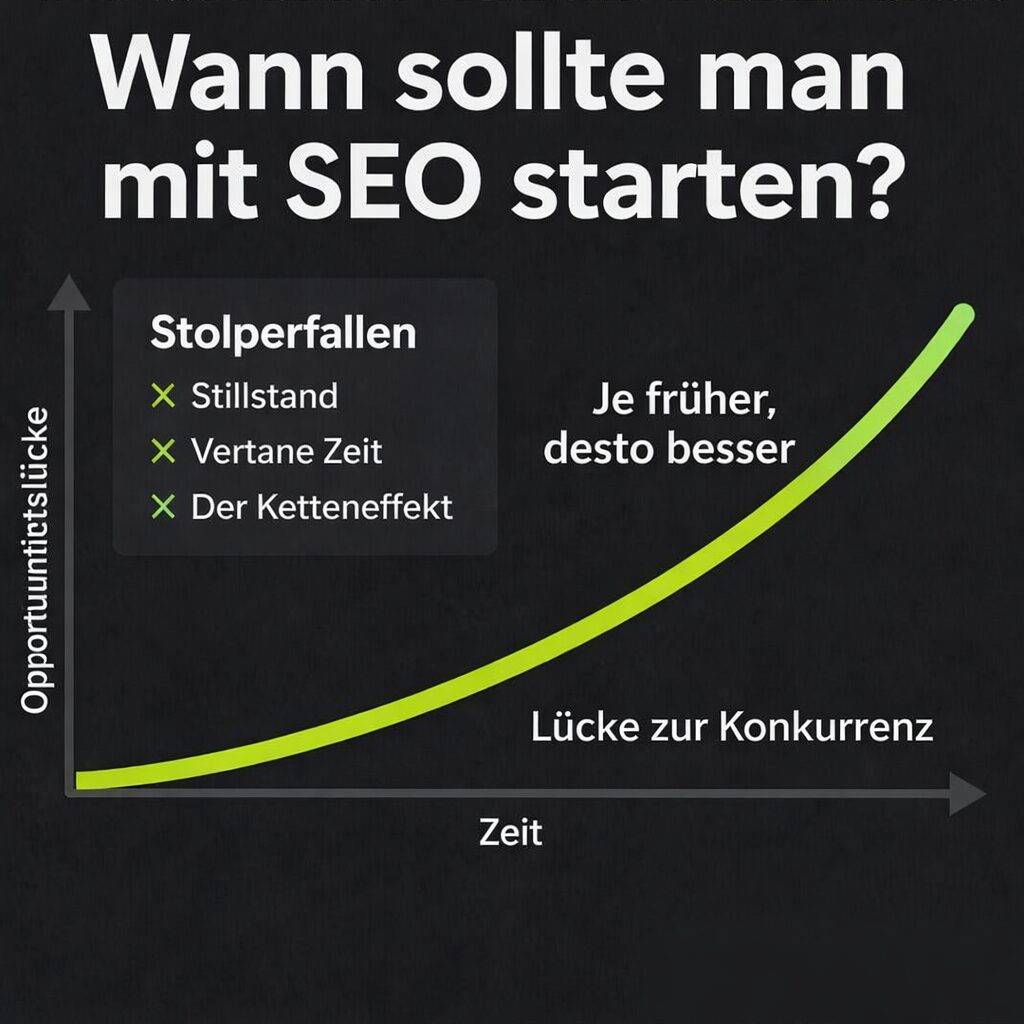
It usually takes several months before you see noticeable results, which is why you should not neglect it under any circumstances. The later you start, the longer you will have to wait for success.
If you integrate SEO into your planning from the very beginning, you create a stable foundation for organic growth, increase your visibility and strengthen your credibility in the long term.
In short: do not wait, start early so that you do not miss those golden opportunities.
How long does SEO take?
Think of SEO like gardening: it is not an overnight miracle, it is a long-term investment that pays off over time.
If you are in a very weak niche, you can expect noticeable improvements within three to six months, although the really big successes often only arrive after a year or later.
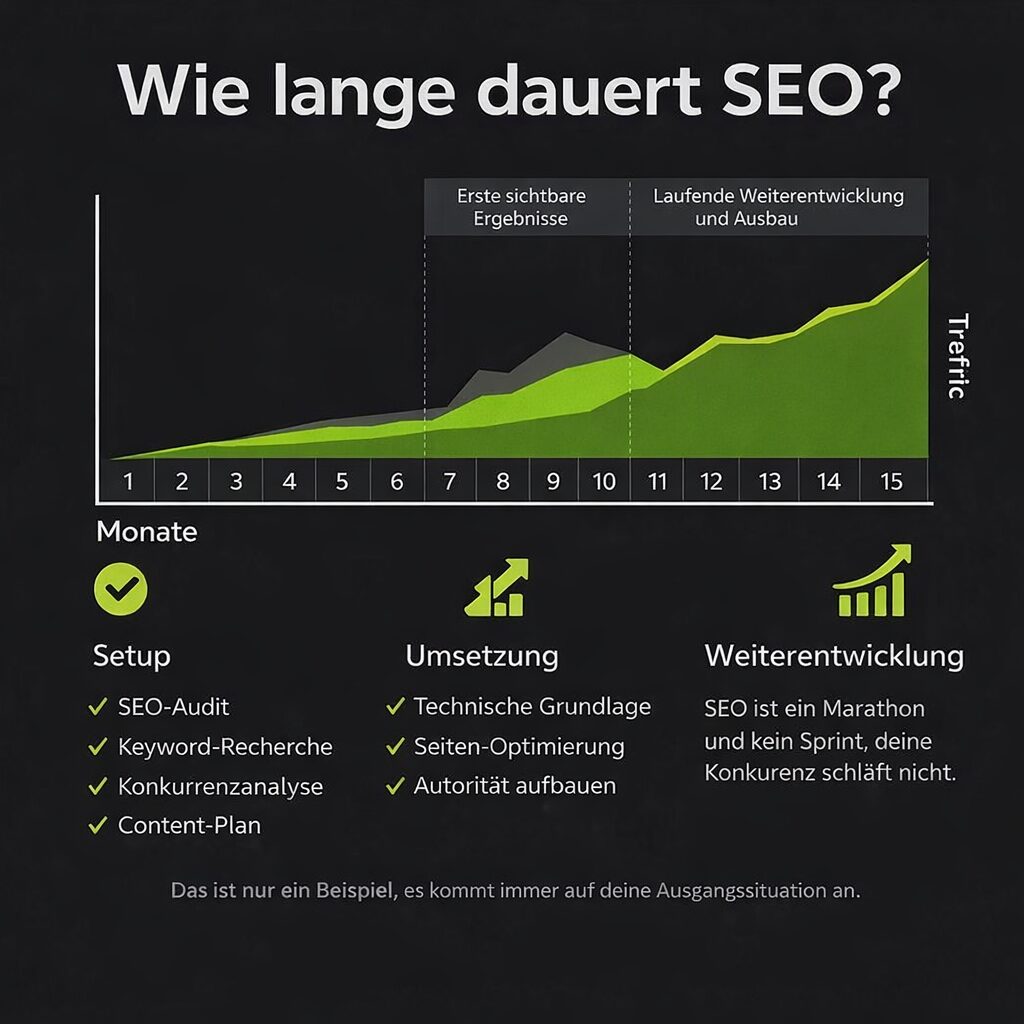
Even if you are already a well-established SME with a certain amount of authority, you will usually see first SEO results after three to six months.
With a completely new website in a fiercely contested international market, you will probably need 12 to 18 months of patience before anything really moves. If your competition has already built an SEO skyscraper and you are starting from zero, then it simply takes a while.
But hey, do not let that put you off. Just think about why your competition is investing so much in SEO.
Remember, SEO is a marathon, not a sprint. Continuous effort leads to long-term success.
Expert tip
Be careful if an agency promises you position 1 within a few days, or even immediate visibility on page 1. Those are typical bait offers from disreputable SEO providers.
Of course, in theory you can always rank on page 1 if you simply pick a keyword that nobody searches for and that has no competition whatsoever. But what does that get you? And nobody can guarantee you position 1, because nobody has direct influence over it. In the end, Google decides, not the agency.
Steps for getting started with SEO
Diving into SEO might feel like wrestling a digital octopus, but with a solid plan and these clear steps you are well on your way to taming the beast.
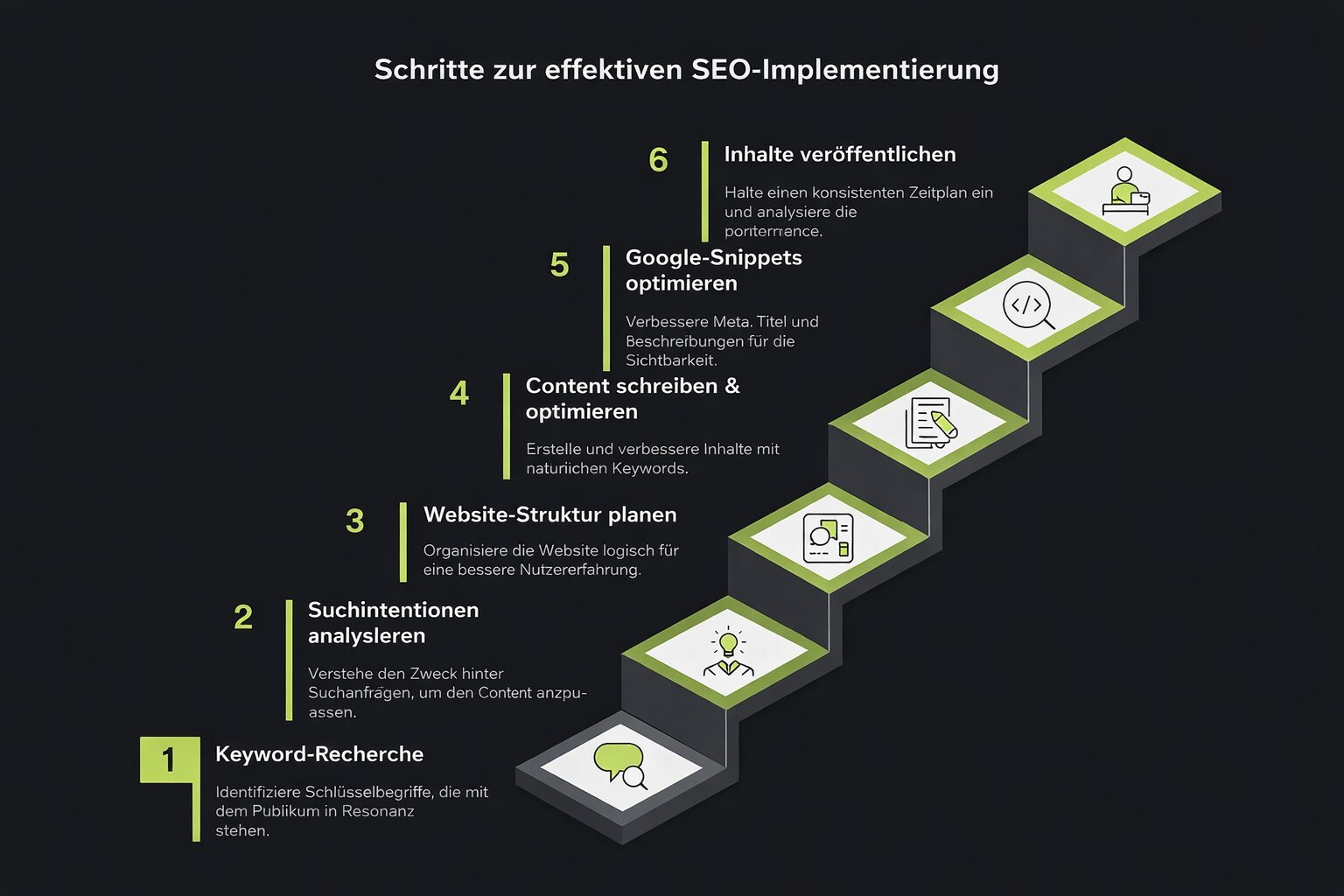
Step 1: keyword research
See keyword research as the treasure map of your SEO journey. Use specialised tools to discover the words and phrases your target group is searching for, and check their search volume and competition. This step ensures that your content speaks the same language as your visitors.
Step 2: analysing search intent
Understanding search intent is like working out why your friend keeps asking about pizza preferences: what is the real wish? Are they looking for details, are they ready to buy, or are they simply browsing options? Adapt your content to that mood and watch engagement and relevance shoot up.
Step 3: planning the website structure
A clear website structure is like a well-organised wardrobe: it makes everything easier to find. Arrange your pages logically with intuitive navigation and a clear hierarchy. That not only makes your site user-friendly, it also helps search engines crawl and index your content effortlessly.
Step 4: writing and optimising SEO copy
Now it gets creative. Create appealing, valuable content with your target keywords woven in naturally. Focus on clear, information-rich copy that answers users’ questions. And do not forget: regular updates and adjustments keep your content in top form over the long term.
Step 5: optimising Google snippets
Think of your meta titles and descriptions as inviting headlines in a magazine. Use concise and convincing language that highlights the benefits of your content. Implemented correctly, these snippets can increase your click-through rates and draw more visitors into your world.
Step 6: publishing content
Consistency is the key: regular publishing creates momentum and authority. Keep your audience happy with fresh updates and use real-time feedback and analytics to optimise your strategy. Soon your SEO efforts will pay off, just like your favourite subscription box.
In-house SEO vs. SEO agency
Whether you should take SEO into your own hands or commission an agency depends on your resources, your expertise and your business goals.
DIY SEO
- Cost efficiency: it is usually cheaper than paying an agency. (Whether it is more effective is debatable.)
- Learning curve: you have to invest time to learn best practices, master tools and keep an eye on SEO trends. Think of it as a fun (and sometimes challenging) self-improvement project. We also train you, though, so that the learning curve is faster.
- Limited expertise: without specialist know-how you could miss advanced tactics or run into common pitfalls. It is like trying to repair a car engine with a YouTube tutorial: you might get there, but it can be bumpy.
Commissioning an SEO agency
- Expertise: agencies bring a wealth of specialised knowledge and experience, which can lead to faster and more effective results.
- Time savings: leave your SEO to the professionals while you concentrate on your business (or on perfecting your coffee-making skills).
- Comprehensive strategies: from technical audits through to creative content and link building, agencies offer a complete service package that covers every area.
- Costs: it is usually more expensive (at first glance), but see it as an investment in a first-class team that can give your organic traffic and your conversions a solid boost. If we generate more revenue for you than we cost, we are not expensive, we are a money machine.
As a general rule: if you have absolutely no budget, you will probably have no choice but to take SEO into your own hands.
But if you are a small or medium-sized business, or have a budget from 1,500 EUR upwards, then I clearly advise against doing it yourself. Why? Because a successful SEO strategy cannot be handled by a single person. You need several competences: strategy, technology, content, link building and above all experience.
Without specialist knowledge you simply lack the overview. And here is the problem: the SEO market is full of bad apples. Many claim they are doing something but in reality do nothing at all. So make sure you look at genuine case studies before you commission anyone.
We, for example, have projects with over 1000 % growth. No joke, four zeros. 🚀
And if you think you will get away more cheaply by hiring three or four people yourself: unfortunately not. We have developed our own software and AI-supported agent tools to speed up our processes, and that is exactly what saves our clients real money.
Ready for more revenue?
Book a free SEO and GEO audit

Find out in a free call how much revenue your website is leaving on the table, with no obligation and no agency waffle.