


Key Takeaways
- How much does professional search engine optimisation (SEO) cost? If you opt for high-quality SEO support, you should budget for monthly spending of between 1,000 and 8,000 euros.
- Hourly billing: brings transparency and flexibility.
- Common hourly rates in the DACH region: Freelance SEO specialists usually charge between 75 and 150 euros per hour. In established agencies, prices can also range from 150 to 300 euros per hour, depending on the consultant’s experience.
- Organic search: usually delivers considerably more traffic than paid search channels.
- Cheap SEO: anything under 500 € is fraud.
How much should SEO really cost? Let us be honest.
SEO is not just another item on your digital to-do list, it is the engine behind long-term visibility and growth. But when it comes to pricing, things often get rather murky. With hourly rates that can rival those of top-tier consultants, flat-rate packages that sound too good to be true and bespoke quotes that promise the earth, it is no wonder you find yourself asking: what is fair, what is just window dressing and what genuinely pays off?
In this article you will learn:
-
what SEO may legitimately cost,
-
why you should turn down cheap offers and why they amount to fraud,
-
and which billing model suits you best.
If you are not yet an SEO expert, have a look at our guides: What is SEO and Why SEO
SEO ROI calculator
The basic principle is this: no matter how expensive a marketing measure is, in the end it has to deliver a positive ROI. That means revenue or profit must be higher than the costs. As long as that is the case, the price itself is irrelevant. What matters is not how much SEO costs, but how high your ROI is and how you can increase it further.
Use our small calculator for this:
SEO ROI calculator explained briefly and simply
The calculator shows you from what point your SEO pays off and how much profit you can expect in the short term and over 24 months.
1) Choose a mode: AOV or CLTV
- AOV = average value per order or appointment. Shows you the short-term revenue per conversion.
- CLTV = total value of a customer in euros. Shows you the total customer value (when a customer buys or returns several times).
AOV and CLTV are display modes, they are not tied to “shop” or “service”. Simply choose what you want to see (one-off value versus lifetime value).
2) Fill in these fields
- Clicks in the starting month: estimated SEO visitors at the beginning (for example 200).
- Monthly growth (%): how strongly the clicks increase per month (for example 20 %).
- Conversion rate (%): the share of visitors who buy or book an appointment (for example 3 %).
- AOV or CLTV: enter the value in euros, depending on the mode.
- SEO costs per month: your budget per month (for example 2000 €).
3) What the calculator shows
- Starting month: customers or orders, revenue, profit, ROI.
- 12-month balance: total across 12 months plus amortisation (the month from which SEO pays for itself).
- 24-month balance: total across 24 months (shows the long-term effect).
- Chart: blue line = clicks per month, green line = profit per month.
4) How to read the results
- ROI = (profit ÷ costs) × 100. Example: 200 % means you get back three times your money (your stake plus 200 % profit).
- Amortisation: the month from which the cumulative profits exceed the costs.
- AOV versus CLTV: switch the mode to compare the short-term view with the lifetime view.
Tip: start with realistic values (for example 200 clicks, 20 % growth, 3 % conversion). Play around with the inputs to see how profit, ROI and break-even shift.
Invest wisely in SEO
If you invest wisely in SEO, you lay the foundation for scalable, long-term traffic growth. Intelligent budgeting not only delivers short-term wins, it also ensures that your website adapts to changing market requirements.
Most companies know that SEO is important, but very few know how much budget is really needed and why.
Traffic potential and scalability
According to research, organic search can generate up to 5.66 times more traffic than paid search channels, which suggests that investing in SEO offers a considerable scaling advantage.
Even though SEO is a good long-term investment for your website, that does not mean you should do without SEA in your overall online marketing strategy. Combining both approaches can give you more visibility and more progress over time.
Our approach combines the best of both worlds. Switching off profitable SEA campaigns is like leaving money on the table. If you are already achieving good results with SEA, you should invest in SEO there all the more, because you already have clear proof that certain keywords deliver a positive ROI for you. That is exactly where you can secure high-quality leads organically over the long term.
If an SEO agency tries to tell you that SEO is the only true path and that Google Ads are “bad”, that is already the first red flag. A genuinely good agency should master both paid and organic Google results.
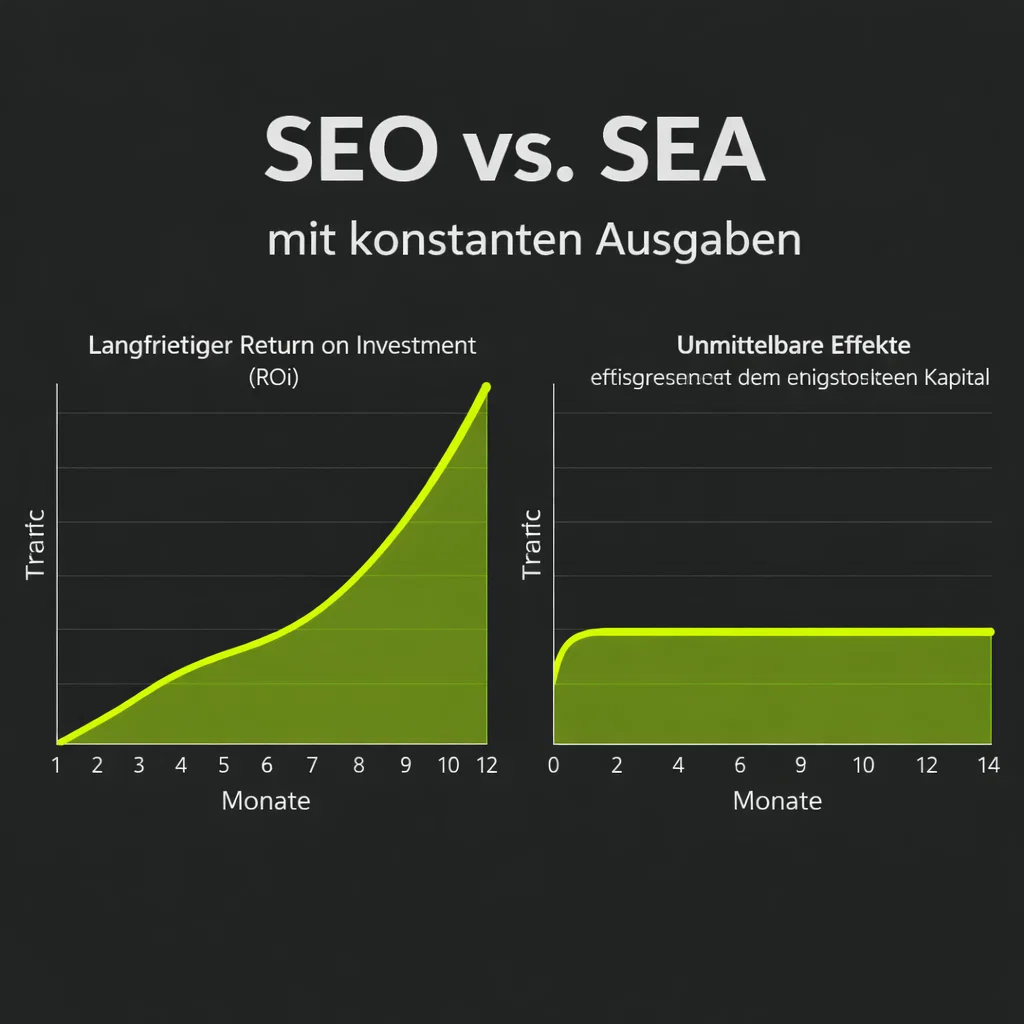
The big advantage of SEO over SEA: SEO is like a snowball rolling down a hill. As soon as you cover the most important keywords and your website ranks well, it starts to run by itself. Over time you build up more and more authority, and with considerably less ongoing effort.
The most common term for this phenomenon is “topical authority”. In plain language, it means you have proven again and again that you are a trustworthy website and that Google classifies you as an authentic source of information on a particular topic.
As soon as your website gains visibility through high-quality content, you automatically receive new backlinks. After that, all your new keyword sets are picked up more easily.
The older your URLs become, the better they rank on Google by themselves. Like a good wine.
SEO is a continuous process
Even though SEO requires considerable effort at the start, it is never really a “one and done” project. Unless your project stops developing and the competition stands still, but that is the exception.
Let us assume, for example, that you are a new website working day and night to rank on the first page of Google. You will probably achieve that by overtaking a competitor who is relatively slow in their SEO strategy.
But in most cases: the competition does not sleep. That is precisely why you have to keep sending out ranking signals in order to stay ahead of the curve.
Do not forget: even if you reach position 1 on Google once, that does not mean you will stay there forever. SEO is a dynamic competition. If your competitors optimise continuously, you also have to keep at it in order to hold your top position. If they barely do any SEO, on the other hand, you have more room to manoeuvre and do not have to invest quite as much.
But if you have a positive ROI, why would you stop?
Individual service packages are only suitable for small projects or local businesses. But even with attractive local keywords, the competition is anything but idle.
Setting the SEO budget correctly
If you are new to SEO, the first question you probably ask yourself is:
“How much budget should I plan for SEO?”
Expert tip:
Let me get one thing out of the way immediately: again and again I come across offers such as “position 1 on Google, guaranteed, for only 300 € per month”. Honestly? That is complete nonsense, and quite simply fraud.
Why? Because nobody can force Google to rank you first. There are countless factors that cannot be influenced, from your competition to user search behaviour and constant algorithm updates.
And let us be honest: 300 € per month? At an hourly rate of 100 €, that is barely three hours of work. Do you really believe that is enough for a well-thought-out SEO strategy, clean on-page optimisation, good content and ongoing monitoring?
Moving on: as already mentioned, the older a URL is, the more easily it ranks on Google. SEO has been around for ages, and almost all websites that rank highly on Google have been relying on SEO for a long time.
That makes it harder for a brand new website to reach the top position. It means you need more effort to reach their level.
The average SEO budget for an established company is around 3,000 to 4,000 euros. That may seem like a lot, but if you start your case with too tight a budget you will not get the results you are hoping for. Because, as has often been said, how much you have to do depends on the competition, not on the agency.
If you are starting from scratch, you first have to set up a well-considered strategy, create high-quality content, optimise the user experience (UX) and build backlinks. Backlinks alone, that is links from other websites to yours, often come with publication fees that can easily reach 500 € or more. And if you run digital PR (which often makes a great deal of sense), you also need a clear PR strategy.
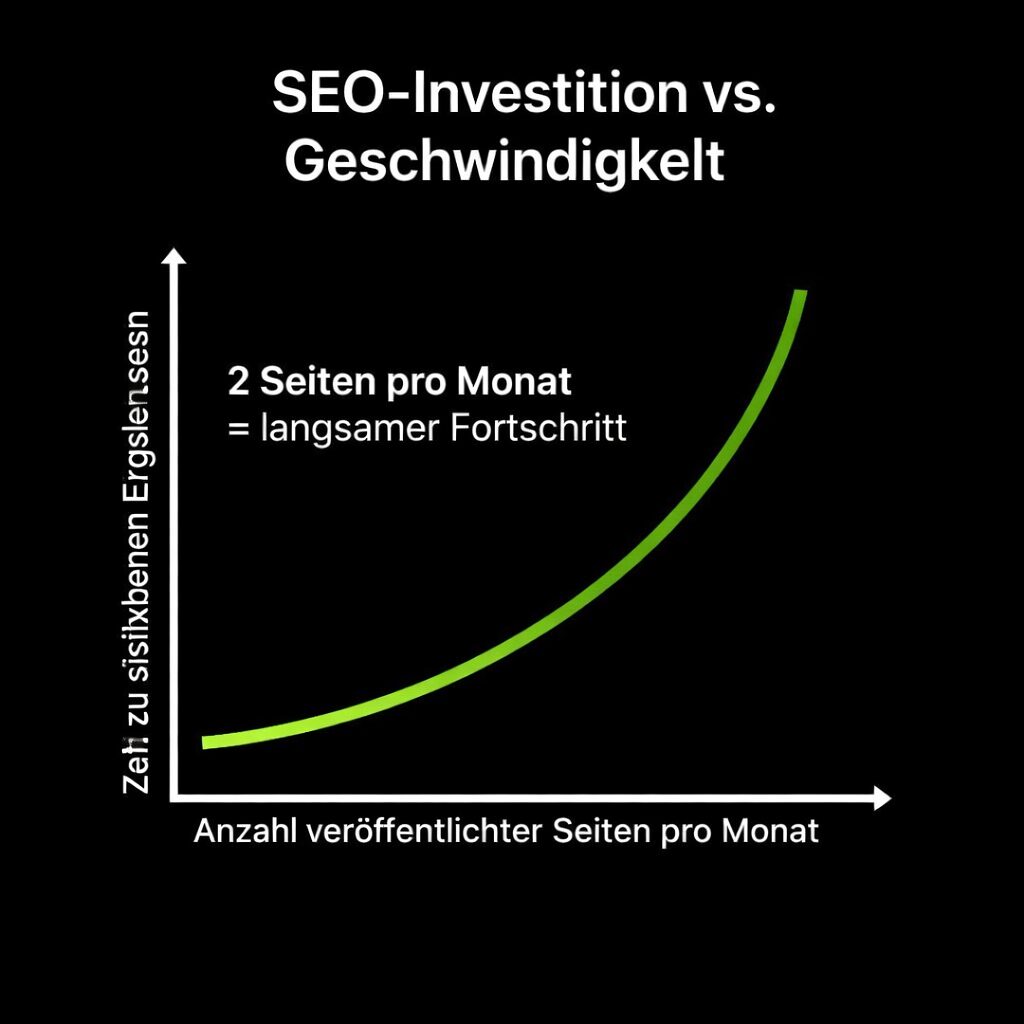
A well-structured service page, a blog article or a guide can quickly take 8 hours or more from concept to publication. If you only put two pages online per month, you will see your first results correspondingly slowly.
And if you are honest with yourself: if you are dissatisfied, you may switch agencies, and the whole game starts again from the beginning. Then it takes months or even years again until you finally see results and think: “Wow, at last an agency that delivers.” But in truth, those successes are very likely built on the groundwork done by the first agency.
The ideal path is therefore to provide a sufficient budget from the outset, so that you achieve your desired result on the first attempt.
SEO is consumer-centred
SEO has always changed drastically through Google updates. These days it is no longer enough to stuff a keyword into low-quality content in order to rank.
Google works hard to make the user experience as rich as possible. SEO is strongly consumer-centred, and you need high-quality content as well as the full range of SEO measures to stay ahead of your competition.
Producing top-quality content is not cheap, and that is precisely the message. It shows your audience that your company:
- puts value and quality first.
- has genuine professional expertise.
- is established and built to last.
- invests considerably in content creation.
- is excellent at what it does.
What does the competition do better to stay ahead?
Do you sometimes feel that your competitors are one step ahead? The answer is fairly simple.
They have been working on their websites for years and have probably invested a lot of money to keep the quality of their content at the highest level.
They have known the importance of SEO for a long time, and that is exactly why you have to invest more in SEO.
It is as if a long queue of companies were doing their very best every day to play at the top. The longer you wait with your SEO measures, the further back you are pushed in that queue.
Bespoke quotes versus standard packages
The total cost of your search engine optimisation depends on many factors. Every project is unique and all services are delivered individually.
Here are some of the most important factors that are taken into account:
- A competitive analysis, in which we assess where your website stands compared with the competition.
- An SEO audit, which identifies where your website still has room for improvement and what needs to be done.
- A keyword research exercise and website structure planning, in order to determine which pages and keywords are needed in line with demand.
Ideally the process begins with close collaboration in order to develop a bespoke keyword strategy. This strategy immediately helps you identify the five most influential competitors in the market.
We then draw up a monthly budget together that enables you to close the gap to these key competitors effectively within a defined time frame.
Standardised offers are therefore ineffective and reveal a misunderstanding of the underlying principles. Off-the-shelf SEO packages are only suitable for very small projects. For sustainable search engine optimisation, bespoke solutions are the only genuinely sensible option.
Your starting position and goals
Before we work together, we first clearly define your current digital presence and set measurable goals.
There are a number of points that need to be discussed in advance. Clarify these aspects before you decide whether you want to work with an SEO agency.
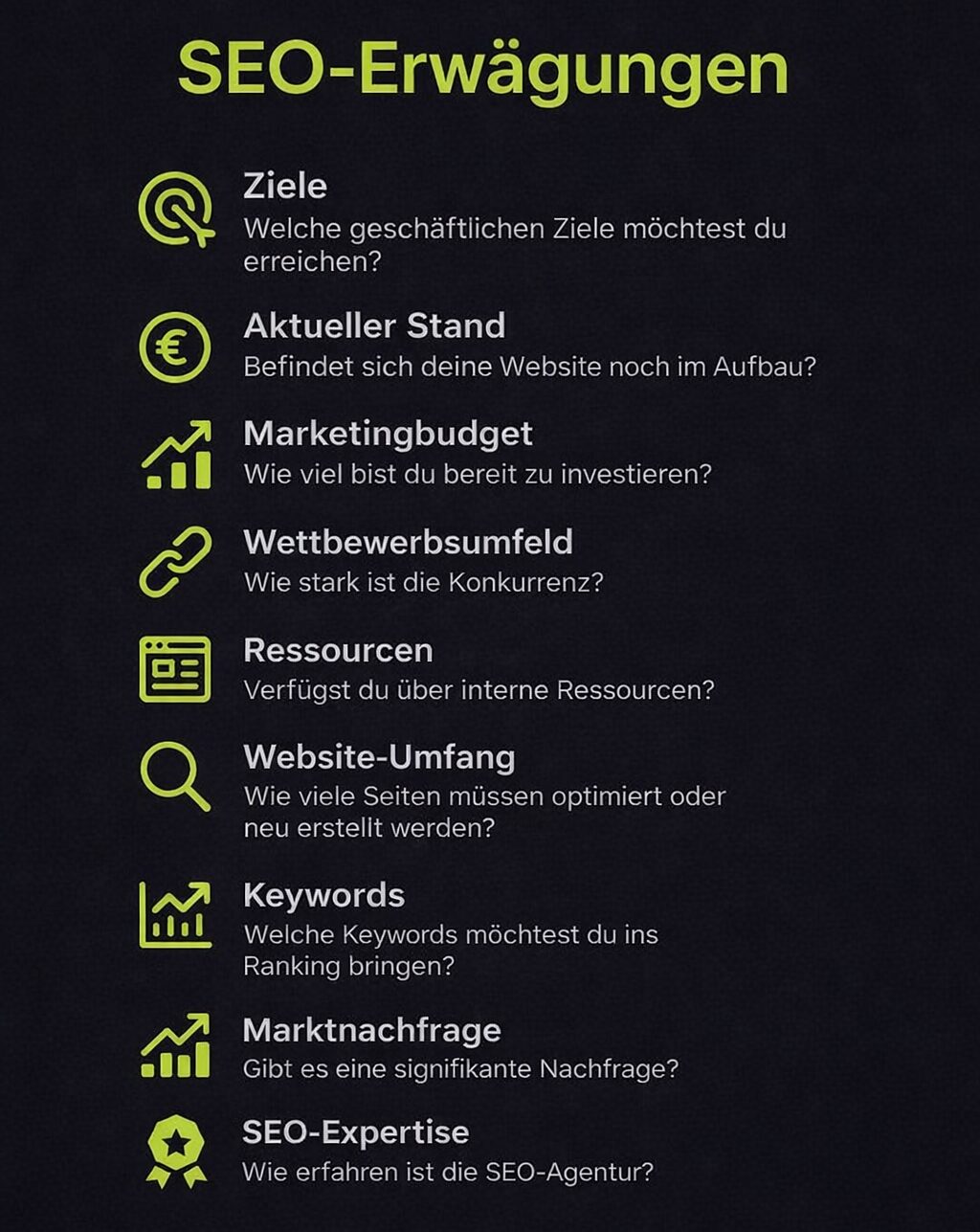
- Goals: Which business goals do you want to achieve? What is the main purpose of your website, and how quickly do you want to increase organic visibility?
- Current status: Is your website still being built, or does it already have high domain authority, a steady flow of brand searches, impressive user metrics and high-quality content tailored to your focus keywords?
- Marketing budget: How much are you prepared to invest in SEO support?
- Competitive environment: How strong is the competition? How good is the quality of your competitors’ content, and how many new referring domains do they typically gain per month?
- Resources: Do you have internal resources to support the SEO provider, or are you limited to exchanging emails?
- Website scope: How many pages need to be optimised or created from scratch?
- Keywords: Which keywords, and how many of them, do you want to get ranking?
- Market demand: Is there significant demand for your product or service, and how large is the actual interest?
- SEO expertise: Bear in mind that an SEO agency’s level of experience and track record directly influence its prices. The more experienced and successful they are, the higher the costs will usually be.
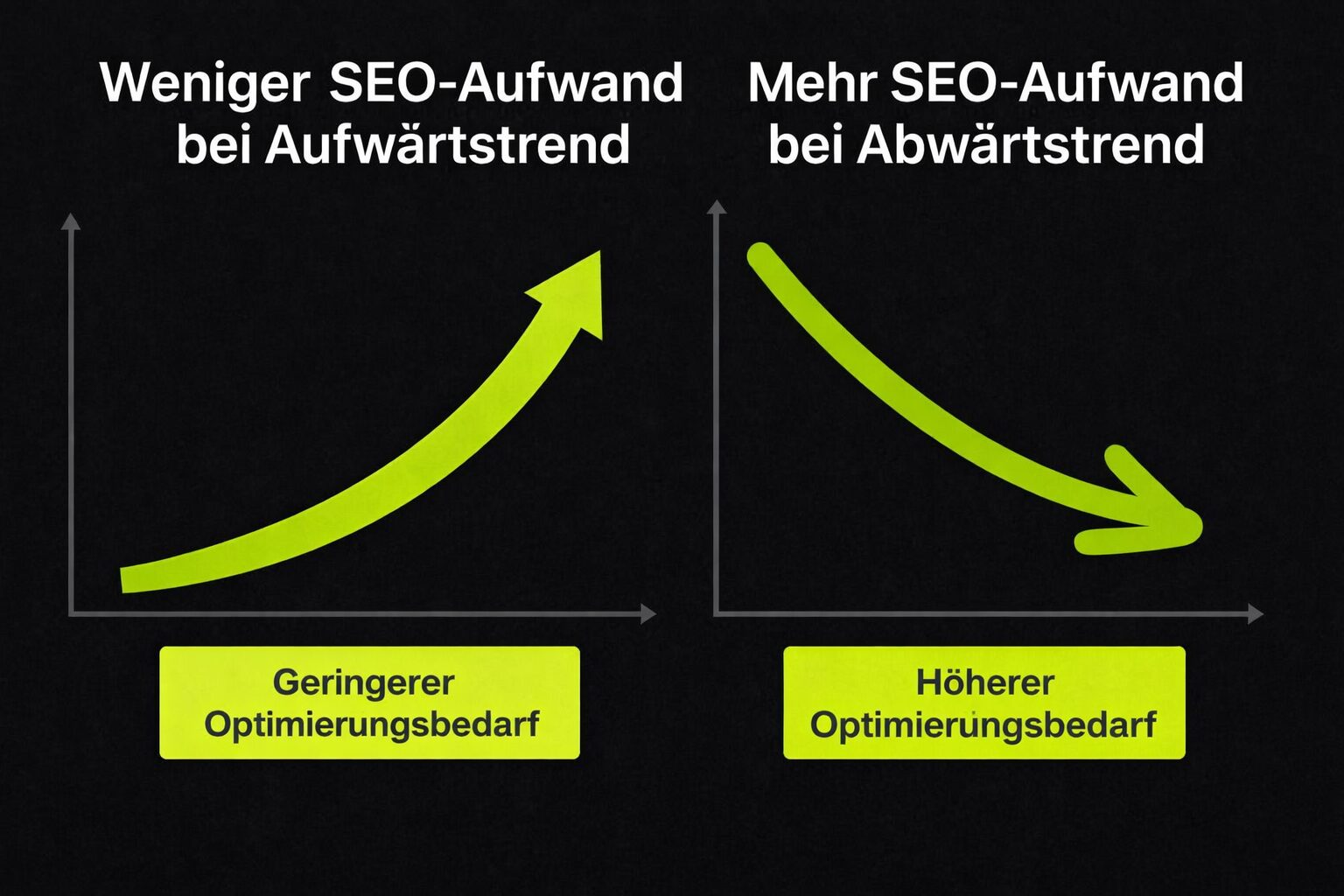
SEO costs are determined by whether your web project is on an upward or downward trend. If your project already achieves good results and ranks well, it will take less effort to improve it further than if there is a downward trend.
The more effort is required, the higher the costs for your project. Likewise, if you have big goals, SEO will be expensive for you.
Also, do not forget that SEO takes time. It can take several months before you see results. And if you want to enter a highly contested market with difficult keywords and active competitors, your progress can even take 1 to 2 years.
But it can also happen quickly if the market is not that heavily contested and you have a good SEO agency like us. See the example:
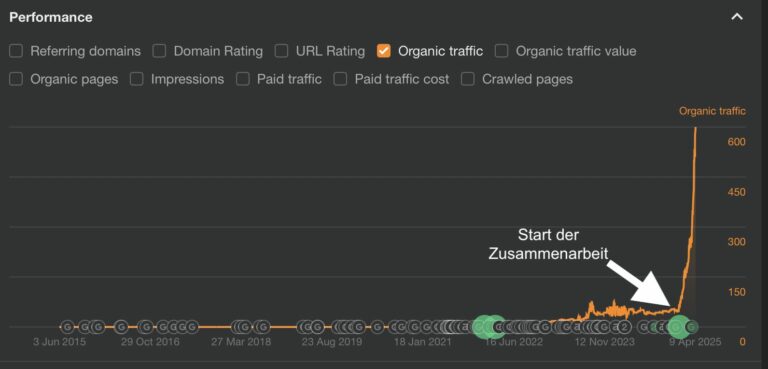
You can find the full case study here: SEO for dermatologists, 340% growth
That is why it is important to clarify the time frame with your SEO agency. They cannot give you a guarantee, but they can name an estimated time frame that your project will require.
Billing and pricing models
SEO prices vary widely, from hourly rates to flat-rate packages and performance-based fees.
The following billing and pricing models are the most common in SEO:
- monthly flat rates,
- performance-based remuneration,
- profit sharing,
- clearly defined service components, or…
- hourly or daily rates (our solution).
Flat rates and all-inclusive packages
Flat rates are a common model in the SEO industry. The price depends mainly on the package you select, and the costs usually vary according to the scope of your project.
As already mentioned, the costs rise when your website requires more effort. This model is usually based on a contractual agreement for a specific period, most often between 6 and 24 months.
The price range in European countries is usually between 1,000 and 6,000+ euros per month.
Performance-based payment (profit sharing)
Another billing model, although not very widespread, is the performance-based model, in which the provider is paid according to how well the website performs. The performance improvement is measured using various factors.
- Ranking rewards: If your website reaches the top position for a keyword, it is as if you were earning 50 euros a day. For each position lost, 10 % is deducted. If you slip onto the second results page (position 11 or lower), the SEO team earns nothing at all.
- Visitor bonus: Every additional visitor who arrives after your optimisation is a bonus, and each one earns the SEO team an extra 1 to 10 euros. That is by no means exaggerated, by the way: a click on Google Ads can cost between 1 € and 100 €, depending on the industry.
- Lead or sales bonuses: For every enquiry or every sale, the SEO provider receives a previously agreed fee, so every conversion is a clear win.
- Profit sharing: In this model the SEO agency receives a share of your revenue. Since it cannot see all the financial details, this is a less common and riskier arrangement.
Fundamentally, these methods require a high degree of trust, both in the SEO agency and in the provider themselves. Clicks are easy to manipulate, for instance by simply clicking on the website several times. But how is an SEO agency supposed to prove qualified enquiries or check whether an enquiry actually leads to a deal?
When it comes to profit sharing, the question of actual profit and margin quickly arises, and many companies do not have a precise overview of that themselves (yes, this happens more often than you would think). For us it is clear: we reject such pricing models on principle.
Deliverables
A deliverable is essentially a clearly identifiable and easily verifiable interim result of a project. For example, it can be a detailed keyword research report or a monthly analysis of SEO performance.
If an SEO provider uses this model, the quote contains a precise list of the tangible results you will receive during the period of support.
This approach ensures that you know exactly what to expect, for example a scheduled report on technical improvements to your website or a strategic plan for content optimisation.
Sounds a bit too good to be true, doesn’t it?
The problem with this approach: how exactly do you price the deliverables? And the whole thing brings delays with it, because each time a quote first has to be drawn up and approved.
A blog article can take 8 hours, or it can take only 3. That is not always predictable. Building a backlink can take 2 hours, but in other cases 13.
As an agency we would rather get on with the work than constantly draw up quotes down to the last detail, only for everything to turn out differently from the plan anyway. Every entrepreneur knows that the target plan is rarely the same as reality.
With an hourly rate and a fixed budget, you also have deliverables, but you do not have to sign off on each one individually. That means more flexibility and agility, both for you and for us.
Hourly and daily rates
If flexibility matters to you when commissioning SEO agencies, the hourly or daily rate model is ideal for you. However, it is important that you can trust your provider. We, for example, work with a clearly structured ticket system including time tracking, which ensures full transparency.
Hourly rates normally range between 100 and 300 euros per hour, and daily rates between 1,200 and 2,400 euros per day in the DACH region. However, this varies greatly from agency to agency and according to seniority, whether junior, associate or senior.
Expert tip
Do not focus too heavily on the hourly rate. What matters are the case studies and the actual ROI.
We, for example, have developed our own AI agents, which makes our processes considerably faster than those of many other agencies. The actual output per hour can vary greatly from agency to agency.
At Pixxel Solutions we offer the hourly pricing model in order to allocate the time required to your project in the best possible way, in line with its specific requirements. This keeps us flexible and agile and allows us to concentrate on the things that matter, without having to write a quote every time, which would otherwise lead to unnecessary delays.
Expert tip
Agree a realistic monthly budget with your SEO agency, for example 3,000 to 5,000 €, and look for an agency that bills on an hourly basis. That way you keep maximum transparency and stay flexible and agile. Nothing slows projects down more than constantly comparing quotes and negotiating over every single item.
So what does SEO really cost?
Understanding the basic SEO costs helps you set realistic expectations. Budget requirements can vary widely. In this section you will see the typical investment levels and the services that go with them.
Overview of SEO costs
When estimating the total cost of SEO for their web project, many people fail to recognise that SEO is not only about high-quality content or purely on-page aspects.
Off-page SEO, link building and other factors are just as important. If all these aspects are taken into account, a minimum budget of around 1,000 euros per month should be planned for, even in small niches.
Monthly cost breakdown for SEO
Since there is no one-size-fits-all model for SEO prices, the whole thing can be divided into the following main categories:
One thing is also clear: not every niche assigned to a particular category automatically fits there. It always depends on the competition, the location and the specific goals.
A doctor can spend 2,000 € per month, or equally 5,000 €. That always has to be assessed individually.
| Monthly budget (excl. VAT) | Services | Suitable for |
|---|---|---|
| 1,000 – 2,000 € |
|
|
| 2,000 – 4,000 € |
|
|
| 4,000 – 6,000 € |
|
|
| 6,000 € and above |
|
|
1,000 to 2,000 euros per month (excl. VAT)
With this budget, clients usually receive basic SEO services covering the essential technical setup, keyword research, on-page optimisations and content creation.
This tier is ideally suited to small businesses, self-employed professionals or startups who want to test the waters first. For example:
- Micro businesses
- Self-employed professionals
2,000 to 4,000 euros per month (excl. VAT)
In this range the offering includes more intensive content creation, regular reporting and extended technical optimisations.
This is suited above all to companies in medium-sized cities, where there tends to be more competition for customers. For example:
- Private doctors (dermatology, orthopaedics, aesthetics)
- Lawyers
- SMEs
- Trade businesses
- Local service providers
4,000 to 6,000 euros per month (excl. VAT)
This segment involves a full-service approach. The services include advanced analytics, dedicated account management, strategic content planning and more extensive link building campaigns.
This tier is aimed at companies with a national niche market that want to stay one step ahead of the competition.
- Medium-sized online retailers
- Photovoltaic companies
- B2B SMEs
- Plastic surgeons
- Software companies
6,000 euros and more per month (excl. VAT)
For large companies or highly contested markets, premium packages provide a highly bespoke, comprehensive SEO strategy.
These companies often aim to go international and need a broad customer base and reach.
- International corporations
- Fashion and luxury brands
- Large e-commerce stores
- Insurance and finance
Cheap SEO and its drawbacks
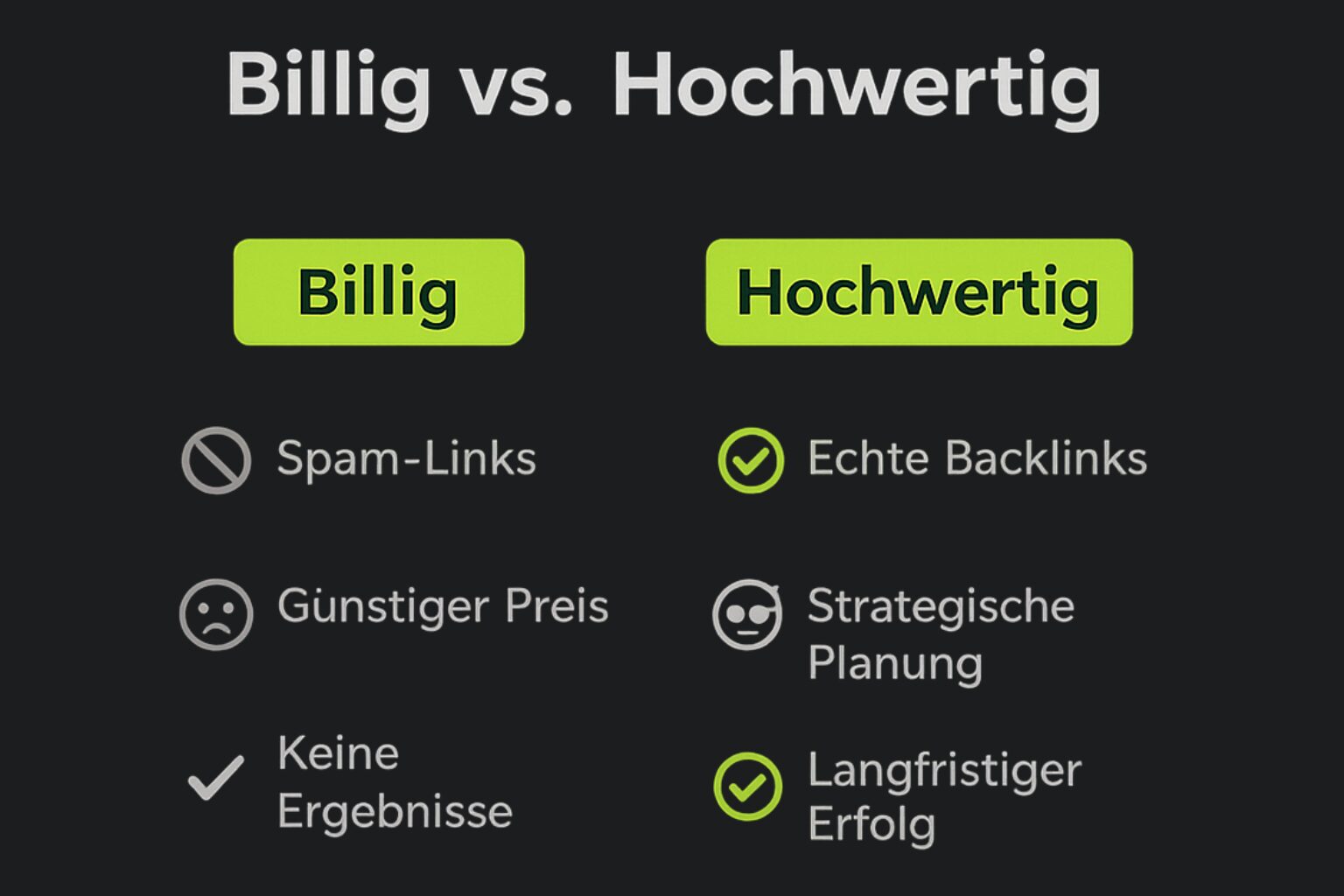
It is common for companies to try to get the lowest possible prices to get their tasks done. But in SEO this strategy can backfire. You do not want the cheapest agency, you want the highest ROI.
If you buy cheap SEO, it is like spending money on an expense that brings no return. The main goal of SEO is to be right at the top, and there you have no room to be average, because average brings no traffic.
Investing more in SEO is therefore always the better option.
Understanding the mechanics of SEO pricing
Setting the hourly rates for SEO services requires careful calculation of both tangible and intangible factors. We take several key aspects into account in order to arrive at a fair and sustainable rate:
- Creating a guide: The tasks include research, writing, reviewing, coordination, optimisation, design and maintenance of the guide. This process usually requires 10 to 15 hours of work.
- Link building campaign: Each backlink often involves researching contacts, writing and adapting outreach letters and producing guest articles. This detailed process requires roughly 8 to 13 hours per backlink (not counting link purchases from link brokers).
- SEO audit: An audit for an average online shop covers various aspects such as technical SEO, usability and information architecture. Carrying out a comprehensive audit usually takes 20 to 30 hours.
If we break this down further into individual tasks, this is the average time needed to implement quality SEO:
- Keyword research and strategy: Identifying target keywords, especially in competitive niches, can be a detailed process. It involves analysing search volumes, competition and user intent and can take between 5 and 10 hours depending on the scope.
- Competitive analysis: A deep look into competitors’ SEO strategies, backlink profiles and content performance requires thorough research. This analysis can take around 10 to 15 hours per project.
- Content creation and optimisation: Creating or optimising content (such as blog posts, landing pages or product descriptions) requires time for planning, writing, revising and SEO optimisation. A single high-quality piece can take 4 to 8 hours or more.
- Technical SEO optimisations: Fixing technical aspects such as page speed, mobile friendliness, crawlability and schema markup requires a thorough audit and subsequent implementation, often an additional 10 to 20 hours for larger websites.
Tangible metrics: focusing on what we can control
Detailed long-term contracts are clever, but here is the catch: Google’s algorithm changes constantly, and your competition does not take a break either.
- Content creation: The amount of content we will produce in x months.
- Keyword coverage: Exactly how many keywords will be covered with search-intent-focused content.
- Link building: The number of high-quality backlinks we secure for you.
- Developing mockups: The number of design mockups we will create.
Anything beyond these measurable targets is like forecasting the weather: nice in theory, but often inaccurate.
It is also important to note that much of our work depends on how quickly our clients cooperate. With larger companies, delays are more likely.
Put simply: an SEO agency cannot guarantee specific traffic figures or top rankings, because we cannot predict exactly how the competition will act or how Google will adjust its algorithms. If I could, I would probably be the most sought-after SEO expert in the world.
What does SEO cost with us?
Our SEO services start from 1,500 € per month, with a minimum contract term of 6 months. After that you can cancel on a quarterly basis.
Would you like an individual quote for your project? Then feel free to contact us. We will give you a first, quick assessment and tell you honestly what budget you should realistically plan for.
Why 6 months and not just 1?
Because SEO takes time. In most cases, no visible results can be expected after just one month.
If you already have an internal SEO team and are only looking for specialist consulting, that is of course also possible. Just drop us a line.
Further SEO cost factors
Besides the core services, there are various factors that can influence your total SEO spending. This section highlights additional elements such as tool subscriptions and different levels of support that affect your total costs.
Paid SEO tools
One thing about SEO is that it requires a great deal of manual work. Despite the advances in AI, SEO has to be monitored continuously to ensure that everything works optimally in line with Google’s algorithm.
Every brand is unique, and SEO has to be specifically adapted to the needs of the brand in question.
To achieve the best results, you need the best and most suitable SEO tools. We make data-based decisions in SEO, and without the right and precise tools those decisions cannot be made.
Some of the most frequently used tools are:
- Checking keyword rankings: Ahrefs or SEMRush
- Monitoring and analysing backlinks: MajesticSEO and Ahrefs, SEMRush
- Crawling the website and analysing on-page optimisation: DeepCrawl and Screaming Frog
SEO tools cost a lot of money. The more tools a project requires, the higher the fixed costs climb. These fixed costs can amount to as much as 2,000 to 10,000 euros per month. No joke.
You may think that the same tools can be used for several clients, and that is true. However, one employee can only look after 2 to 3 clients at the same time, which is why the fixed costs are quite high for us.
Building sustainable SEO
Achieving sustainable SEO is a long-term, multi-layered process that goes far beyond basic monitoring and research. The tools we use do provide a good starting point, but they are only one part of the overall concept.
Competent SEO consulting has to take a holistic and entrepreneurial approach and consider several time-intensive aspects:
- Holistic overview: It is not enough to focus only on your website. A first-class SEO specialist assesses the entire business, including offline marketing and other online presences, to ensure that all elements work together harmoniously.
- Competitive analysis: Understanding what your competition is doing is just as important as optimising your own strategies. Continuously analysing the market helps to recognise trends and opportunities.
- Continuous learning: Since Google’s algorithm is constantly evolving, ongoing training is essential. Attending conferences, trade fairs and specialised courses ensures that you always apply the latest insights and techniques, an integral part of the SEO process.
- Link building and content strategy: Let us be honest, every SEO agency “buys” backlinks, even if that is not always in the spotlight. Quality content is decisive, but without high-quality backlinks your reach remains limited. Securing these links is labour-intensive and can become expensive. Almost every backlink carries some kind of “fee”, whether that is research or a payment for publishing a guest article.
In short, sustainable SEO is like a marathon: it requires a balanced mix of solid basic tools, continuous learning, a watchful eye on the competition and creative strategies for building authority. This comprehensive approach ultimately leads to successful and lasting results.
Ready for more revenue?
Book a free SEO and GEO audit

Find out in a free call how much revenue your website is leaving on the table, with no obligation and no agency waffle.