


Everything at a glance
- Strategy instead of scattered tweaks: connect SEO to business results through clear goals and KPIs, and assign the work to the page types that drive revenue.
- Win on intent, not on volume: build topic clusters out of real customer problems, align formats to learning, comparing and acting, and prioritise quick wins with high intent.
- Turn visibility into revenue: use performance landing pages, tight internal linking and solid UX to convert qualified traffic.
- Compete deliberately: analyse your real SERP rivals, fix high-impact technical problems and build clean authority. Differentiate yourself so you stand out in AI Overviews.
- Work as a system: run ship, measure, learn loops with dashboards and regular refresh and prune cycles; scale what works and stop the rest.
Search is where important decisions begin. If your brand does not show up in that moment, you are not just missing a click, you are missing the conversation, the lead and the sale. Visibility is no longer a vanity metric; it is how your business earns trust at scale.
An SEO strategy is the plan that makes this visibility repeatable. No hacks. No checklist. A clear roadmap that connects your goals to what people are actually searching for, to the content they want to see, and to the technical foundation that lets everything load and index fast. It protects you from random tweaks and focuses your time on work that compounds.
In this guide we walk step by step through the building blocks that matter in 2025: setting goals and KPIs, mapping search intent to topic clusters, building high-converting pages, tightening your technical foundation and building the kind of authority that both Google and AI experiences recognise. You get a practical sequence, examples to copy and a way to measure progress without drowning in metrics.
If you want traffic that turns into pipeline, and a system you can keep improving, this is your starting point. Let us build a strategy that pays off every month.
What is an SEO strategy?
An SEO strategy is your practical roadmap for turning search demand into measurable growth. It combines goals, audience needs and the actions (content, technical fixes and authority building) into one coherent plan.
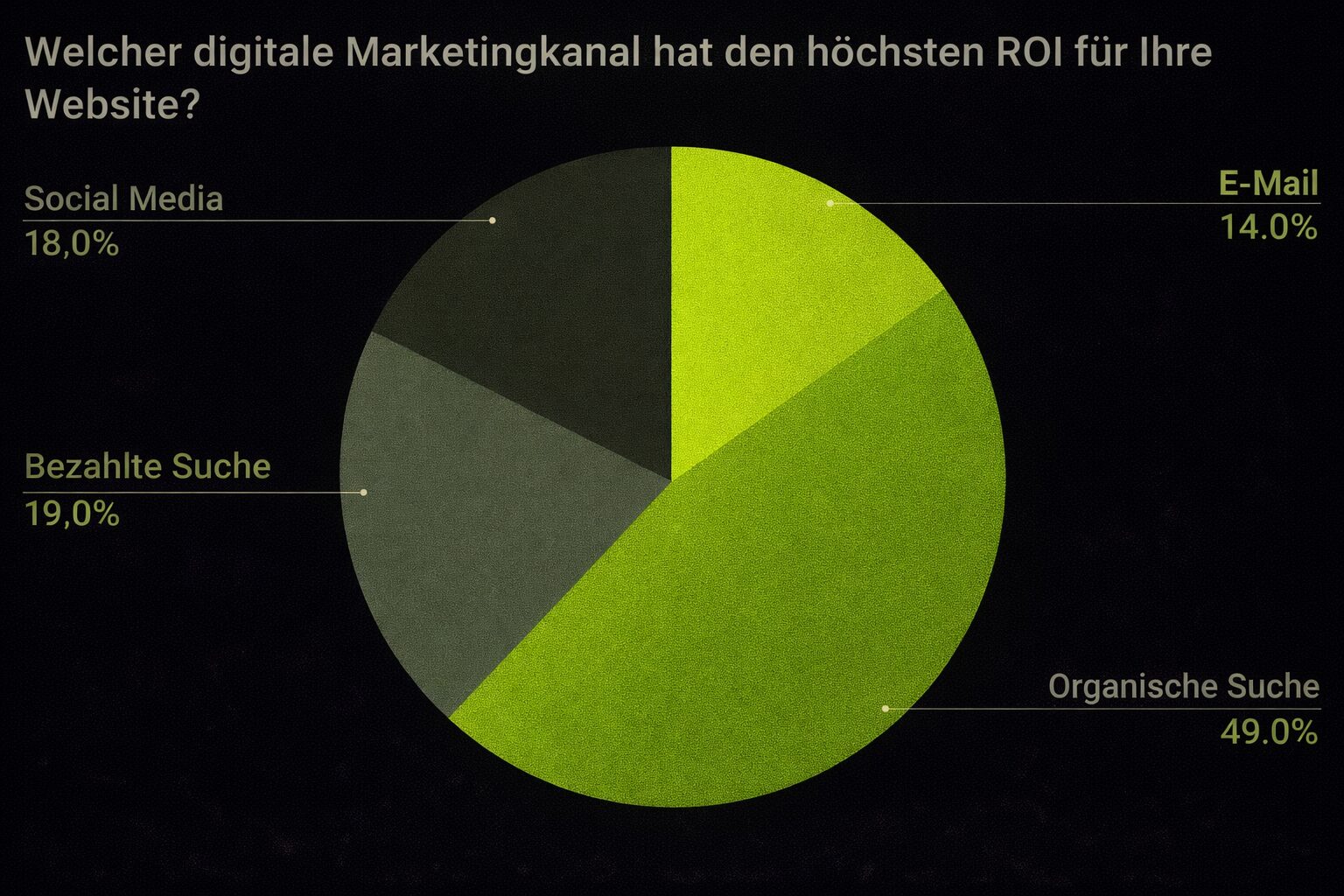
Before we go deeper: organic search remains one of the most efficient growth engines online. In 2025, 49% of marketers say organic search delivers the best ROI of any channel, which is exactly why a considered SEO strategy beats random optimisation. (Backlinko)
Definition and purpose
An SEO strategy sets direction and rules of play: what you want to achieve (traffic, leads, revenue), who you serve, which topics you cover and how you build the technical and authority foundations you need in order to rank.
It is not a checklist; it is a decision-making system that aligns daily tasks with business results. A modern approach combines a full audit, keyword research mapped to a page structure, and competitor analysis, then prioritises the work against your goals.
In short:
- Your strategy is the indispensable basis for the operational work.
- The concrete measures (content, links, UX, technology) depend on your business model and the goals you defined up front.
More precisely: your business model shapes your site architecture and your content economics. Where do you make money? Do you serve a niche or a broad market? What creates value for customers?
Your goals are the pivot point: do you need visibility, conversions or attention for a specific offer? This is why a one-size-fits-all template cannot work; no single approach suits every model and every goal.
Strategic vs tactical
Tactics are individual moves (rewriting a title, fixing a 404). Strategy decides which moves matter, when and why. Without a strategy you can “do SEO” and still miss revenue, because you improved the wrong pages or chased the wrong topics. Strategy makes trade-offs explicit and frees you from low-impact work.
| Strategic SEO | Tactical SEO | |
|---|---|---|
| Focus | Where to compete and why | How to implement concrete fixes |
| Horizon | Long term, compounding | Short term, immediate |
| Decisions | Sequencing: what comes first, next, later | Page-level changes within the sequence |
| Examples | Choosing clusters, defining key page types | Rewriting titles, fixing 404s, adding internal links |
Think of it as momentum management:
- Where to compete: which topics, SERP types and formats really move your funnel.
- Sequencing: what ships first, what pauses, what gets stopped.
- Iteration: ship, measure, learn, refine. SEO is not a “once and done” job; it is a long-term system that evolves with the market and with your customers.
And a reality check: strategy is not a magic world with different rules. Brand strength still counts. If you are invisible offline and online, ranking will be hard work. Build signals that people trust, then SEO amplifies them.
The difference between an SEO strategy and an SEO checklist
Checklists are useful for hygiene; as a plan they are dangerous. A copy-paste template can waste time, or worse, push risky shortcuts such as blind link building. A real strategy chooses focus areas, orders them and adapts as soon as the data comes in.
| SEO strategy | SEO checklist | |
|---|---|---|
| Purpose | Sets direction, focus and priorities | Secures hygiene and consistency on routine tasks |
| Scope | Chooses what, when and why; adapts with data | Tick-box tasks (titles, links, speed checks) |
| Time frame | Ongoing, iterative, compounding | One-off or recurring maintenance |
| Channel view | Integrates other channels (email, PR, paid) | Often siloed; encourages single-channel thinking |
| Risk when misused | The steering wheel: it guides decisions and prevents waste | Dangerous as a plan: copy-paste work, wasted effort, risky shortcuts |
Also worth stating: what an SEO strategy is not:
- Not a business model. SEO does not rescue a broken model. Sail and boat: a great sail does not repair a leaking hull.
- Not a single-channel solution. Depending on one channel is fragile. Combine SEO with at least three complementary channels (for example email, PR and partnerships, paid search or social) so that wins reinforce each other.
- Not a short sprint. There is no “and that is it” moment. The market moves, competitors ship, content ages, so your strategy has to learn and adapt.
The bottom line: use checklists to keep the engine clean, but let your strategy steer where you are going, why it matters and what you do next.
Why every website needs an SEO strategy
A quick overview: a strategy prevents scattered effort, protects you from avoidable mistakes and directs resources into work that compounds. It also makes SEO a partner for the rest of marketing rather than a silo.
Reality check for 2025: zero-click searches are increasing. In March 2025, 27.2% of US Google searches ended without a click (and organic clicks fell year on year). So you need a plan to earn the remaining clicks, and to win visibility in the places where users get answers directly in the SERP. (Search Engine Land)
1. Avoid aimless optimisation
Strategy starts with goals. Without them you are moving, but not necessarily forwards. You can work hard, ship dozens of “optimisations” and still tread water, because you started in the wrong place and in the wrong order.
A clear plan points effort at the few levers that genuinely move your model. Saying “no” becomes easier and the budget lasts longer.
A concrete example: just because “backlinks matter” does not mean they are your biggest growth driver right now. Weeks of link building can achieve little if the real blockers lie elsewhere (for example intent mismatch on key pages, thin product content, weak internal linking or technical crawl problems). Validate first, then act.
Stay focused with this goal-first filter:
- Define outcomes before tasks: revenue and lead goals, then journeys, then page types, then actions.
- Prioritise by impact x confidence / effort: compounding work first (consolidations, internal links, conversion upgrades on money pages), then the nice-to-haves.
- Run small proofs: upgrade 2 to 3 high-intent pages, measure the lift, then scale the pattern.
- Say “no” to distractions by default: if a task does not fit your goals or a tested hypothesis, park it.
The bottom line: random tweaks do not stack. A goal-led sequence does, and it stops you investing in the wrong move at the wrong time.
2. Prevent SEO damage caused by inconsistency
Uncoordinated “optimisations” can slow pages down, fragment internal linking, create duplicate or cannibalising content, or trigger trust problems that take months to resolve.
If you push on with risky shortcuts, such as thin, spun content or manipulative links, you can earn yourself a manual action or an algorithmic hit. Recovery often takes quarters (sometimes years) and even then you are only back at your starting level, while others keep compounding.
That is not progress, that is opportunity cost. Without a strategy you waste resources in the best case; in the worst case you actively sabotage yourself.
Simple guardrails that prevent the crash:
- Change discipline: one accountable person, documented intents, pre-flight checks (speed, indexing, internal links) and a clear rollback plan.
- Content and link standards: no thin pages, no doorway tactics, no paid or irrelevant links. Publish only what creates real value and earns clean mentions.
- Control cannibalisation: assign topics to pages, audit duplicates and consolidate. Do not let several URLs fight over the same query.
3. Understand your audience better
Keyword research is demand research. Search terms show what people want at each stage of the journey and which formats they trust. You are not guessing, you are listening.
An essential part of every SEO strategy is translating these queries into usable insights. The words people actually type contain pain points, desired outcomes and buying triggers. This understanding does not stop at blog posts; it shapes your UX, your offers and even your sales conversations.
How to read the intent behind the query:
- Learning: “how to…”, “what is…”, “symptoms of…”
- Comparing: “X vs Y”, “best [tool] for [industry]”, “alternatives”
- Buying or acting: “pricing”, “near me”, “demo”, “coupon”
Put the insights to work:
- Map core needs to specific page types (guides, comparisons, calculators, product pages) instead of forcing one format onto everything.
- Take language straight from queries into your copy, FAQs and CTAs. Answer the exact question that was asked.
- Feed recurring concerns back to product and sales (for example add spec tables, make proof more visible, address objections) so the whole journey improves.
The bottom line: the better you understand intent, the less you waste. Keyword research shows what is genuinely needed and wanted, and helps you build the pages, messages and experiences that meet it.
4. Connect SEO with overarching business goals
No more “traffic for the sake of traffic”. Ask first: did last month’s SEO work move a business metric you care about (leads, sales, demos, bookings)? If not, tighten the connection between tasks and outcomes so that growth accumulates instead of inflating vanity numbers.
Strategy and stakeholders
- Modifiability: can you actually change the pages that are supposed to deliver your goals (templates, CTAs, forms, copy)?
- Stakeholder buy-in: make sure product, content, dev and leadership know why these pages matter.
- Impact first: rank tasks by impact x confidence / effort. Ship what touches revenue journeys first.
- Data sources: do not rely on one tool, triangulate (Search Console, analytics, crawler, CRM).
Content alignment
- Meta basics: target keywords appear naturally in titles and key headings.
- Intent match: update pages so they meet expectations (guides, comparisons, pricing, FAQs).
- Relevance: build what your audience actually searches for; leave off-topic content out.
- Linking: connect related pages so clusters strengthen each other (pillar and subpages, in both directions).
- Pruning: merge or remove content that does not support the core goals.
- Topic clusters: let focus keywords anchor clusters, not single posts.
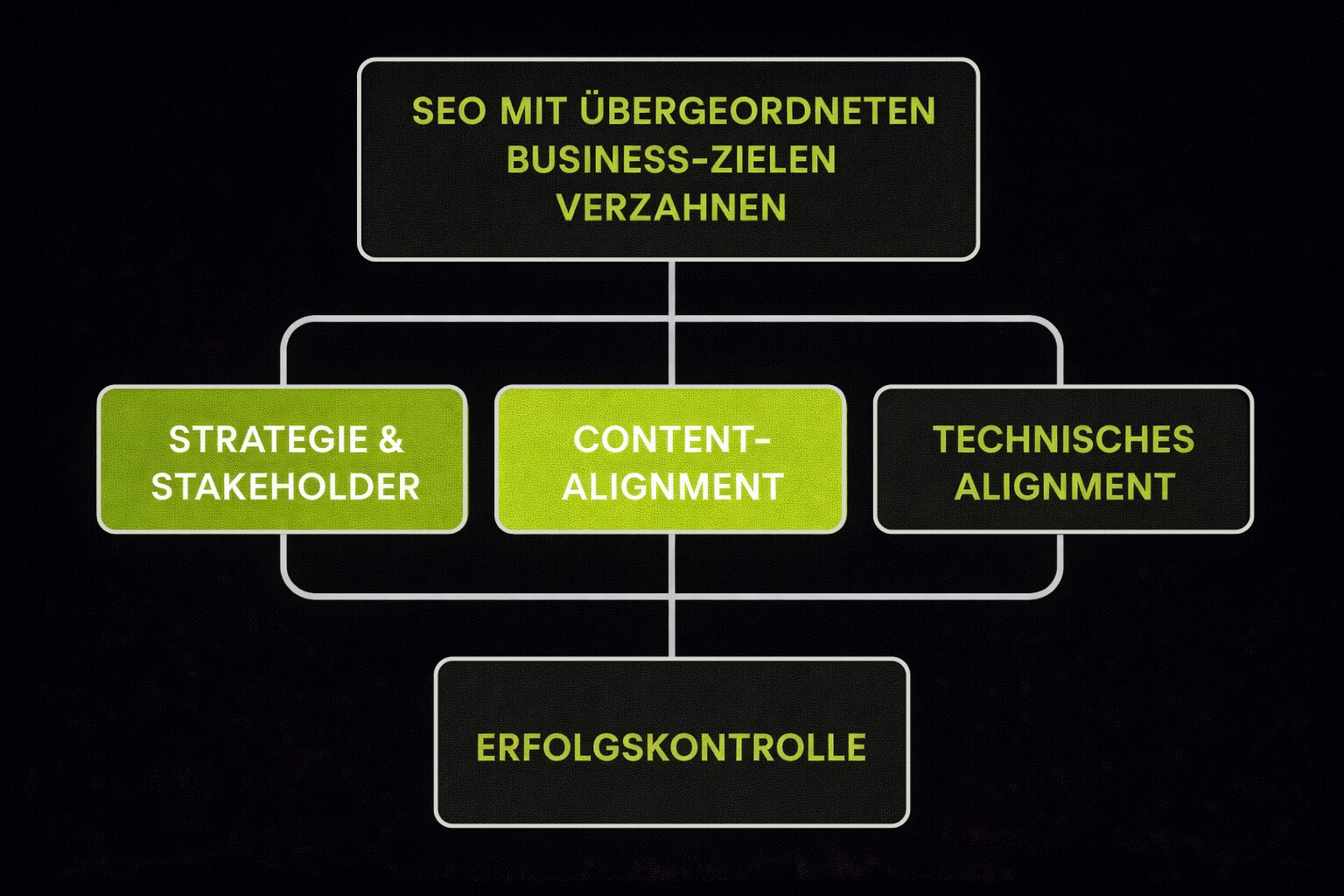
Technical alignment
- Page speed: prioritise money pages; fix render blockers and bloat.
- Usability: clear navigation, unambiguous next steps, frictionless forms.
- URL structure: predictable by page type; easy to browse.
- Duplicates: handle HTTPS, trailing slash and other variants; avoid cannibalisation.
- Responsive: smooth on mobile, where most discovery happens.
- Crawling: check logs and coverage for blocked or orphaned pages.
- Structured data: mark up conversion-relevant elements (for example Product, LocalBusiness, FAQ).
- Canonicals: check that they point to the right version.
- Core Web Vitals: aim for pass rates across your central templates.
Measuring success
- Logbook: record changes so you can attribute wins (or roll them back).
- Monitoring: track target keywords, pages and conversions, and set alerts for drops.
- Markers: annotate big releases in GA4, Search Console and your SEO tool.
- Prioritisation: turn these checks into mini audits and rank them with an ICE score to answer “what is next?”.
Close the loop with a one-page map of business goals, journeys, page types, metrics. If a task does not fit into it, it is noise, not strategy.
5. Measure performance and create accountability
With goals and KPIs defined up front, measurement turns into accountability. Set a fixed cadence (weekly operational, monthly strategic), name owners and define in advance what counts as success or as a pivot. That way you can prioritise, forecast, report clearly and reallocate budget quickly when the data says so.
Track metrics that fit your goals (not vanity numbers):
- Rankings: movements on priority keywords versus your main competitors.
- Clicks (year on year): the trend from Google Search Console.
- Sessions (year on year): the trend from analytics, segmented by page type and intent.
- Sales and revenue (year on year): or qualified leads and demos in lead generation.
- Visibility and share of voice: how your presence changes across topic clusters.
- CTR: by query and page, to find copy and intent gaps.
- Bounce rate and engagement: to identify content or UX mismatches.
Avoid manual busywork, build a simple reporting stack:
- Keyword segments with Ryte: use Search Success (Monitor and Analyze) to group and track critical terms; filter by device, country or brand versus non-brand.
- Looker Studio dashboards: connect Search Console, GA4 and Sheets so you have one link for stakeholders; highlight target KPIs, not every metric.
- Goal values in GA4: define conversions (Admin, then Events and Conversions) and assign monetary values to couple SEO to business outcomes.
- Custom reports in GA4: build focused views (Explore or Custom) for your core journeys; schedule a monthly review so changes get evaluated rather than forgotten.
- Scheduled Screaming Frog crawls: automate template checks (status, canonicals, Core Web Vitals extractions); export them and feed them into Looker Studio for trend lines where useful.
Close the loop by annotating big releases in your tools and keeping a simple changelog. Measure what you ship, compare it against your goals and let the data decide whether you double down, iterate or stop.
How to develop an SEO strategy: 8 core steps
You clarify the essentials, set goals, analyse the playing field and then ship a prioritised plan you can actually execute. Expect iteration: strategy is a living system, not a one-off document.
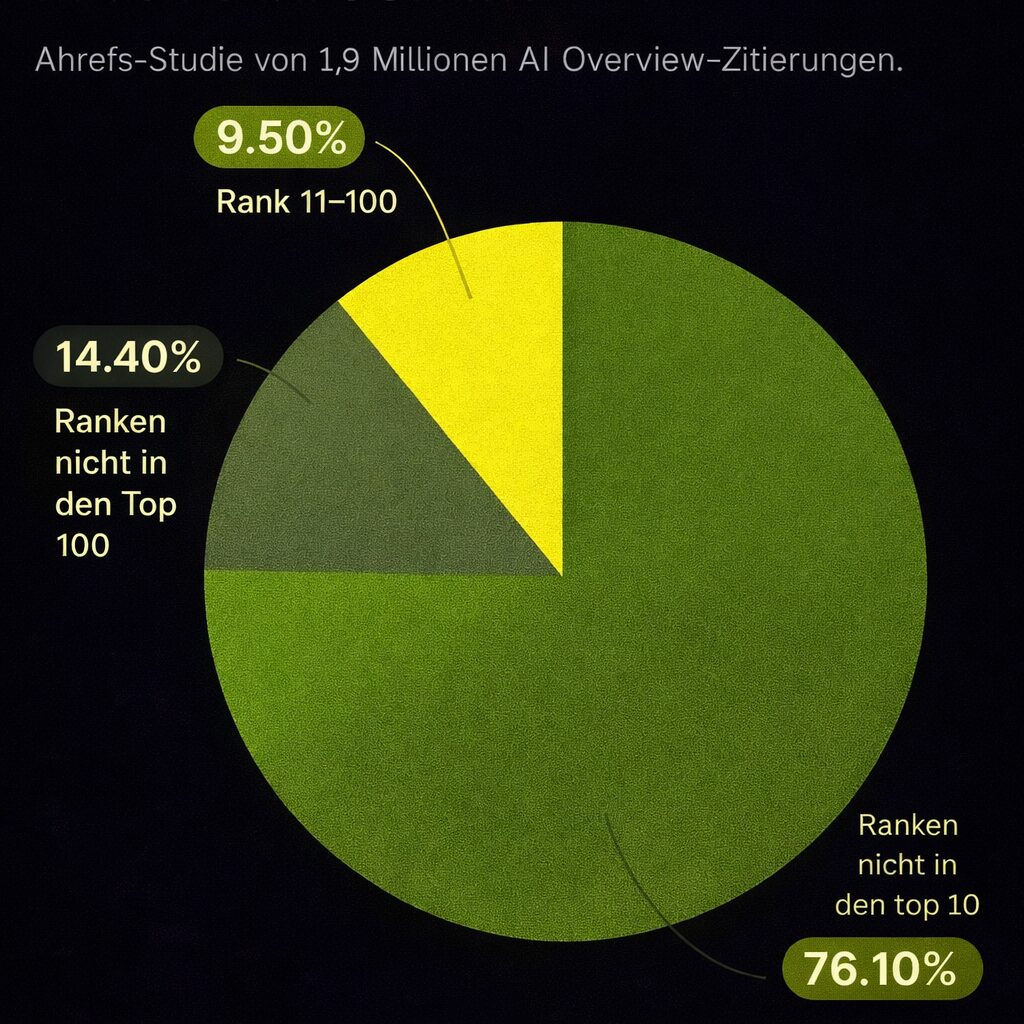
One 2025 insight as an anchor: 76% of Google AI Overview citations come from pages that already rank in the top 10, so fundamentals such as crawlability, relevance and authority continue to pay off across both classic and AI-infused search. (Ahrefs)
What you should clarify in advance
- Business model and offers: where does the profit come from? Which journeys matter most?
- Constraints: internal resources, CMS limits, legal and compliance, brand tone.
- Dependencies: engineering capacity, content ops, PR resources.
Step 1: define overarching SEO goals
Start with the hard question: what exactly should SEO achieve, and does that currently fit your model? “Everyone is doing it” is not a strategy. Be honest about where SEO can move the needle and where it only creates extra work.
Choose outcomes rather than activities. Examples: increase qualified demo requests from organic by 30%, lift shop revenue from organic by 20%, reduce acquisition costs from search by 15%. Then connect each goal to the journeys and page types that drive it (product pages, comparison pages, local listings, lead magnets, demo pages). If you cannot connect a task to a goal, it does not belong on the roadmap.
Two quick scenarios to sharpen your focus:
- Scenario 1 (visibility first): you need awareness and traction. Prioritise topics with broader demand and educational formats that pull people into your world.
- Scenario 2 (conversions first): you sell a specific solution to a narrow audience. Volume matters less than intent. Focus on high-intent queries (pricing, “X vs Y”, industry use cases) and conversion-ready pages.
Goals are not KPIs. Goals give direction; KPIs are the scoreboard (leads, revenue, share of voice, conversion rates). Choose the goal first, then how you measure progress.
Step 2: make goals measurable by defining KPIs
Once the goal is clear, define how you will know you are getting there. Choose KPIs that reflect reality, not just rankings, and connect every metric to a journey and a page type (product, comparison, demo, local). That way you see which levers move outcomes.
Avoid vague goals. Make them precise.
- Imprecise: “We want more traffic.”
- Precise: “Increase qualified demo requests from organic by 30% in 6 months by upgrading our three most important comparison pages.”
Build a lean KPI set that feeds into business results:
- Visibility and demand: impressions, CTR and share of voice in priority clusters.
- Indexing quality: indexed pages by type (blog, product, location) and coverage errors.
- Experience health: Core Web Vitals pass rates across key templates.
- Conversion and revenue: leads and demos, ecommerce revenue, assisted conversions, pipeline.
- Efficiency: cost per lead from organic, CAC from organic (if you track effort or spend).
Adapt KPIs to the scenario so you do not optimise for the wrong thing:
- Visibility first: share of voice in 3 to 5 core clusters, non-brand impressions and CTR, new rankable pages per cluster.
- Conversion first (lead gen and B2B): demo starts, form completion rate, MQL to SQL from organic, assisted conversions.
- Ecommerce: organic revenue, AOV, conversion rate on product pages, share of revenue from high-intent queries (brand versus non-brand).
- Local: calls and directions from GBP, local pack visibility (service plus city), reviews won.
Operationalise it:
- Build a dashboard that connects page types, KPIs and outcomes (Search Console plus GA4 plus crawler).
- Annotate releases, run weekly operational checks and a monthly strategy review, and assign owners.
- If a KPI does not influence a decision, delete it. KPIs are a steering wheel, not a scrapbook.
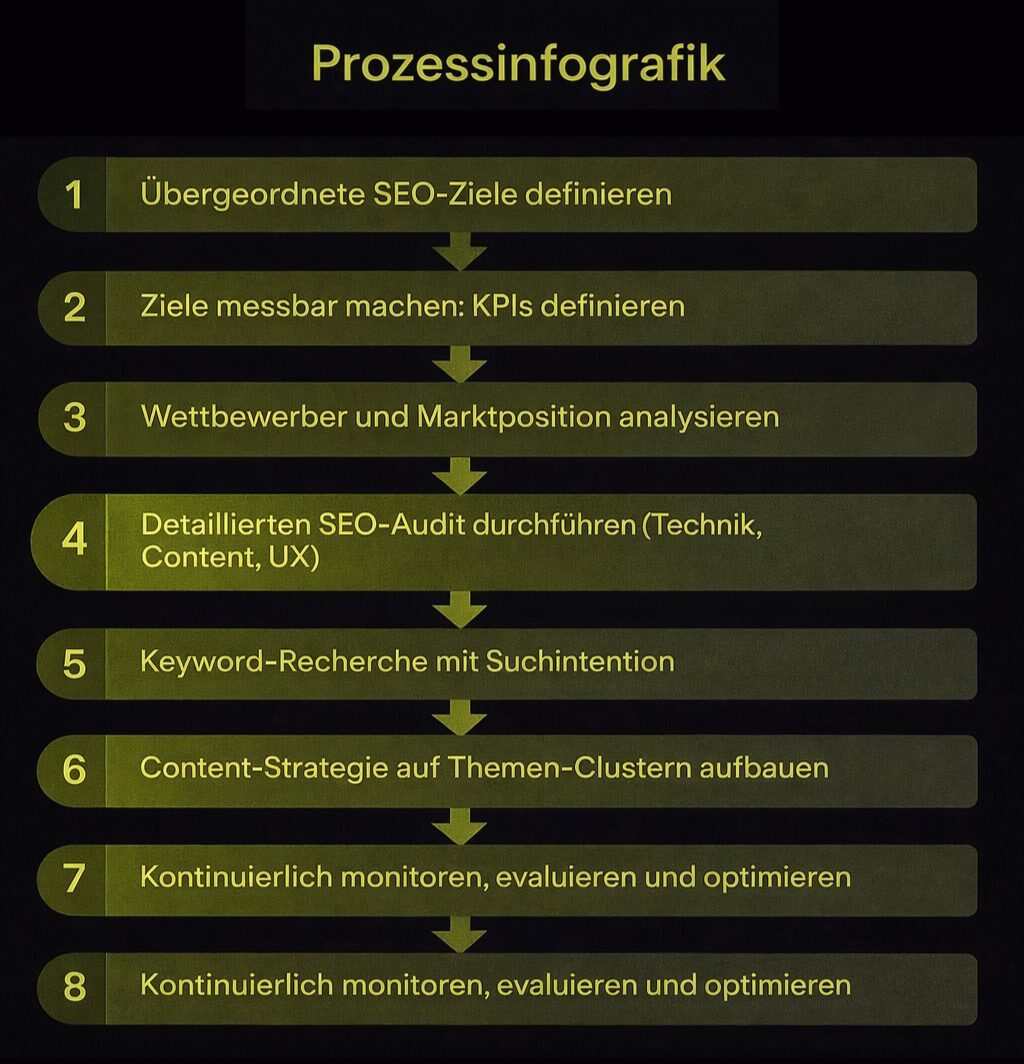
Step 3: analyse competitors and market position
Competitor analysis shows who really owns your SERPs and where you stand, as opposed to where you think you stand. Treat it like field reconnaissance: learn the rules of your niche, measure the gap honestly, then decide where you can win.
Start by mapping your actual SERP rivals (often marketplaces, directories and media, not your sales competitors). Pull your top queries, list the recurring domains and categorise them by page type and intent. Data does not lie: accept the baseline so you can plan moves that count.
What to compare (simple, but thorough):
- Brand demand: brand searches and branded CTR (are people searching for you?).
- Site scale: indexed pages by type, crawl depth, internal link structure.
- Traffic mix: organic share versus other channels, for dependency and resilience.
- Organic performance: non-brand clicks, rankings in priority clusters, share of voice.
- Authority profile: referring domains, link velocity, topical relevance (not just a score).
- Experience and speed: Core Web Vitals pass rates on key templates; mobile usability.
- Conversion reality: form and demo starts, add to cart, revenue or pipeline from organic pages.
Find gaps you can use:
- Intents they miss (for example comparisons, pricing, local “near me”).
- Formats they underuse (calculators, data studies, case stories, FAQs).
- Page types they neglect (category hubs, performance landing pages, location pages).
- SERP features they ignore (People Also Ask, video, image, FAQ schema).
Make the picture visible: put the results on a single page, with a bar chart for share of voice by topic cluster, a radar chart for strengths and a short story about your moat. The aim is not to admire their lead, but to decide where your defensible advantage lies (proprietary data, local expertise, partnerships, publishing pace, brand trust).
The bottom line: almost every niche has incumbents, but they do not have to stay on top. Once you know your position and theirs, you choose fights that compound and skip the time sinks.
Step 4: run a detailed SEO audit (technical, content, UX)
Run a one-off baseline check across technical, content, UX and off-page, and tag every finding with impact x effort so you fix what matters first.
- Technical: crawl depth and indexing or coverage, robots, canonicals and hreflang, the internal link graph and orphaned pages, load times and Core Web Vitals, structured data, duplicates, URL hygiene, navigation and template consistency.
- Content: rankings and coverage by topic cluster, intent match and depth (E-E-A-T), internal linking between related pages, freshness cadence, traffic trends by page type (blog, product, category, location).
- UX: a clear value proposition above the fold, a scannable layout, friction in forms and checkout, trust elements near CTAs, a smooth mobile journey.
- Off-page: link profile quality and relevance, referring domains and toxic patterns; clean link acquisition via partners, PR and data assets.
- Prioritisation: assign impact x effort to every issue, separate template fixes from page fixes and build a 30/60/90-day sequence.
Step 5: keyword research with search intent
Keyword research discovers and organises the search terms that reflect your audience’s problems and priorities. Search intent is the “why” behind them, whether that is learning, comparing or acting, and it should steer every decision.
Start with your buyers’ real problems, not with a random list of high-volume phrases.
Build topic clusters out of these problems, then map keywords and formats to each journey stage (guides for learning, comparisons for comparing, pricing, demo and product pages for acting). Relevance beats raw volume; if you are only a so-so match, leave it.
- Turn pain points into clusters: group related terms, assign intent and give each one a page type (pillar, subpage, comparison, calculator, product, location).
- Create hierarchy: separate short-tail (broad) from long-tail (specific) and structure them so that pillars support, and are supported by, focused subpages.
- Run a relevance test: am I genuinely a good result for this query, measured against my offer and my model? If not, park it.
- Check the live SERP: note the winning formats (PAA, videos, reviews, local packs) and align your format with what Google rewards.
- Prioritise what is winnable: rate terms by impact x likelihood and sequence quick wins first (often long-tail with clear commercial signals).
Two quick scenarios make it tangible:
- You want to rank for “online credit calculator” but you do not have a calculator. The intent is missed and the effort is wasted. Build the tool or choose a different target.
- You run a car care shop; do not chase only “buy car wax”. Add supporting queries such as “winter car wash tips” to strengthen the cluster and win qualified discovery.
Your deliverable is a single source of truth: a sheet with keyword, intent, stage, page type, format, priority, notes on SERP features. It becomes the backbone of your content plan and a window into your audience: who they are, what they need and whether you should operate nationally, regionally or locally to reach them.
Step 6: build a content strategy on topic clusters
Use your keyword research to design pillar pages for core topics and supporting subpages (comparisons, FAQs, calculators, use cases). Link in both directions so crawlers, and people, can feel the structure. This builds topical authority and improves discovery for related terms.
Create a simple, living content plan that says what you publish, why and when:
- Topic or cluster, target query set, intent (learn, compare, act)
- Page type and format (pillar, subpage, comparison, calculator, product, location)
- Owner, due date, draft status, required internal links (from and to)
- Primary CTA and evidence (case stories, data, reviews)
- Measurement (target page KPIs) and refresh cadence
If you already have content, run a quick content audit first: merge or cut duplicates, update thin winners and fix internal links so every page has a clear job inside the cluster.
Let your goals steer the mix. Conversion led? Bias towards performance landing pages, pricing, comparisons and FAQs that remove objections. Visibility led? Deep guides, checklists and data pieces that anchor the pillar and earn links, then bridge to the conversion page with smart CTAs.
When you write: hit search intent and answer it fully (not mechanically). Use clear headings, concise answer blocks, visuals where they help, and add trust signals (author, sources, real examples).
After publishing, link internally within the cluster, add the appropriate schema markup and schedule a 30/60/90-day review so you can refresh, expand or retire pages depending on results.
Step 7: prioritise and plan the implementation (including quick wins)
All that research only pays off if you translate it into a focused roadmap. Score every task by impact x confidence / effort and stack the backlog accordingly, with your goals, your model and your strongest competitors providing the context. Always ask: how long will it take and how big is the effect? If the effect is small, it is noise.
Start with a small batch you can ship quickly, then expand:
- Quick wins: consolidate duplicate, cannibalising pages; upgrade thin “money” pages with stronger copy, FAQs and proof; add internal links from strong pages to strategically weak ones; fix template blockers (for example lazy-loaded content that is not indexed, CLS issues).
- Example scenarios: UX and structure chaotic? Plan a template or IA refactor, or a relaunch. Link profile weak? Cover the core topics first, then start clean link acquisition. Technology and authority fine but conversions weak? Prioritise high-intent pages (pricing, category or service, comparisons).
Ship in short cycles, annotate releases and review monthly. Whatever moves outcomes gets scaled; everything else is paused or cut.
Step 8: monitor, evaluate and optimise continuously
SEO is a system, not a one-off. Ship, measure, learn, then scale the winner or stop the noise. Keep a simple monthly loop: what we tried, what we learned, what we try next, so your roadmap keeps getting sharper.
- A sustainable cadence: weekly operational (indexing, Core Web Vitals, key rankings), monthly strategic (leads and revenue, share of voice, conversion rates) and a content audit every 6 to 12 months to prune, merge and refresh.
- Refresh by intent and competition: informational pages more lightly and more often; comparison, pricing and performance pages more deeply and driven by the market.
- Annotate everything: releases, internal links, template tweaks, campaigns. That makes wins attributable (and rollbacks easy).
- Scale or stop: double down on what converts; retire or consolidate underperformers with no links, engagement or revenue.
- Pivot triggers: sustained drops in non-brand visibility, cannibalisation flags, conversion dips on money pages or a superior competitor format.
- Tighten the bridge to the business: track KPIs by page type (product, comparison, demo) and shift effort towards levers that move pipeline and revenue, not just rankings.
Do this consistently and your strategy stays alive: fewer random tasks, more compounding.
Special priorities for 2025
Search is changing fast. AI summaries, answer engine behaviour and new SERP layouts demand new habits, without neglecting the basics. Think both and: classic SEO plus AI-aware execution.
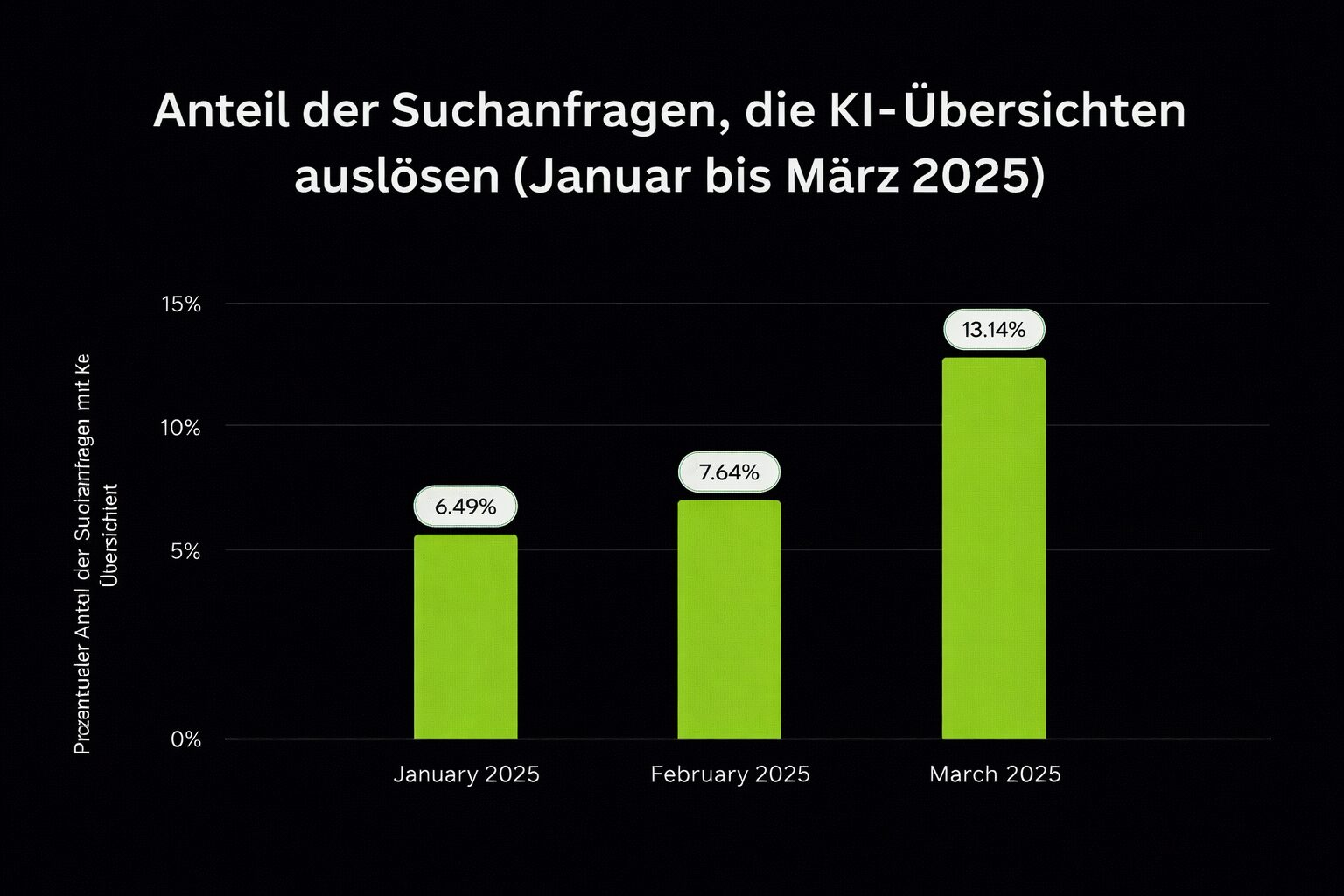
A number to watch: Semrush found AI Overviews on 13.14% of US desktop searches in March 2025 (up from 6.49% in January), most often on informational queries. Plan your content and your measurement accordingly. (Semrush)
How AI affects your SEO visibility
AI Overviews compress the top of the SERP, summarise and cite sources unevenly. Authority and brand signals count for more: Ahrefs shows that the top 50 brands take 28.9% of all AI Overview citations, while 26% of brands receive none. This spread rewards recognised entities with strong mentions across the web. Your strategy should deliberately build brand signals (mentions, branded search, high-quality references) alongside links. (Ahrefs)
Formats preferred by LLMs
LLMs lean on sources that users trust and on content that is easy to parse: clear headings, concise answers, reputable references. Ahrefs also found that 76% of AI Overview citations come from pages that already sit in Google’s top 10, so better organic rankings increase your chance of being cited in AI experiences too. Prioritise high-signal pages and add crisp answer blocks, data points and source transparency. (Ahrefs)
Performance landing pages: the bridge to conversion
Organic visits fizzle out if your “money pages” do not convert. Build performance landing pages for your most important commercial intents: fast, focused, credible pages that meet query intent and reduce friction (social proof, FAQs, risk reversals). This plays into SEO and paid: many teams test messaging in ads and move the winners into their organic landing pages.
Using synergies: how SEO works with PPC, social and PR
- Use PPC to validate intent and copy, and scale successful angles with SEO.
- Use PR and digital partnerships to earn links and brand mentions that lift organic and AI visibility.
- Coordinate content drops with social to accelerate engagement and links. Treat channels as a portfolio that increases your topic share and your brand authority over time.
Why templates alone are not enough
In short: strategy is not copy-paste. Your path depends on your brand, market, constraints and moat. Templates help you start; they do not tell you where to compete or how to win.
2025 underlines the danger of uniformity: in AI Overviews, a few brands dominate the citations (28.9% for the top 50), while many have zero visibility. If you mirror your competitors, you reinforce their advantage. Differentiation, in topic choice, point of view, format and evidence, is your edge. (Ahrefs)
The danger of copy-paste strategies
Blindly following “best practices” produces look-alike pages that earn no links, mentions or trust. Worse, shortcuts such as bought links create long-term risk and fragile rankings. Go for durable, clean link acquisition through PR-worthy assets and partnerships.
Why context matters
A marketplace app, a local practice and an enterprise SaaS have different levers, SERPs and content economics. Your sequencing should reflect that: where to publish first, what to consolidate, what to retire and where to invest in depth versus breadth.
Critical thinking and flexibility
Treat your strategy like a product: ship MVPs (minimum viable pages), validate, iterate. Replace dogma with experiments. Feed learnings back into the roadmap every month so your system keeps compounding.
Conclusion: your SEO strategy is a living system
Two sentences to hold on to: strategy gives direction; execution creates momentum. Connect the two in tight feedback loops and the compounding starts.
Even with AI shifts, organic search remains fundamental. Backlinko’s 2025 roundup says Google organic accounts for around 57.8% of global web traffic, which is why a smart, evolving SEO strategy is still one of the highest-leverage investments available. (Backlinko)
SEO is not about collecting clicks; it is about building a digital brand that people and algorithms trust. That means staying consistent, focusing on real user needs, knowing your competitors and being clear about what your brand stands for and how you help.
It also means challenging your own decisions, moving the plan with the market and accepting that SEO is a game of patience: never “finished”, always improving.
- Back decisions with data, ship small, measure, improve.
- Align every task with a business goal and the page types that drive it.
- Keep monthly learning loops; re-prioritise quarterly; reset annually.
- Build brand signals (proof, mentions, clean links) alongside content.
Double down on what converts; consolidate or retire the rest.
Ready for more revenue?
Book a free SEO and GEO audit

Find out in a free call how much revenue your website is leaving on the table, with no obligation and no agency waffle.