
Everything at a glance
- SEO delivers sustainable organic traffic and high-quality leads.
- It builds brand authority and trust, which is indispensable for decision-makers in companies.
- A proactive SEO strategy saves costs in the long run compared with reactive measures.
- Integrating SEO with content marketing and UX gives you competitive advantages.
- Strategic, continuous optimisation ensures that your digital presence stays robust as trends shift.
- Classic SEO also makes sure that you are found in AI search engines.
Picture this: 68 % of all online experiences begin with a search engine. That is not just a number, it is a wake-up call. In a world where attention is the new currency, visibility means staying in the race. And if your brand does not appear where your customers are searching? Then you are already a step behind.
Search engine optimisation (SEO) is not about outsmarting Google. It is about understanding your audience, creating content that lands and building a digital presence that lasts. Whether you lead a development team, drive the marketing strategy or manage your company’s growth, SEO gives you the power to be visible, relevant and always one step ahead.
And the best part: you reach your dream customers at exactly the moment they are actively searching for you, your service or your product.
8 reasons why SEO matters for you
SEO is decisive because it delivers organic reach and long-term traffic growth while being more cost-efficient than paid advertising. It builds brand trust and positions every business, large or small, for competitive success.
Below you will find the reasons why SEO matters.
- Steady organic traffic
- Cost savings compared with paid advertising
- Brand trust and authority through search rankings
- Increase your digital reach
- Enjoy long-term benefits
- Be there when it counts
- Understand your audience
- Track your success
- Synergies with content marketing and UX
- Classic SEO also makes sure that you are found in AI search engines.
1. Steady organic traffic
A robust SEO strategy ensures that your website is easy to find. What do you actually have a website for?
Imagine putting up a billboard in the middle of a forest: nobody sees it. That is exactly what happens if you do without SEO. Google does not simply show your website to the right people by magic.
That is what search engine optimisation is for: it ensures that the very people who are actively searching for what you offer really do end up with you.
And the best part: organic traffic forms the stable foundation of your online presence. It brings you long-term growth without having to burn through new advertising budgets all the time.
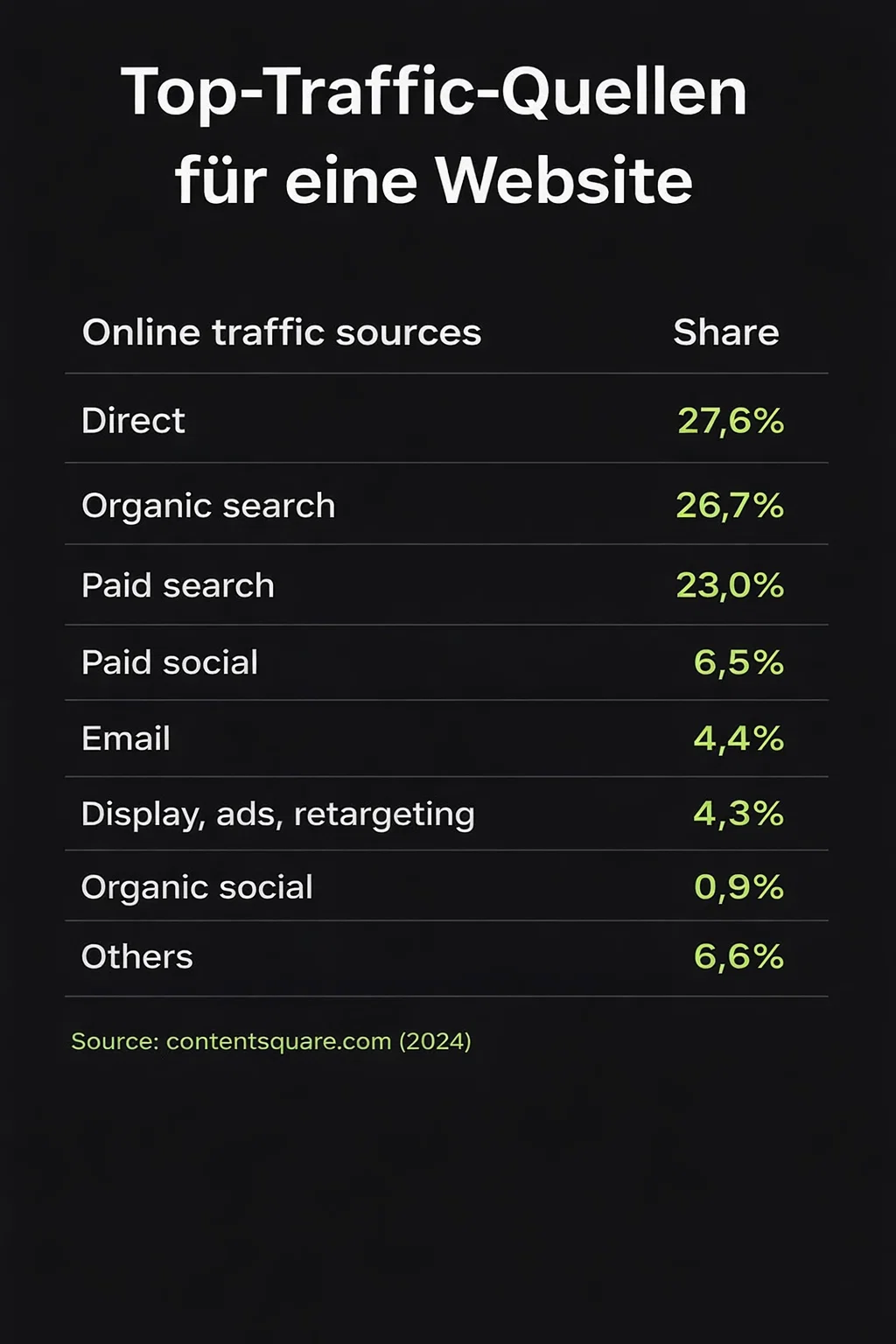
According to a study by Contentsquare, 27.6 % of all website visits are direct visits. That means someone typed your website’s domain straight into the browser, so they did not find it through Google or another search engine.
What is behind that? Branding. The person must already know your company or have been on your site before.
The good news: this is exactly where SEO comes in too. It is not only about getting clicks. SEO creates long-term visibility and trust. But more on that later.
Incidentally, the second strongest channel is already organic search, with 26.7 % of all visits.
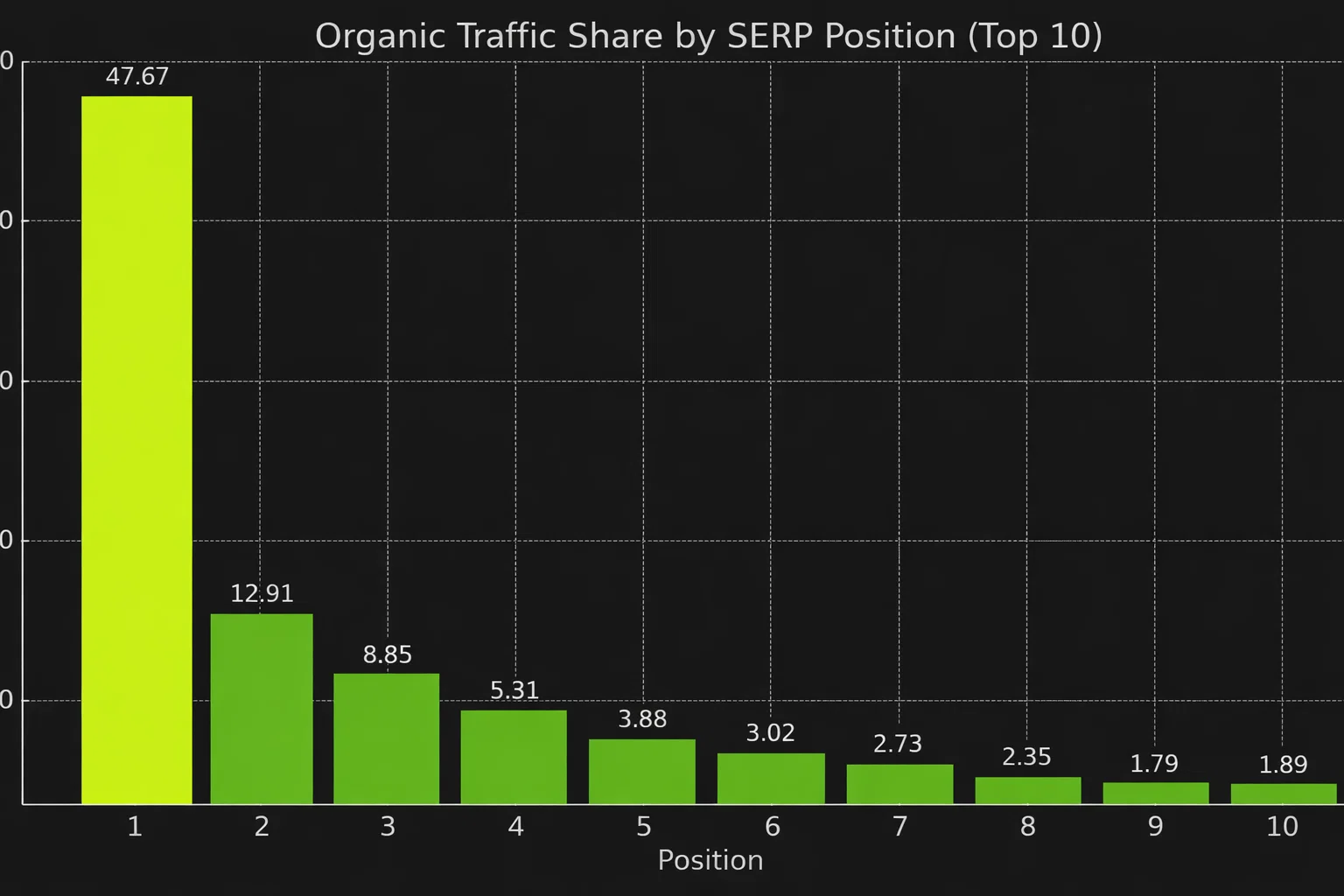
And when you look at who takes away the most traffic, it quickly becomes clear: anyone who is not in the top 3 of the search results goes under. You can find a detailed analysis of this at Advanced Web Ranking.
What does that mean for you?
- Invest in SEO so that you can have a share of the organic search cake.
- The top 10 is mandatory, otherwise you get no traffic. In other words: go big or go home.
2. Search will continue to grow
The volume of online searches is rising constantly, which means your potential audience is growing all the time.
SEO allows you to seize these emerging opportunities by focusing on relevant keywords and trends.
By adapting your strategy to changing search habits, you can open up new markets and expand your reach.
The estimated number of daily Google searches currently stands at over 7 billion, which corresponds to roughly 81,000 searches per second. In 2020 alone, around 2.55 trillion searches were carried out worldwide through Google.
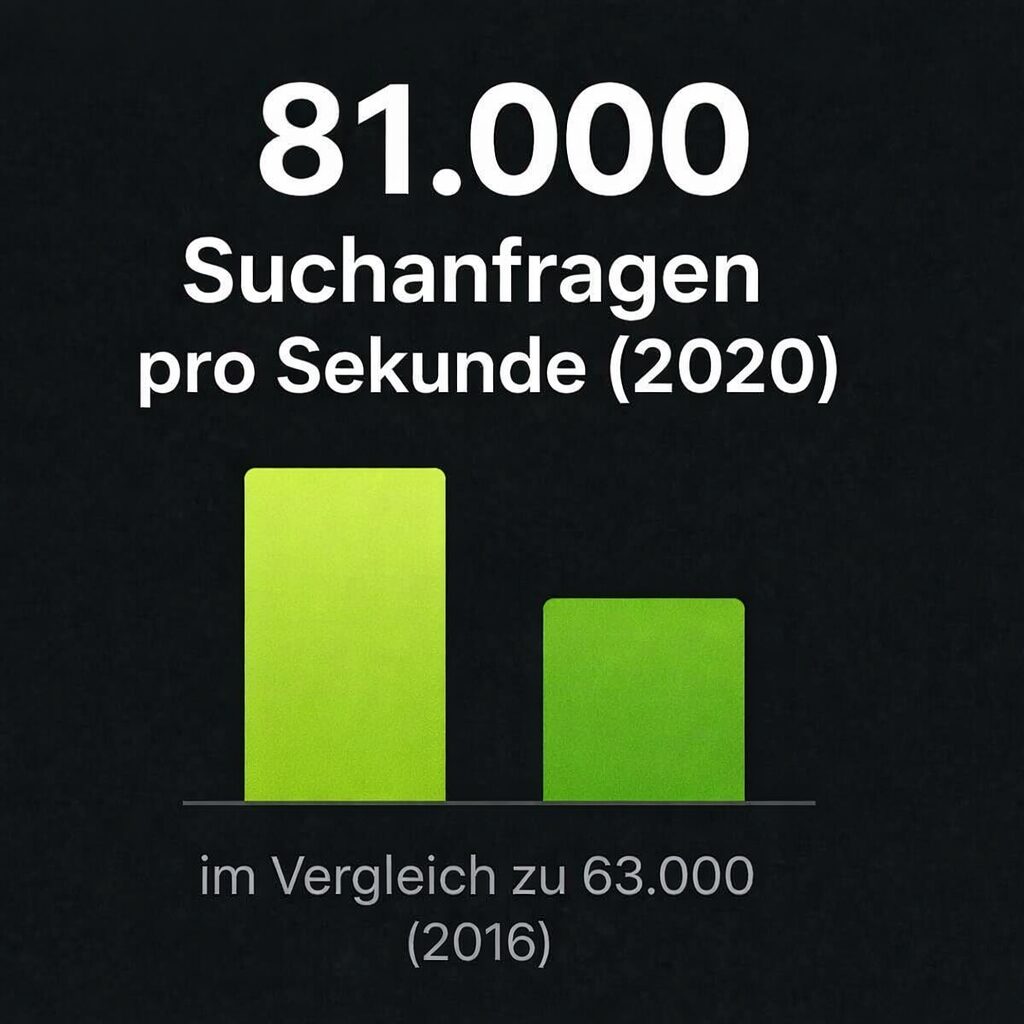
An overview of how search volume on Google has developed (2020 vs. 2016):
- 81,000 searches per second (2020), compared with 63,000 (2016)
- 4.9 million per minute, previously 3.8 million
- 292 million per hour, previously 228 million
- 7 billion per day, previously 5.5 billion
- 212 billion per month, previously 167 billion
- 2.55 trillion per year, previously 2.00 trillion
Sources: Worldometers, SearchEngineLand
Worth knowing: Google itself has not published these figures officially for quite some time. The values above are based on the most recent available estimates, and they are probably on the conservative side. It is therefore acceptable to use the phrase “or more” when quoting them.
3. SEO vs. SEA: slow and steady wins the race
Getting your website onto page 1 of Google is like a race. You have two routes: Google Ads (SEA) or search engine optimisation (SEO).
Google Ads can deliver results quickly, but only if they are profitable. As soon as your adverts cost more than they bring in, you are actively losing money. And if you pause the campaigns, you are practically invisible online again.
That does not mean Google Ads are bad, quite the opposite. SEA and SEO together are a powerful lever. But: Google Ads have to be profitable. (You need very good tracking for that.) So be sure to find an expert such as us for it. If you are profitable with your Google Ads, there is no budget limit: you should then invest as much as your positive ROI allows.
If you are not profitable, however, you are simply burning money.
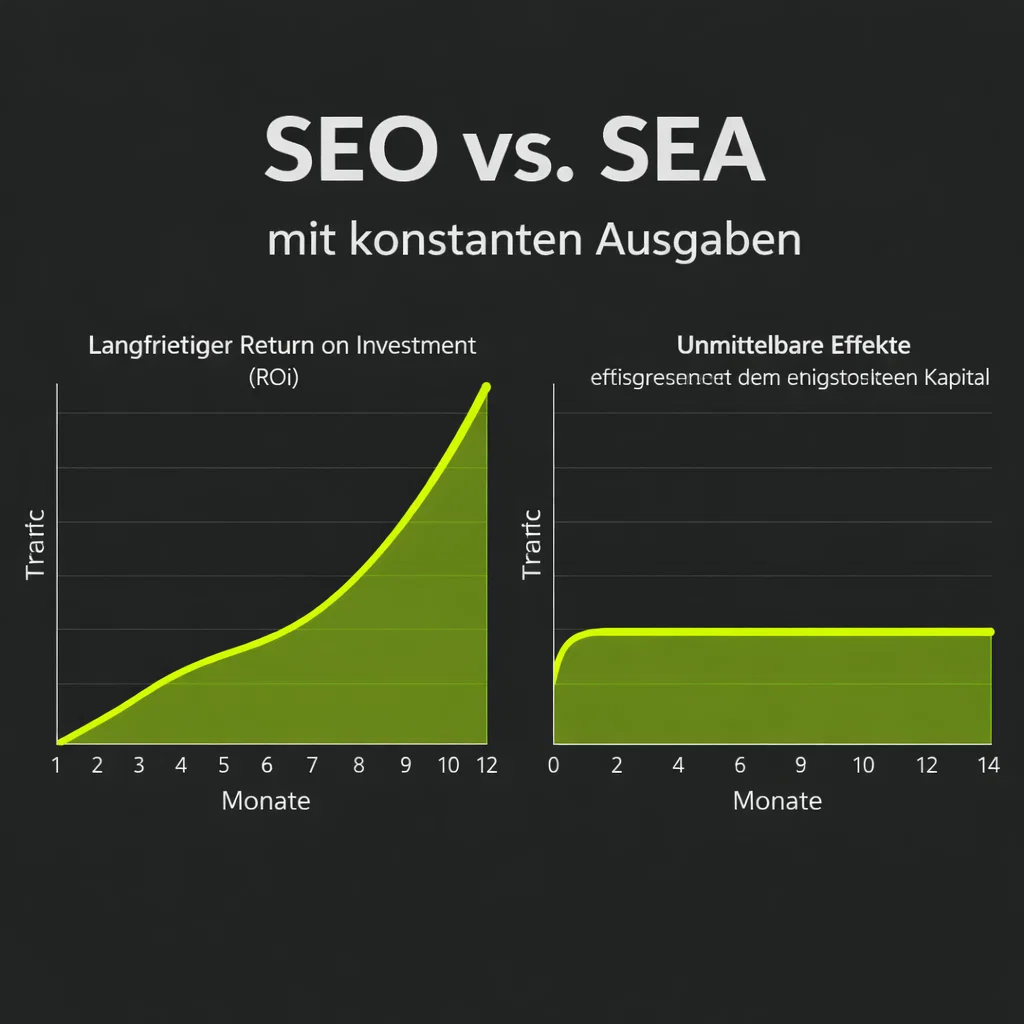
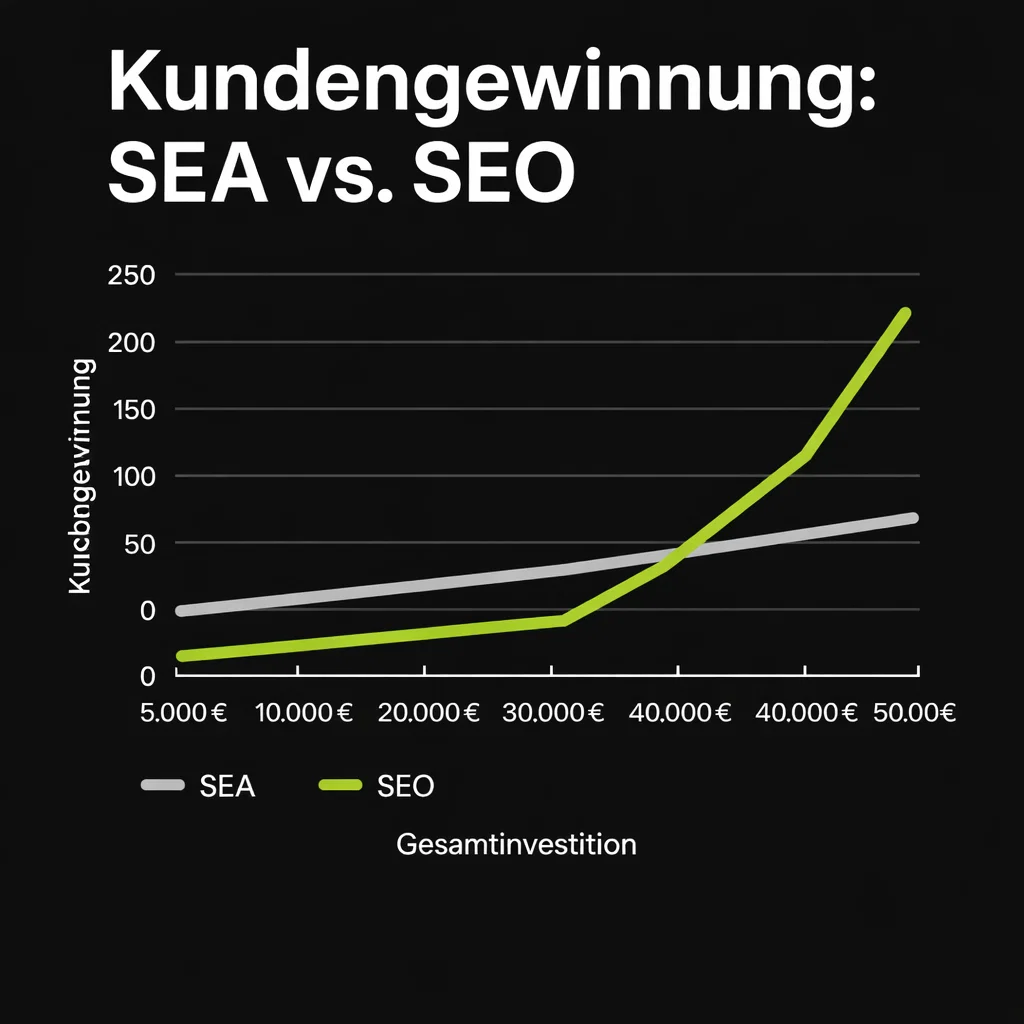
SEO, on the other hand, helps you build your ranking slowly but steadily. As soon as your website ranks, you can achieve exponential returns on your investment. It is a long-term investment that continuously generates traffic over time with targeted optimisation. At the beginning you will probably not be profitable straight away, but over the years it saves you thousands of euros.
4. SEO is a combination of many factors
Although organic traffic is a large part of SEO, SEO does not consist of that alone. Google’s algorithm changes constantly, and for you to stay ahead, your strategies have to adapt too.
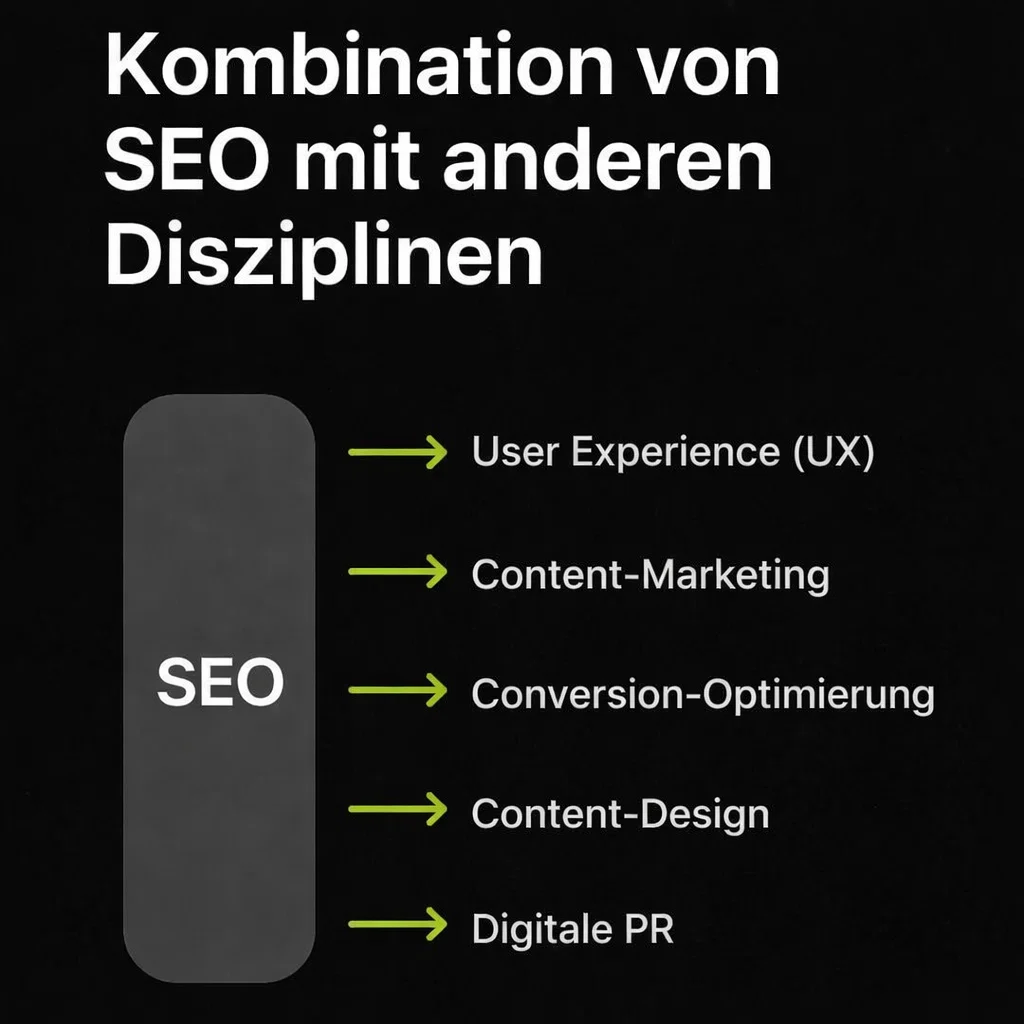
SEO now has to be combined with several other disciplines in order to rank according to Google’s algorithm. These disciplines include:
- User experience (UX)
- Content marketing
- Conversion optimisation
- Content design
- Digital PR
- AI optimisation
If you want to leave a lasting impression on your visitors, you have to observe all of these factors in order to create an unforgettable user experience.
5. Be there when it counts
The essential thing about SEO is that it addresses users who are already searching for products similar to the ones you offer. In marketing this is called pull marketing. You draw customers to your website in order to help them with what they were already looking for.
You are not pushing them to buy a product or to develop an interest in something they were not searching for, as is the case with push marketing.
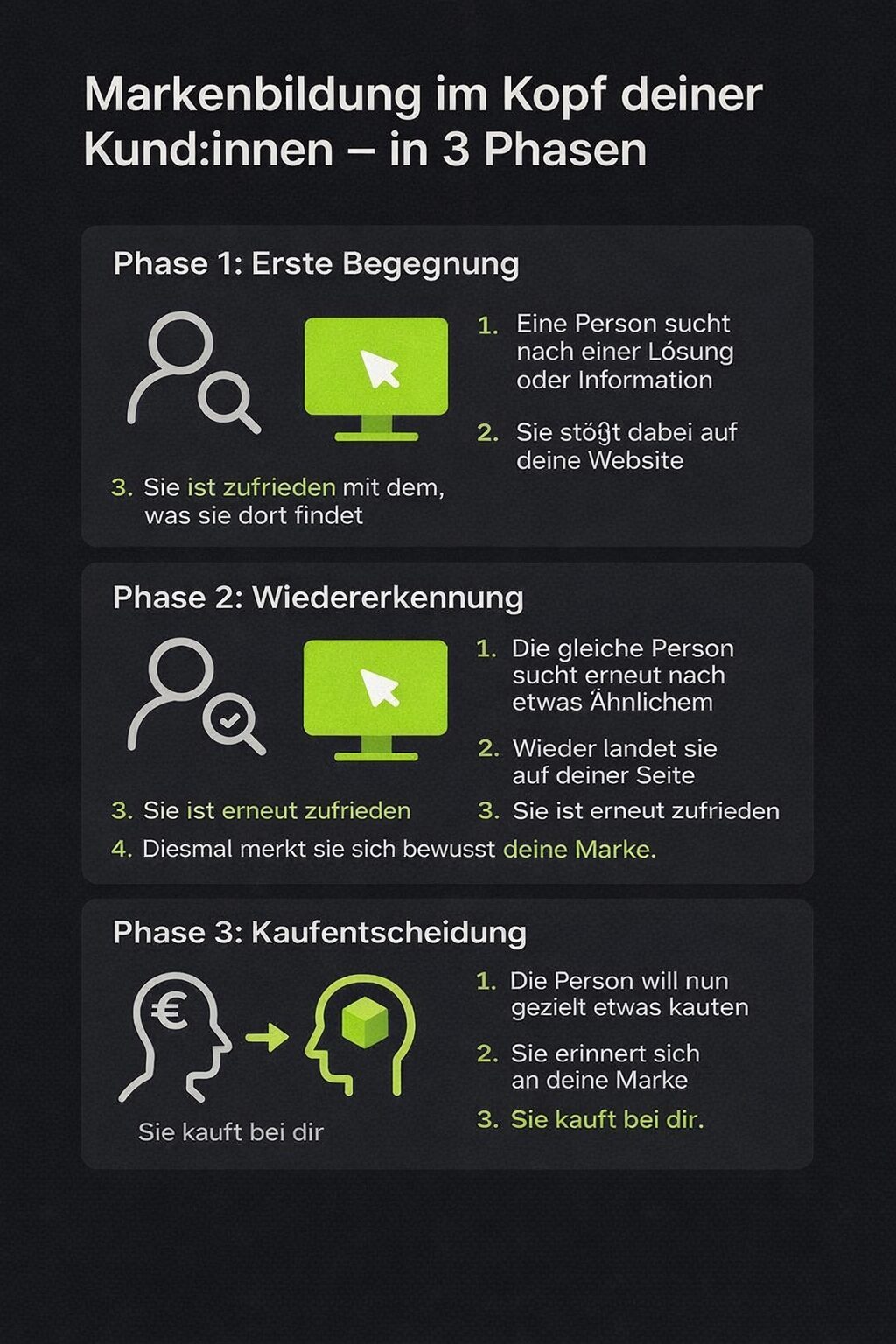
When you invest in your website’s ranking, you are there for customers when they need you, or when they have searched for you. That makes SEO completely user-centred.
This not only helps you win more customers. A consistently good ranking also means you build a reputation and your customers remember you more and more.
6. Understand your audience
As already mentioned, SEO is strongly user-centred.
SEO helps you understand your target audience better so that you can adapt your website to their needs and search intent.
There are many SEO tools that help you analyse your target audience’s search intent. The sooner you notice a change in your target group’s search intent, the faster you can implement it on your website and gain a competitive advantage.
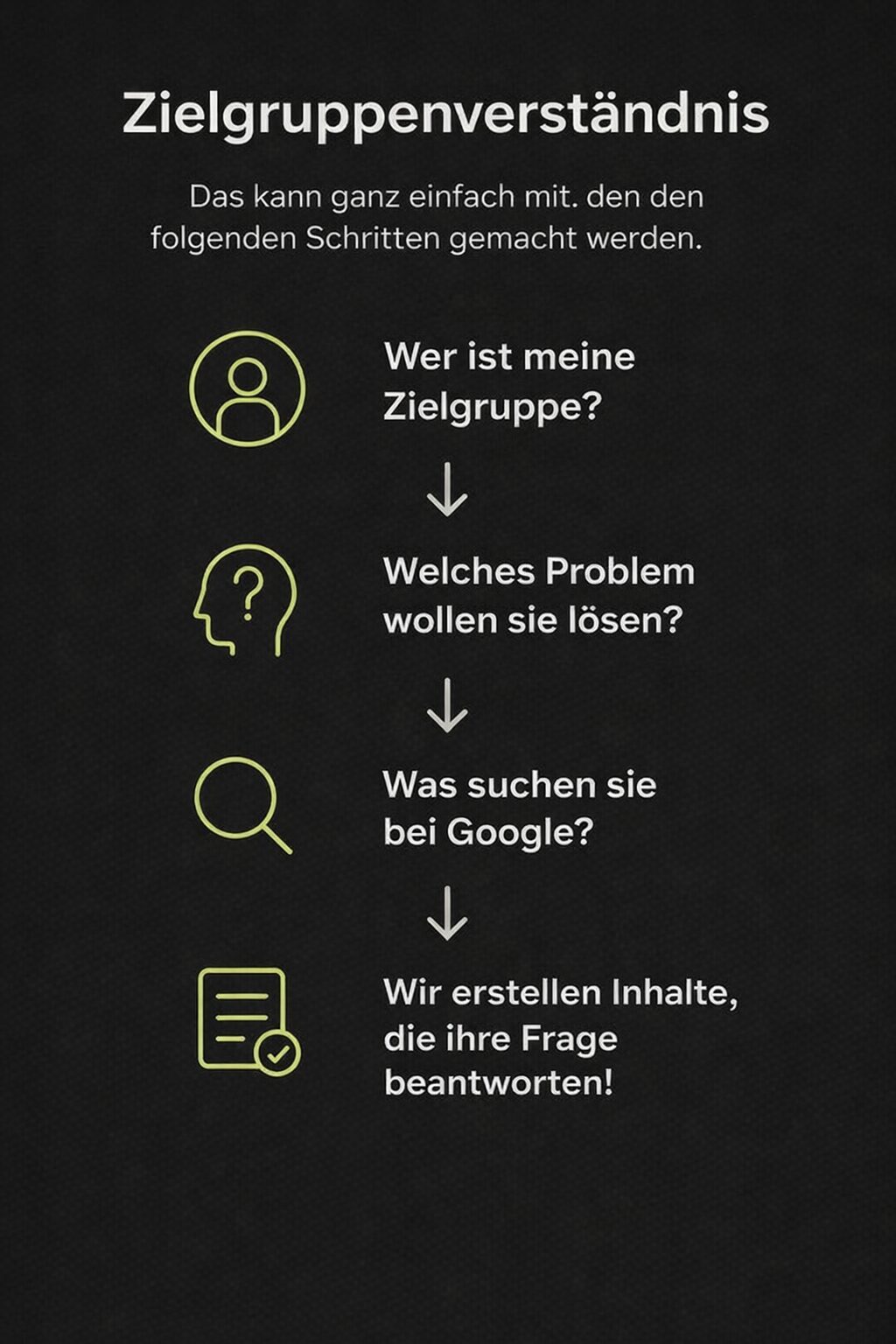
This can be done simply by following these steps:
- Who is my target audience?
- Which problem do they want to solve?
- What are they searching for on Google?
- We create content that answers their question.
7. Track your success
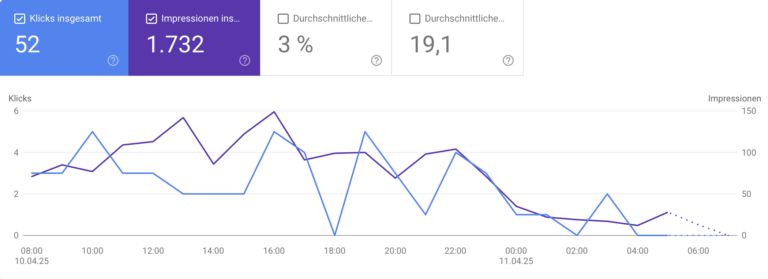
SEO is based on data throughout the entire process. Every click, every keyword, every bounce rate: it is data all the way through. That makes it easier for you to measure whether your SEO measures are working or not.
By checking what your competitors are up to and finding out what people actually type into Google at 2 in the morning (yes, even “how to bake banana bread without bananas”), SEO gives you real, measurable insights. You see where users come from, what they do on your site, which pages bring you money and where the real traffic gold mines are.
The best part? Everything is traceable. If something is not working, you notice it immediately. If something takes off, boom, you double down. No guesswork, no hocus-pocus. For example, you can look at data from the Google Search Console.
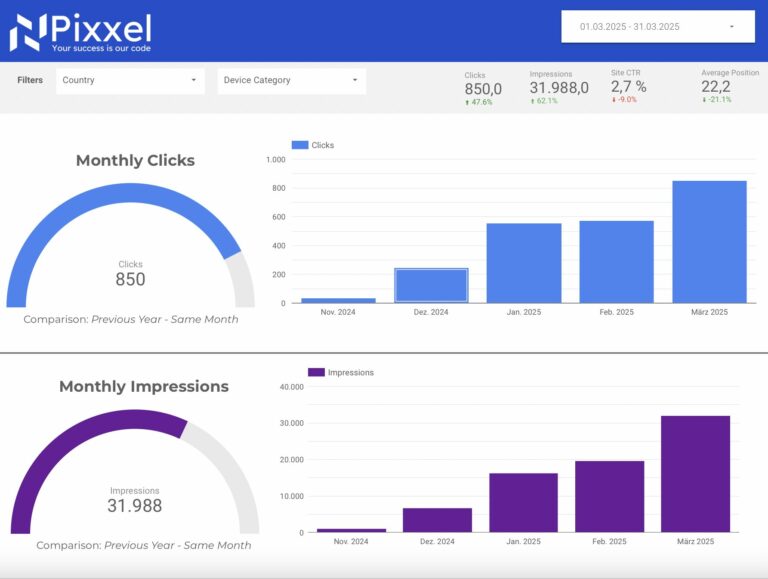
We also send our clients a monthly report in which all the data is clearly visible: which pages get how many impressions and clicks, and what we have done. A page with the annual overview looks like this, for example:
8. Generative Engine Optimization
One aspect that many do not have on their radar at all yet: some may think SEO is dead, and that in future only ChatGPT or other AI systems will count. For exactly those people we have news.
Around 80 % of classic SEO measures also make you visible in AI search engines. If you are currently right at the beginning, you first have to master the SEO basics before you can optimise specifically for AI search engines.
It also depends heavily on the industry and the niche. Not every one of them is already well represented in AI search results, at least not yet. The fact is: Google remains by far the largest supplier of traffic to websites, and that will stay the case for quite some time.
A recent analysis by Seer Interactive shows that there is a clear correlation (r around 0.65) between Google rankings on page 1 and how often a digital brand is mentioned in large language models (LLMs). An important caveat: a correlation does not automatically mean causation.
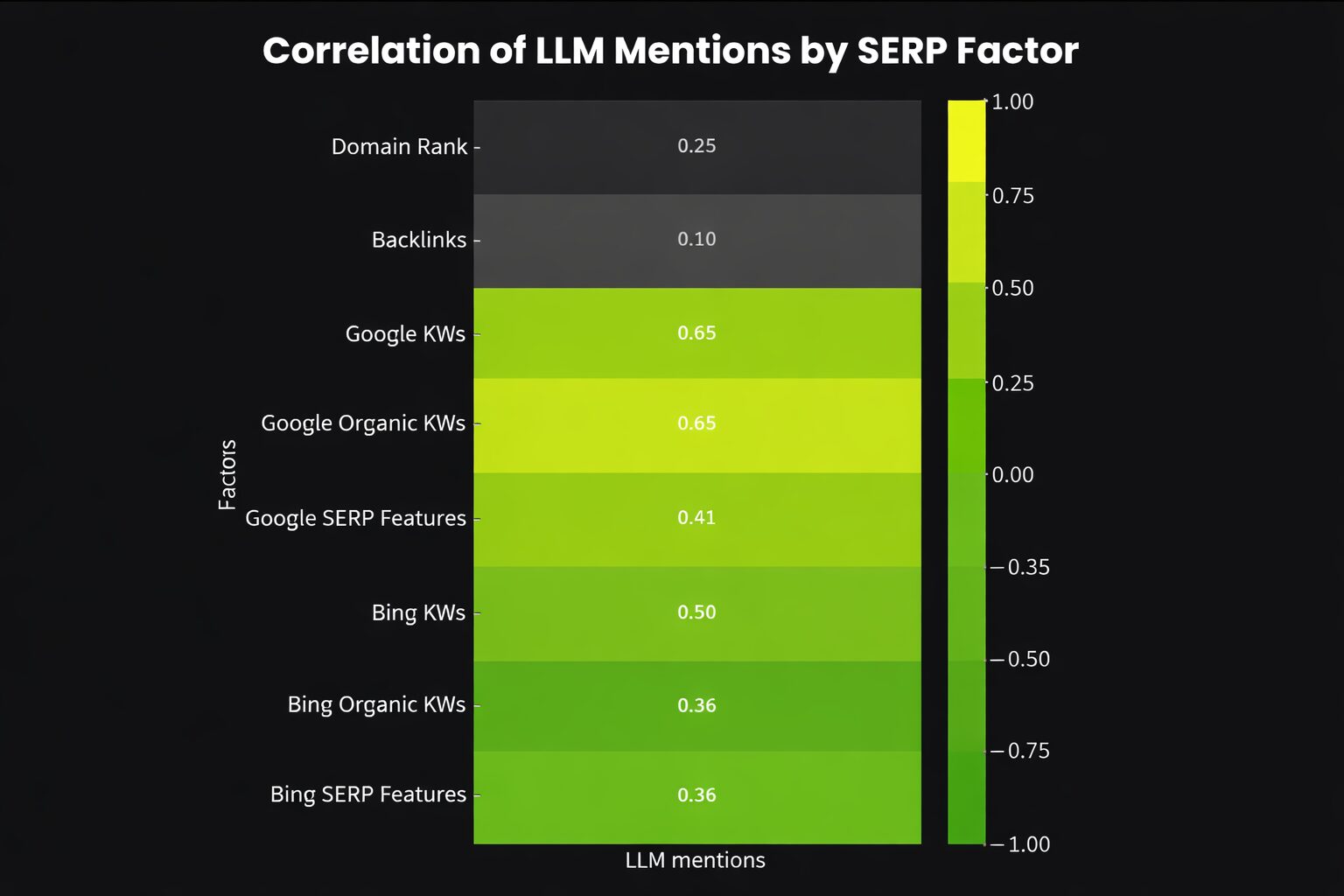
Expert tip:
Concentrate on classic SEO to begin with, because without solid foundations you will not be visible in AI search engines either. Only once the basics are in place can you invest part of your budget specifically in AI optimisation.
How SEO helps different business models
SEO plays a decisive role in being visible online, generating high-quality traffic and building trust, no matter which business model you have.
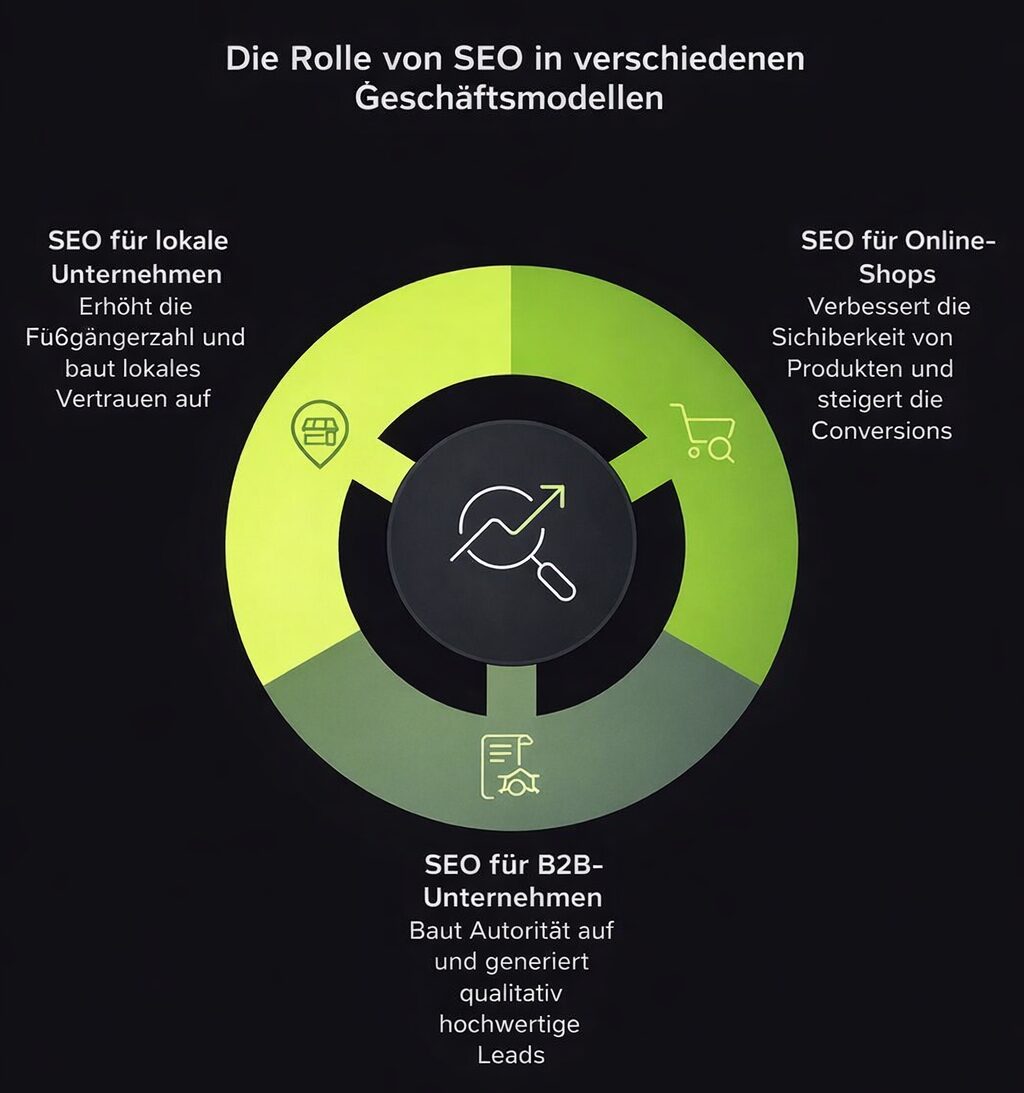
SEO for online shops
Imagine your online shop as a cool little boutique, hidden away in the enormous city of the internet. SEO is like a friendly signpost that leads people to you at exactly the moment they are looking for something special.
If someone is searching for the perfect pair of environmentally friendly trainers, for example, SEO ensures that your product page appears right at the top of the search results.
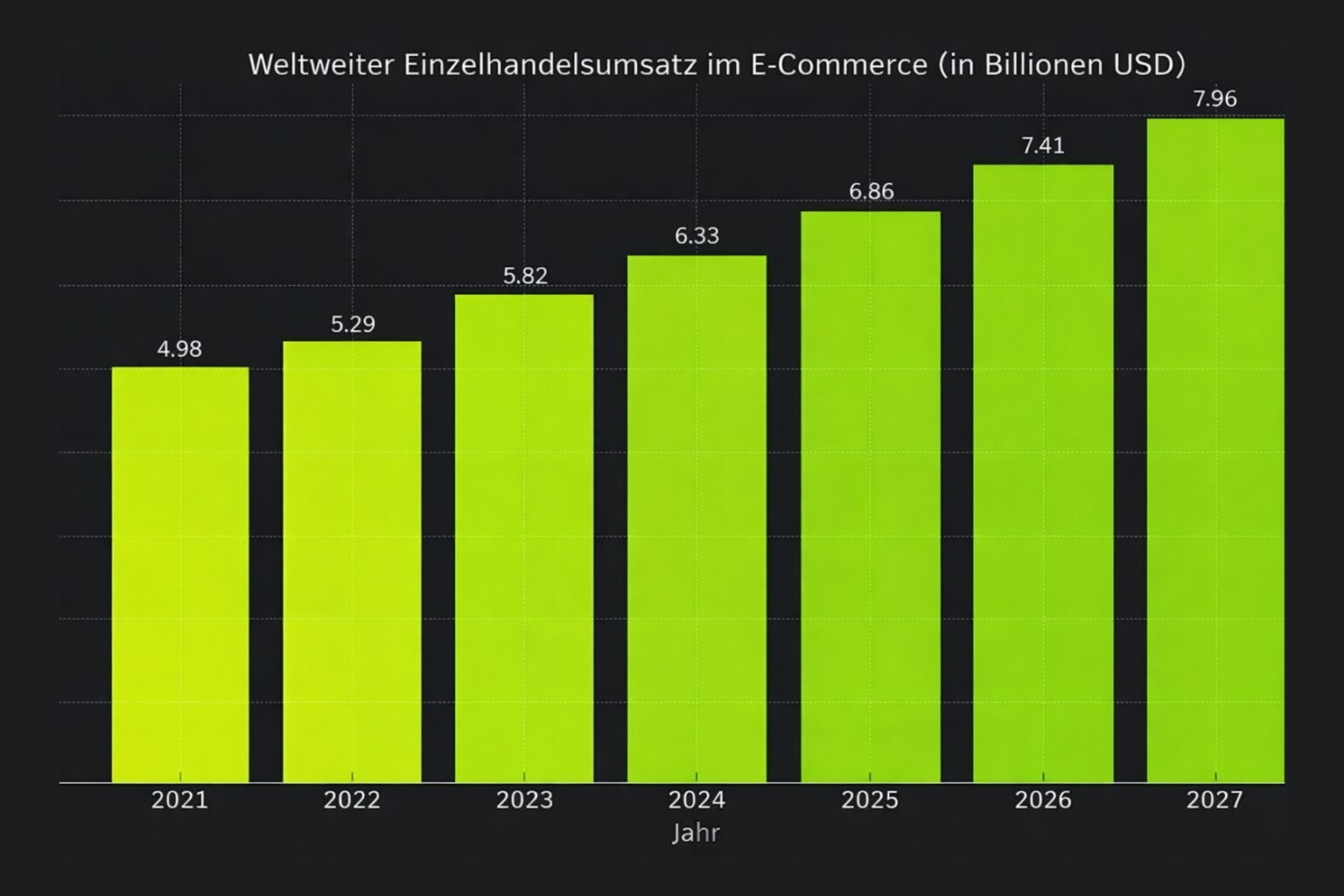
Worldwide retail e-commerce revenue is expected to reach 6.33 trillion US dollars in 2024, which corresponds to an increase of 8.76 % compared with the previous year.
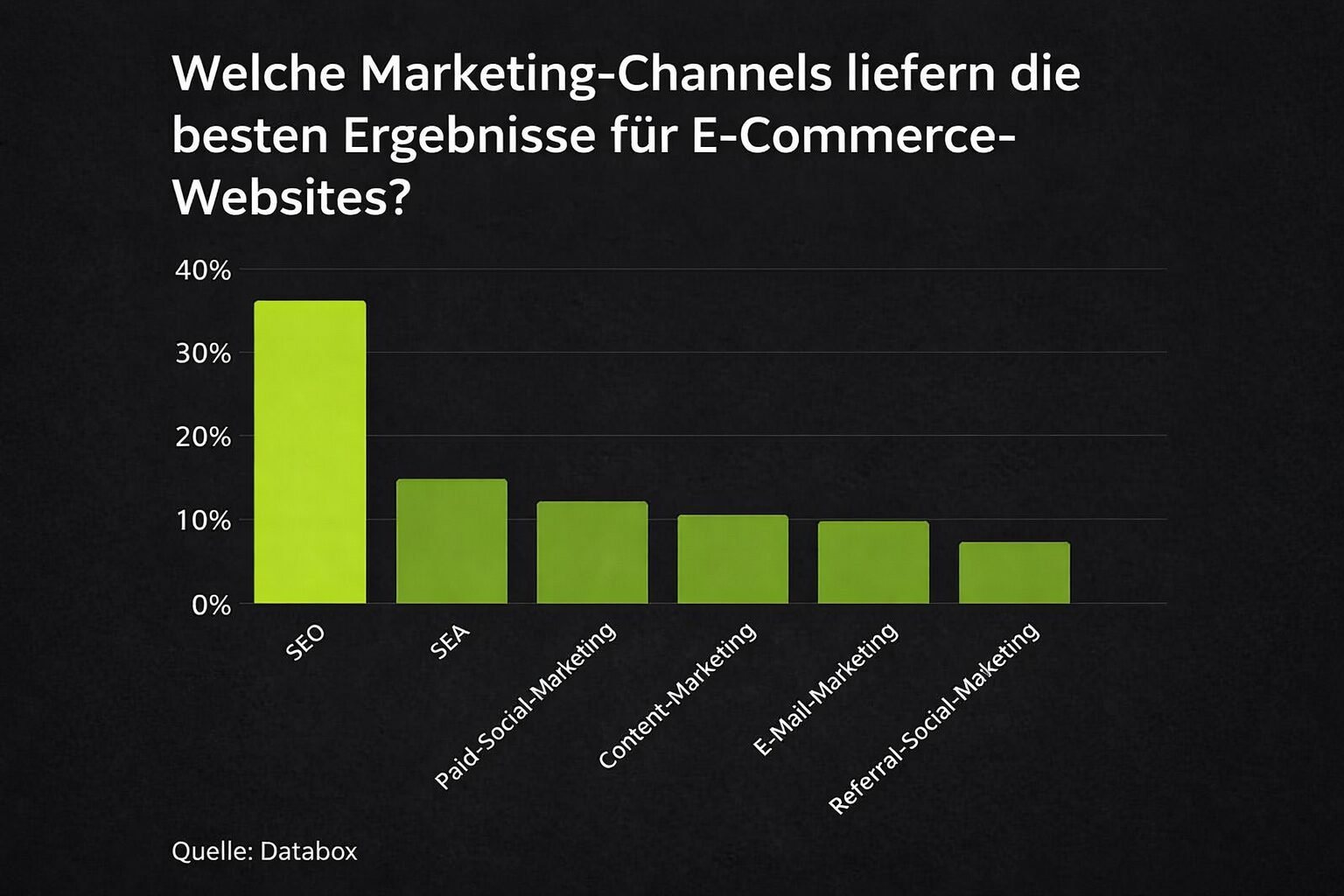
The study by Databox shows clearly that SEO delivers the best results. What does that mean in concrete terms? It is not Google Ads but organic search results that more often lead to actual purchases.
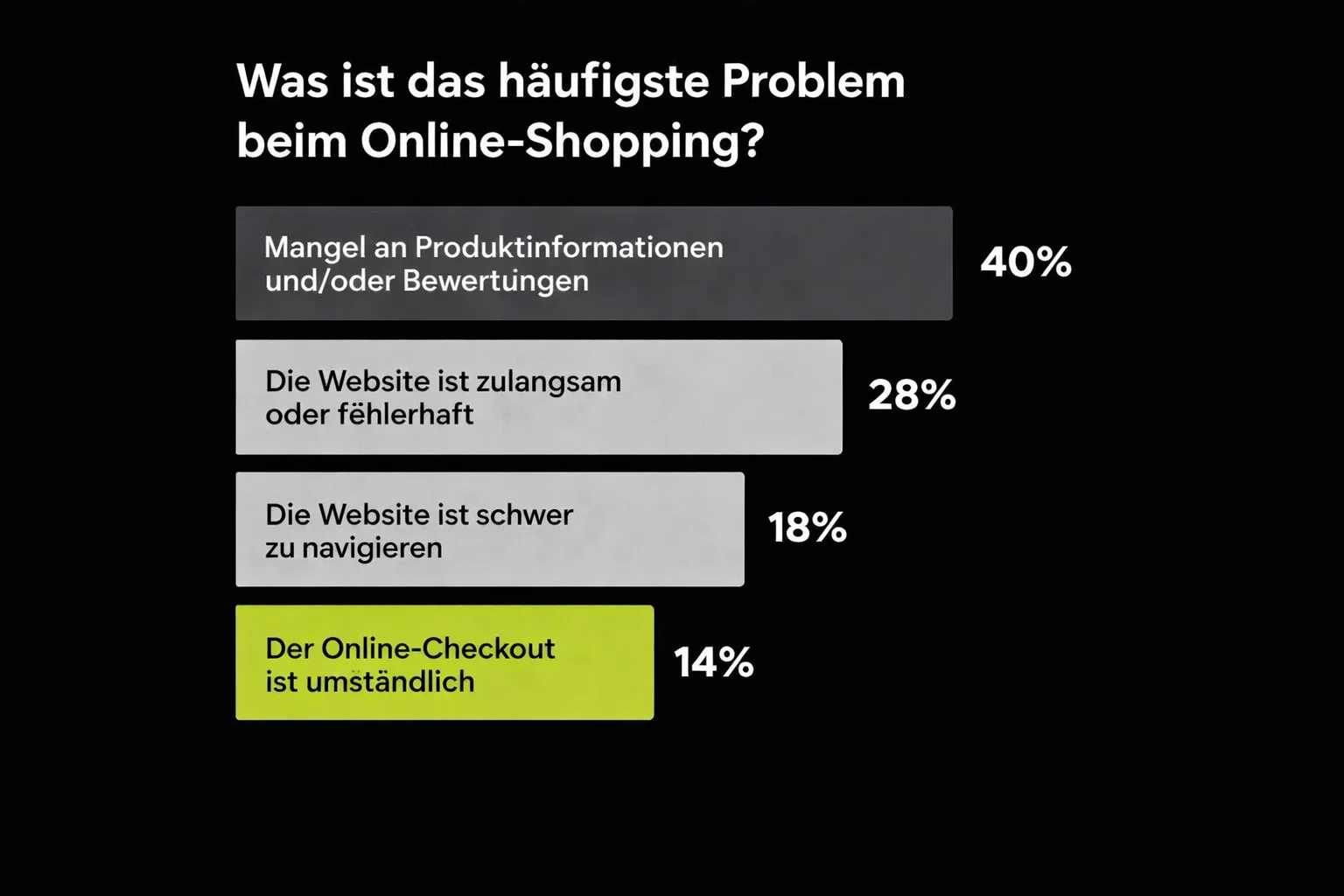
And we must not forget the technology. A technically flawless website that meets Google’s standards for speed and usability not only makes visitors happy, it also produces better rankings. If your pages have technical problems, they probably will not get the visibility they deserve. The study by Inviqa illustrates this:
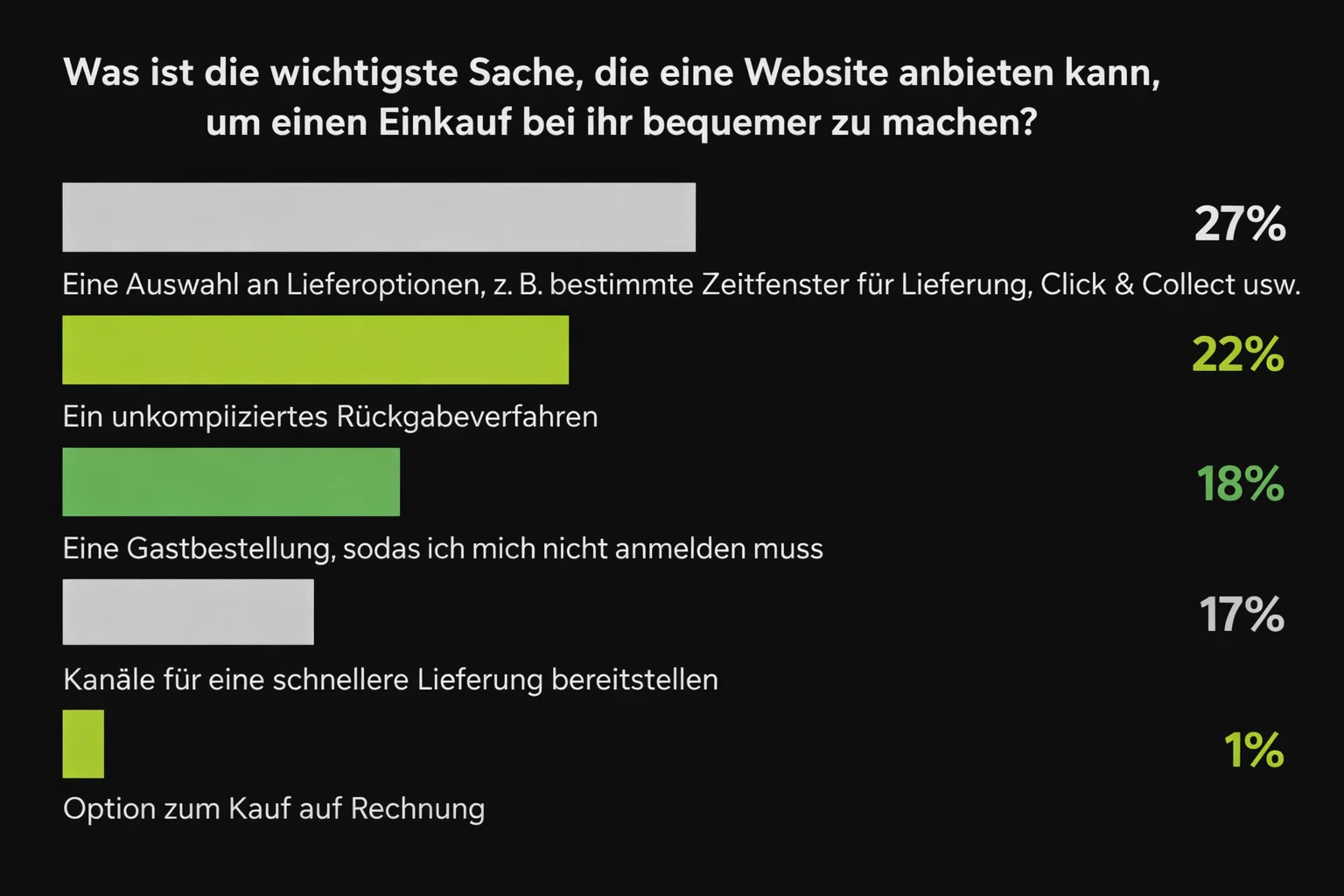
Another statistic shows that flexible delivery options (27 %) and straightforward returns handling (22 %) are above all decisive for customers in making online shopping more comfortable. Features such as guest checkout, fast delivery or “buy now, pay later” also play an important role, while saved payment details and personalised content are barely relevant.
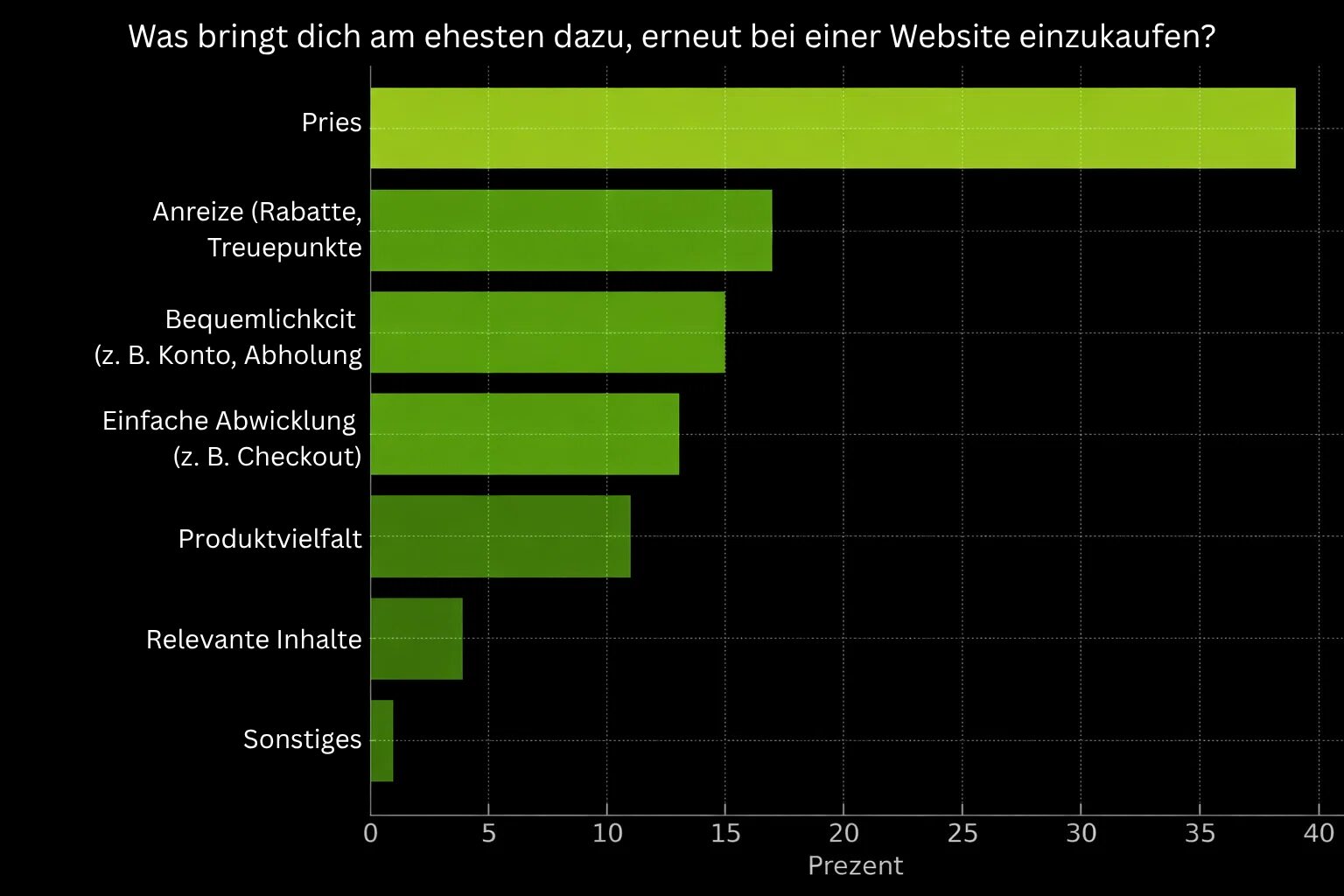
The most important reason why people buy from a website again is price, with 39 % of respondents saying so. Other relevant factors are incentives such as discounts (17 %) and convenience, for instance through easy collection or a customer account (15 %).
SEO for B2B companies
Think of your B2B website as a quiet salesperson: she works around the clock and attracts interested decision-makers who are actively searching for solutions online. In the end, SEO is not about traffic or clicks, it is about revenue and leads.
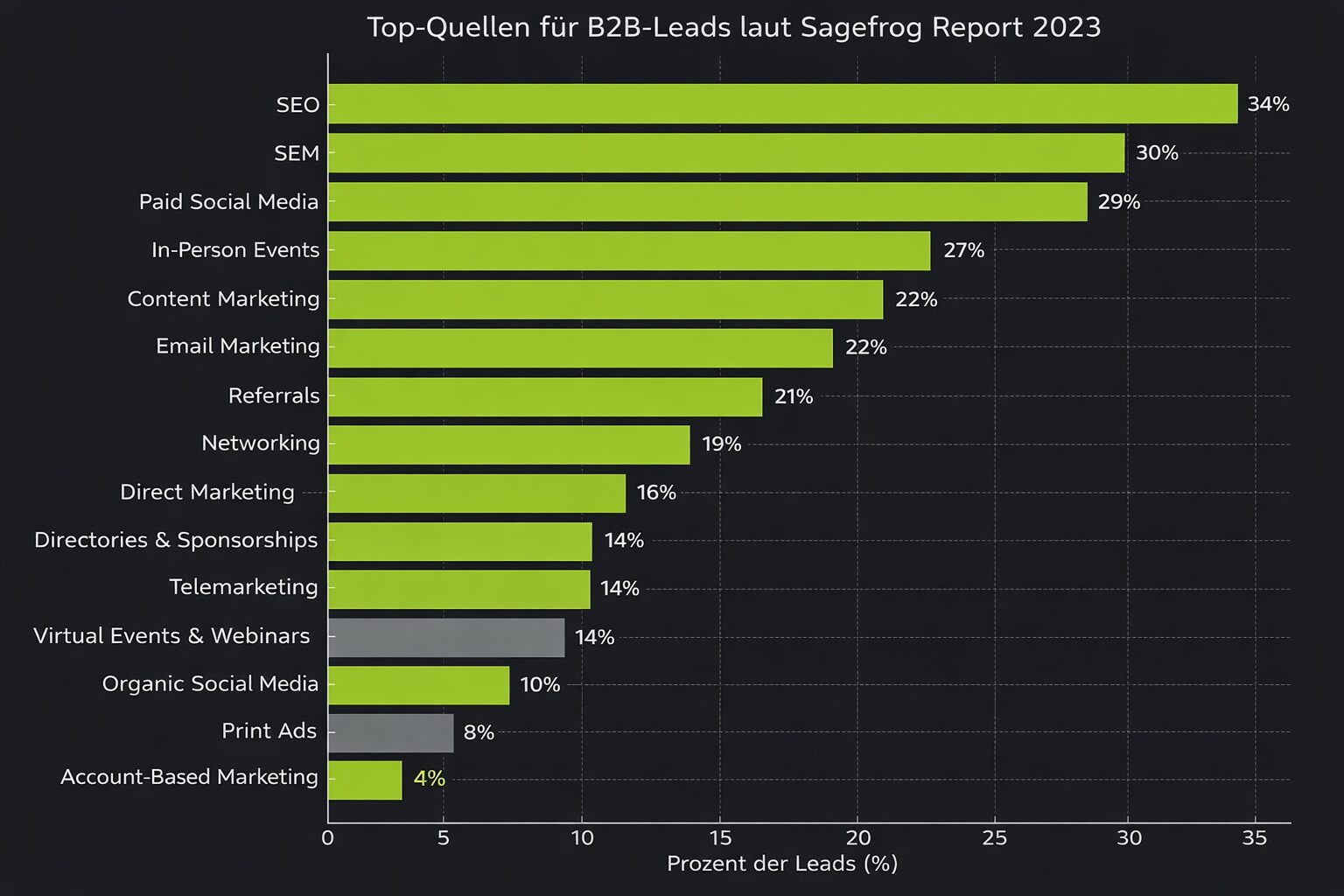
According to the Sagefrog Report 2023, the most qualified leads in 2022 came from a combination of SEO, SEA and paid social media advertising.
In addition, according to a study by BrightEdge, the share of traffic in the B2B sector is as high as an impressive 76 %. That means the overwhelming majority of B2B buyers use search engines to find suitable products and services.
A look at how budgets are distributed confirms this too: SEO and website development are right at the top of the priority list.
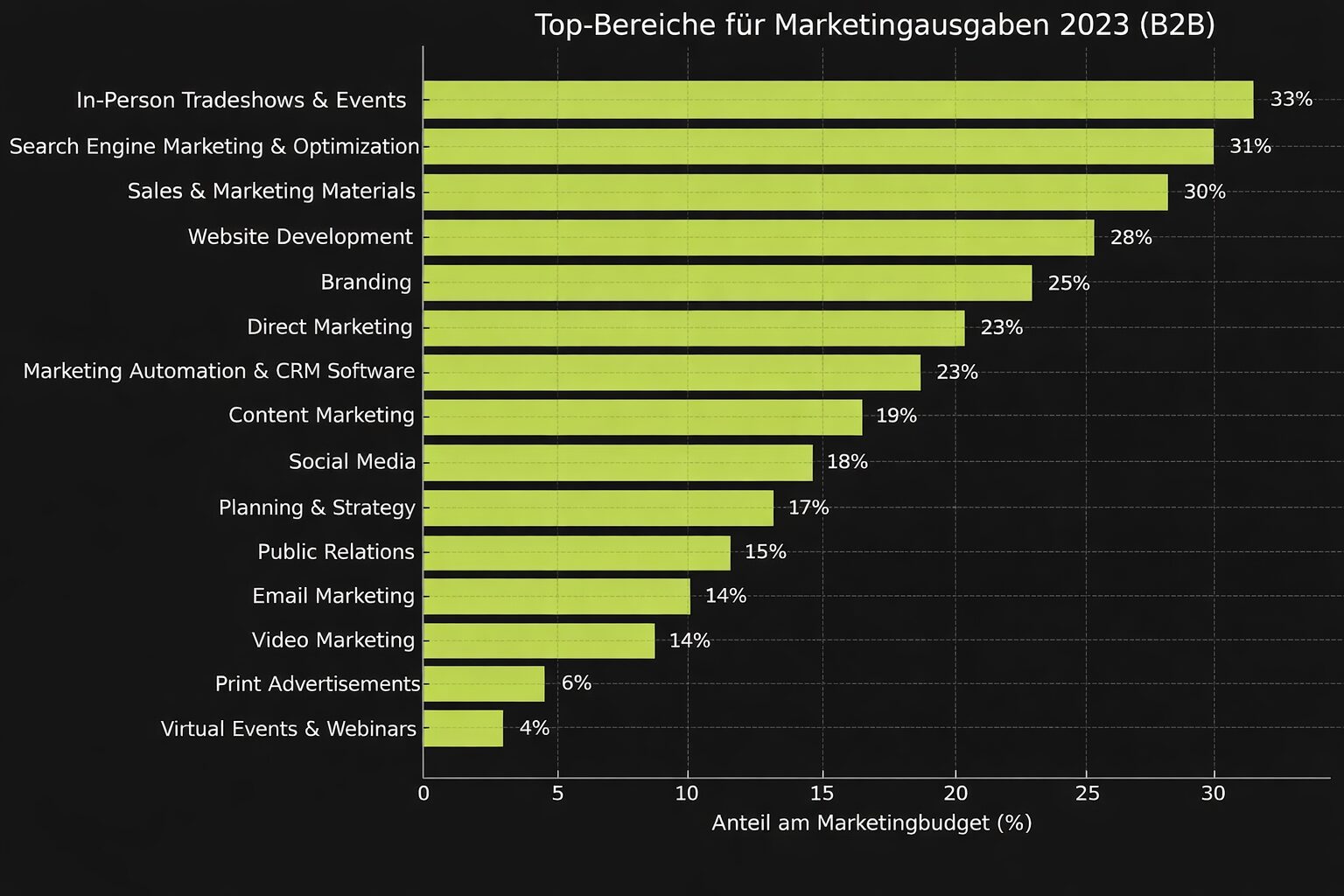
This strong dependence on organic search makes SEO a decisive tool for B2B companies. It not only provides constant, high-quality traffic, it also contributes directly to the five most important marketing goals named in the Sagefrog Marketing Group report. It is no wonder, then, that SEO is regarded as the most important source of leads and sales in the B2B sector.
SEO for local businesses
Local businesses can no longer afford to ignore search engines as an important marketing channel. In our digital world, almost everyone looks online first when searching for something nearby, whether that is:
- A tax adviser
- A doctor
- A tradesperson
- A cosy cafe
Think of a local bakery: if someone searches for “freshly baked bread near me” and your shop appears right at the top with images and information, there is a high probability that this person will actually drop by.
For millennials in particular, a local search is not simply online research. It leads directly to store visits.
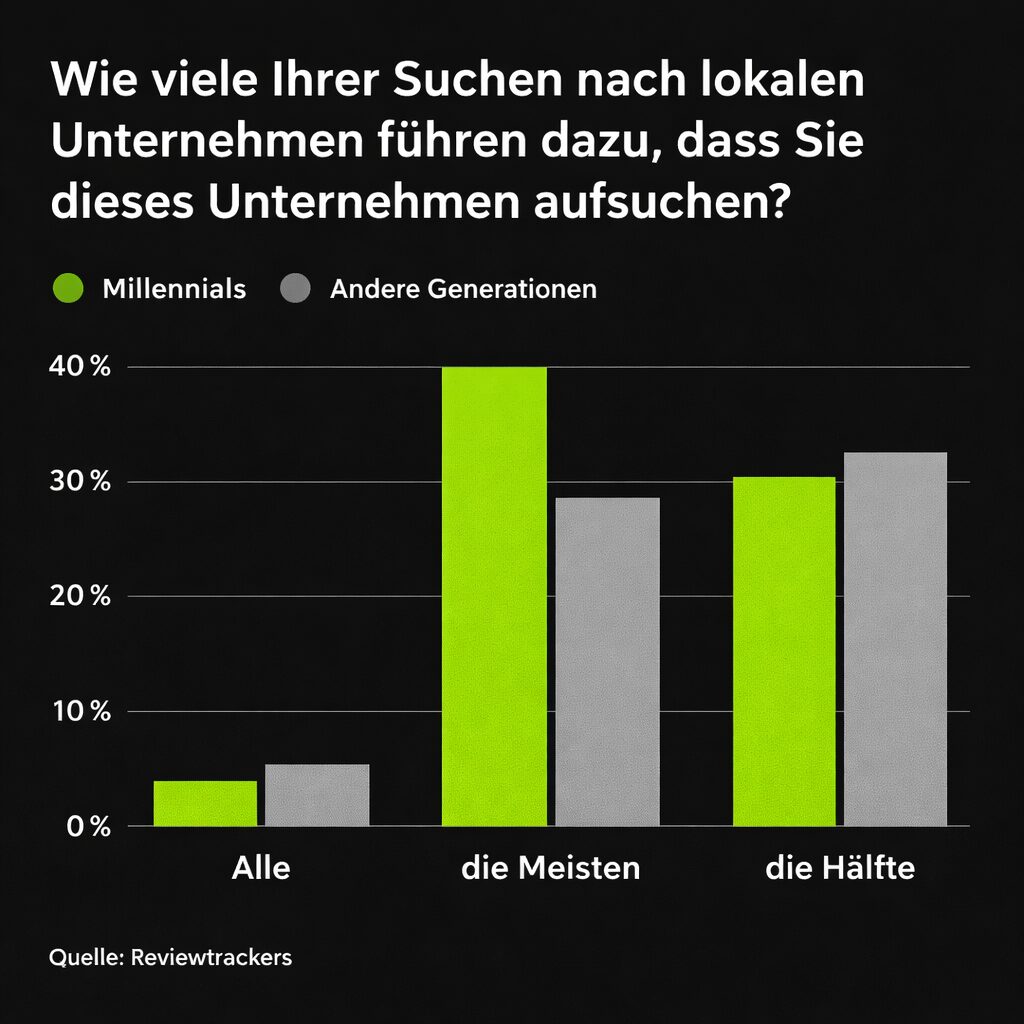
If you also look at the data from Brightlocal, it becomes clear where consumers most often search for local businesses.
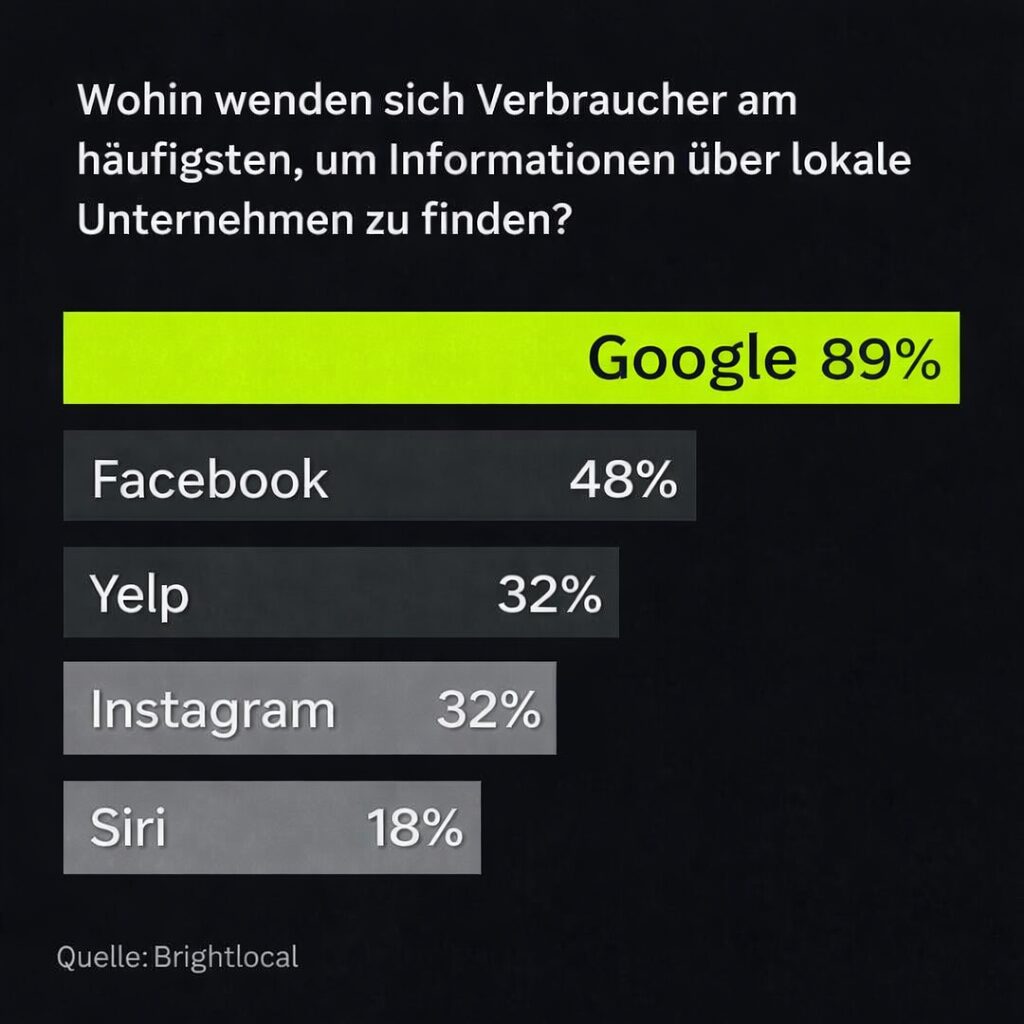
Share of consumers who have used business information pages in the past 12 months:
| Platform | Share of use (%) |
|---|---|
| Google (including Maps and Local Finder) | 89% |
| 48% | |
| Yelp | 32% |
| 32% | |
| Siri | 18% |
| Yahoo! | 18% |
| 17% | |
| Tripadvisor | 17% |
| Apple Maps | 17% |
| Amazon Alexa | 16% |
| Bing | 15% |
| Google Assistant | 15% |
| Mapquest | 12% |
| Better Business Bureau | 11% |
| Waze | 11% |
| Yellow Pages | 7% |
| Angi | 5% |
| Cortana | 4% |
| Foursquare | 3% |
| TomTom | 2% |
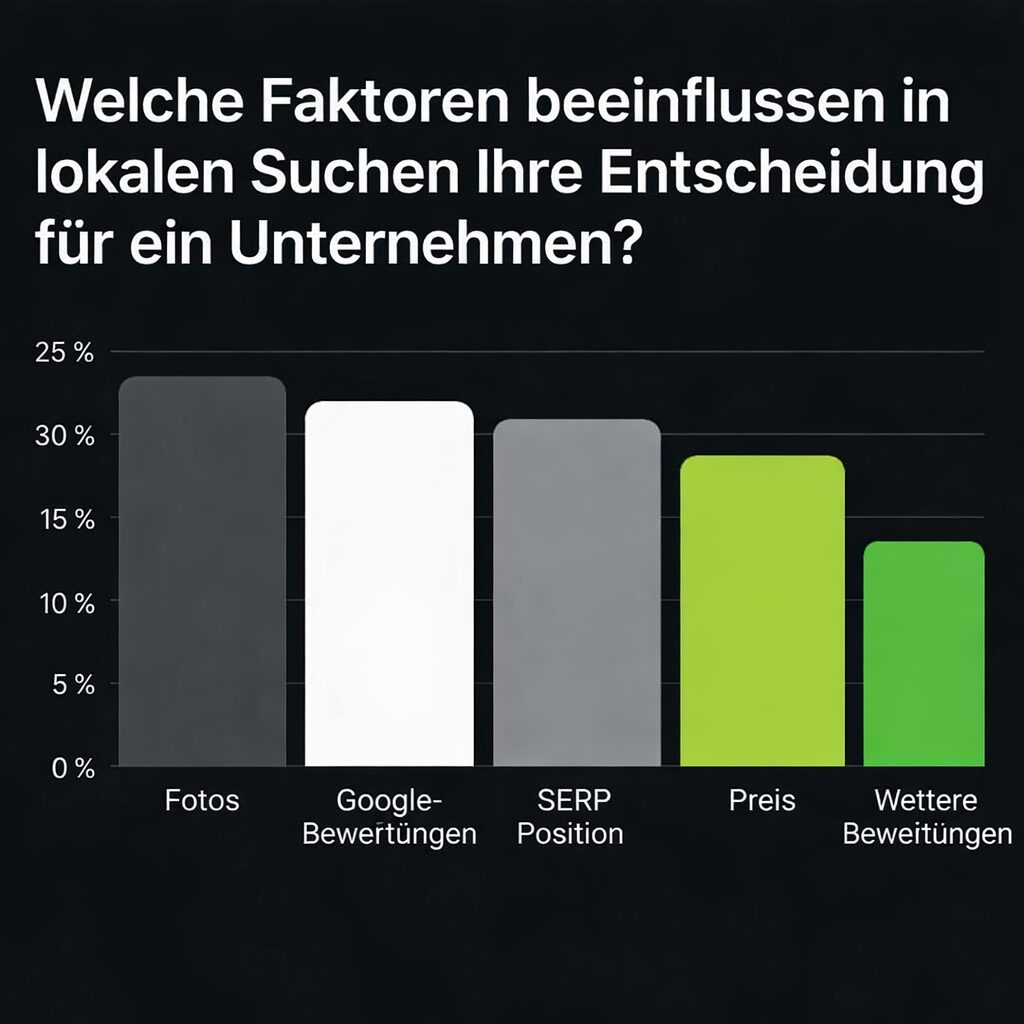
Also very interesting is the Reviewtrackers study again, which shows that photos, Google reviews and the position in the search results (SERP) are the three most important factors influencing consumers’ choice of a business in local searches, ahead of price or other reviews.
What happens if you ignore SEO?
Ignoring SEO means losing valuable visibility, traffic and competitiveness. Without a proactive strategy, companies risk a decline in organic reach and higher long-term costs while competitors conquer the market.
Missed visibility and falling traffic
Ignoring SEO means missing valuable opportunities to be found by potential customers.
Over time, your website’s placements will fall, which leads to a steady decline in organic traffic.
That not only limits your brand’s visibility, it also reduces your chances of converting visitors into customers.
Losing ground to competitors who invest in SEO
If you decide not to invest in SEO, your competitors will seize the opportunity to win market share.
By improving their digital presence and optimising their content, they will attract more traffic and consequently more leads and revenue.
In today’s competitive landscape, falling behind on SEO can be a critical strategic mistake.
Higher long-term costs through reactive strategies
A reactive approach to digital marketing, in which you try to fix problems after traffic has already collapsed, can be far more costly than proactive SEO.
The long-term costs of rebuilding a deteriorated online presence often exceed the initial investment required to implement a robust SEO strategy.
Ready for more revenue?
Book a free SEO and GEO audit

Find out in a free call how much revenue your website is leaving on the table, with no obligation and no agency waffle.