


Everything at a glance
- Local SEO is decisive for winning customers nearby.
- Optimise your Google Business Profile and your website for local signals.
- Use listings, schema markup and reviews as ranking catalysts.
- Local SEO is the most profitable marketing channel for local service providers.
- Monitor, measure and adjust continuously on the basis of data and trends.
Do you want to be the first business locals see when they google “near me”?
Then buckle up, because this is not just another SEO guide. This is your game plan for dominating the digital street corner. Translation? If your business does not show up in local search results, you are handing customers to the competition every single day.
In this ultimate guide I will show you the strategies that get your shop seen, your phone ringing and your reviews shining. Whether you run a cosy cafe or a local medical practice, local SEO is no longer optional, it is a survival strategy.
What is local SEO?
Local SEO (also called “local search engine optimisation”) is the practice of optimising a website so that it ranks prominently in location-based search results. Through targeted local content such as a service plus a location, industry listings and backlinks for a city or region, you reach ready-to-buy customers nearby.
Local versus organic search
- Organic search: the classic ten blue links, without Google Maps being displayed.
- Local search: like a shout from the neighbourhood. For “dermatologist Vienna”, Google also shows the map, not just ten blue links.
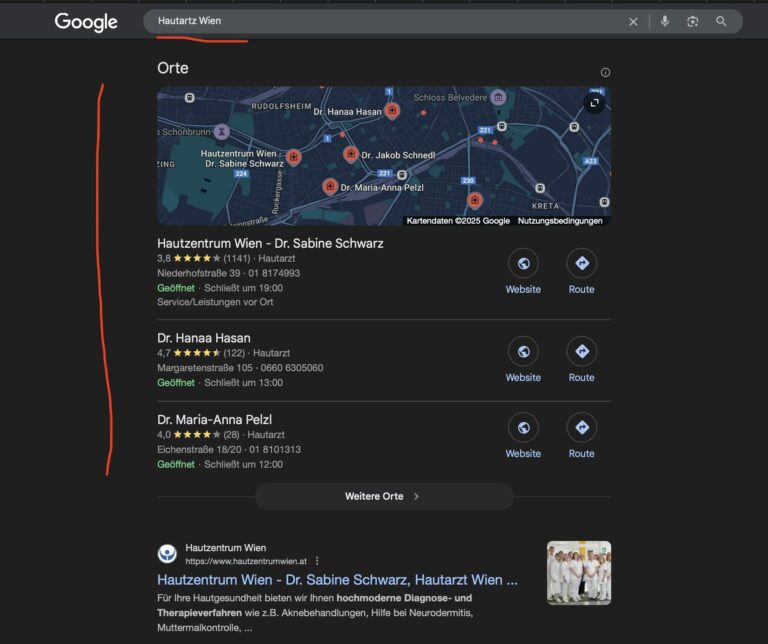
So right at the first result you do not see a blue link, but Google Maps together with the reviews.
Why local SEO matters
More visibility in your area brings walk-in customers, calls and neighbourhood clients, often at a lower cost than broad campaigns. And for local service providers it is indispensable: local SEO is by far the most profitable marketing measure, provided SEO makes sense for the business in the first place. We are happy to check whether SEO is worthwhile for you. Just contact us and we will tell you whether local SEO is the right thing for you.
People nearby are ready to buy, and 46 % of all Google searches have local intent, so almost half of them are looking for something nearby.
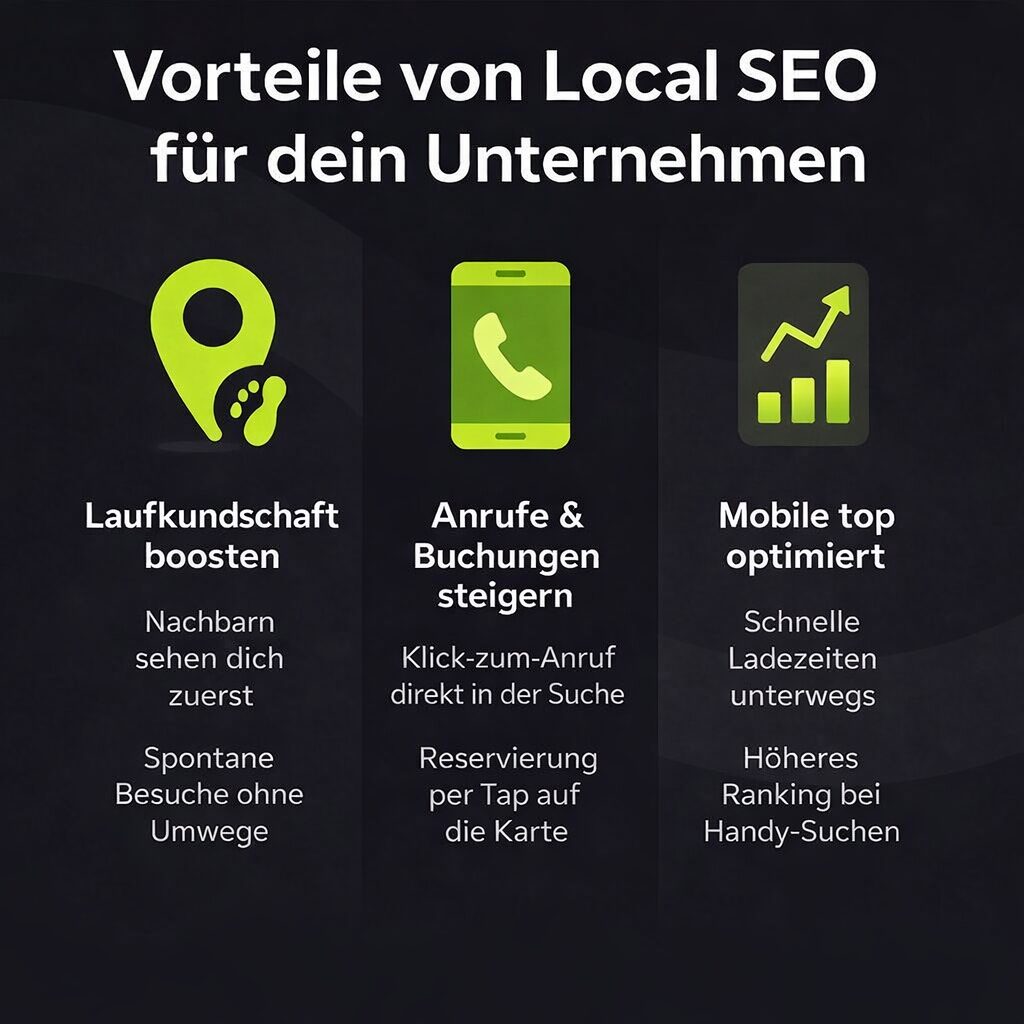
Benefits for businesses
- More walk-in customers: neighbours find you first.
- More calls and bookings: click-to-call and map clicks.
- More revenue: more customers also mean more revenue, without you constantly having to put money into ads.
Important local SEO statistics
- 30 % of all mobile searches are location-based.
- 78 % of local mobile searches lead to an offline purchase.
- 42 % of searchers click on a result in the local pack (the Google 3-pack).
Who can benefit from local SEO
Local SEO helps every business with a fixed location or a service area. Whether you have a small cafe around the corner or run a trade business serving customers on site, when people search for “cafe near me” or “carpenter in Hamburg”, you want to be right at the top.
- Retailers: your bookshop or second-hand store becomes visible for “bookshop near me”.
- Hospitality businesses: your bistro appears when someone searches for “breakfast in the city centre”.
- Tradespeople and service providers: whether roofer, plumber or hairdresser, anyone working in the region gets found automatically.
- Doctors and clinics: patients search for “dentist near me” and land directly on your profile.
Whether you are starting out on your own or have several branches, local SEO makes sure your customers find you before they drift off to the competition.
How local SEO works
Local SEO combines on-site optimisation, trustworthy listings and reputation management in order to rank in local search features.
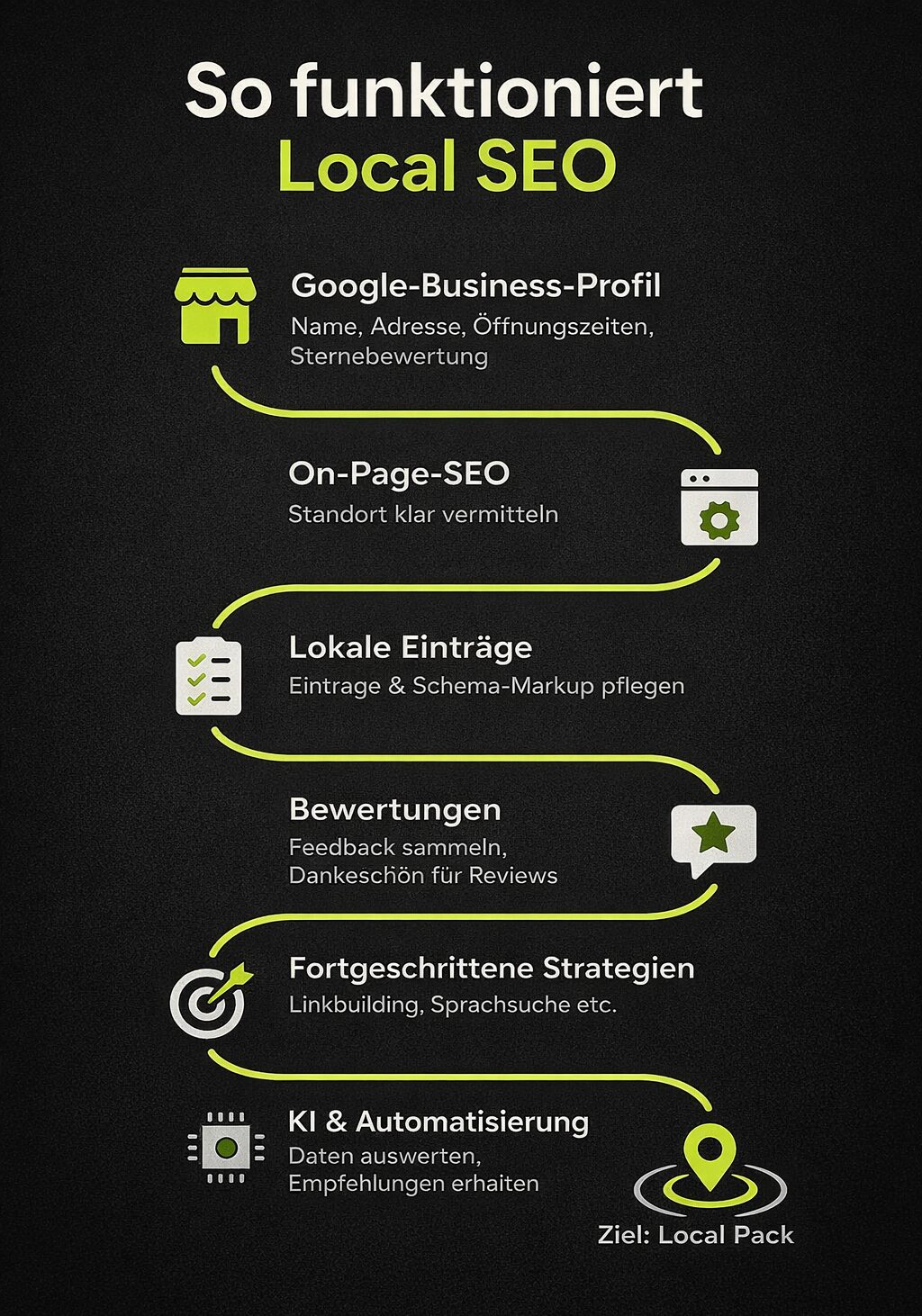
Google Business Profile
Step 1: create and optimise your Google Business Profile listing
Your profile gives Google all the important information, name, address, opening hours, reviews, and ensures that you become visible in the local pack and on Google Maps.
The name of your GBP listing should ideally match your company name and additionally contain the main keyword you want to rank for. Example: Pixxel Solutions, SEO Agency Vienna.
That way you increase your chances of ranking faster and better for your main keyword. (Note: officially Google only permits the exact use of the company name. In practice, however, we have had very good experiences with the keyword extension.)
Important ranking factors:
- Relevance
- Distance
- Prominence (reviews, backlinks)
Best practices:
- Fill in all fields completely
- Post updates, articles or offers regularly
- Add high-quality photos
- Actively ask satisfied customers for reviews
Local SEO strategy
Before you start with on-page measures, you need a well-considered strategy. By “strategy” I do not mean blindly optimising your website, but targeted research: which of the services you offer are actually being searched for on Google, and how often?
Let us assume you are a doctor, a cosmetic surgeon for example. Then you probably offer many different services. The first keyword that comes to mind is presumably “cosmetic surgeon + location”, for instance cosmetic surgeon Vienna. This keyword does have a high search volume, but it is also extremely competitive. Achieving a top ranking here takes a lot of work and often many months.
That is why it is important to additionally create what are known as service pages. Each of these pages focuses on one specific service in combination with the location, such as “lip filler Vienna”.
With this strategy you achieve several advantages at once:
- You become visible not only for your main keyword, but also for more specific search queries.
- You address user search intent far more precisely.
- You improve your chances of appearing several times in the local search results.
- Google often rates such focused pages as particularly relevant.
When someone searches Google for “lip filler Vienna”, almost exclusively pages that deal with exactly this topic are displayed. General cosmetic surgery pages have hardly any chance there.
That is precisely why it is worth creating several specialised pages, each covering one specific service and one location. That way you achieve more visibility with less effort.
Here you can see an example of a local keyword with a high search volume, but also high competition. This is a classic case of high keyword difficulty:
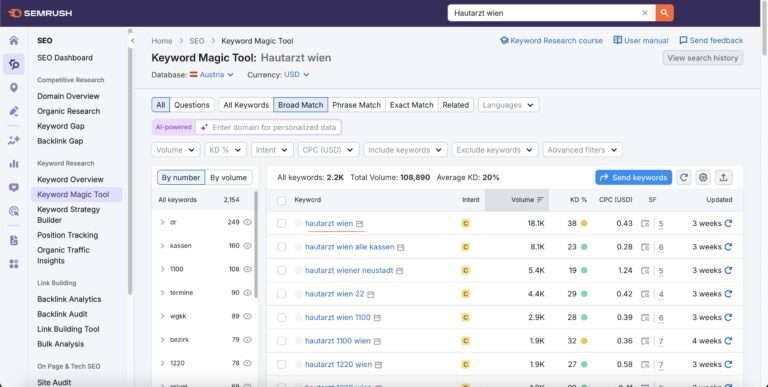
By comparison, the keyword “lip filler Vienna” is considerably easier to reach. It has a monthly search volume of around 1,300 queries, so it is by no means irrelevant, but it does offer you a realistic chance of top rankings.
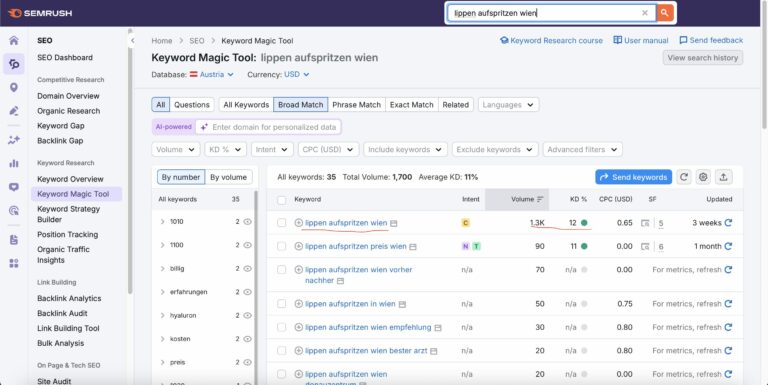
What you should take away from this:
- Main keywords bring a lot of traffic, but they are hard to conquer.
- Service keywords are considerably easier and often deliver faster results.
- By combining both strategies you get the maximum out of your local SEO.
On-page SEO for local search
At its core, on-page SEO is about telling Google unambiguously which search queries you want to be found for. You can think of it as the steering wheel of your entire SEO strategy, because it sets the direction.
On-page SEO means designing your content so that it is clear, understandable and convincing both for search engines and for your visitors. This includes, among other things:
- Headings and structure: use H1, H2 and H3 tags correctly in order to organise your content logically and clearly.
- Keyword integration: integrate relevant keywords strategically, embedded naturally rather than overloaded.
- Content quality: create high-quality, relevant content that answers the actual questions and needs of your target audience.
In local SEO it is additionally decisive that you communicate your location clearly and consistently. That way Google knows exactly where you can be found, and displays you in local search results.
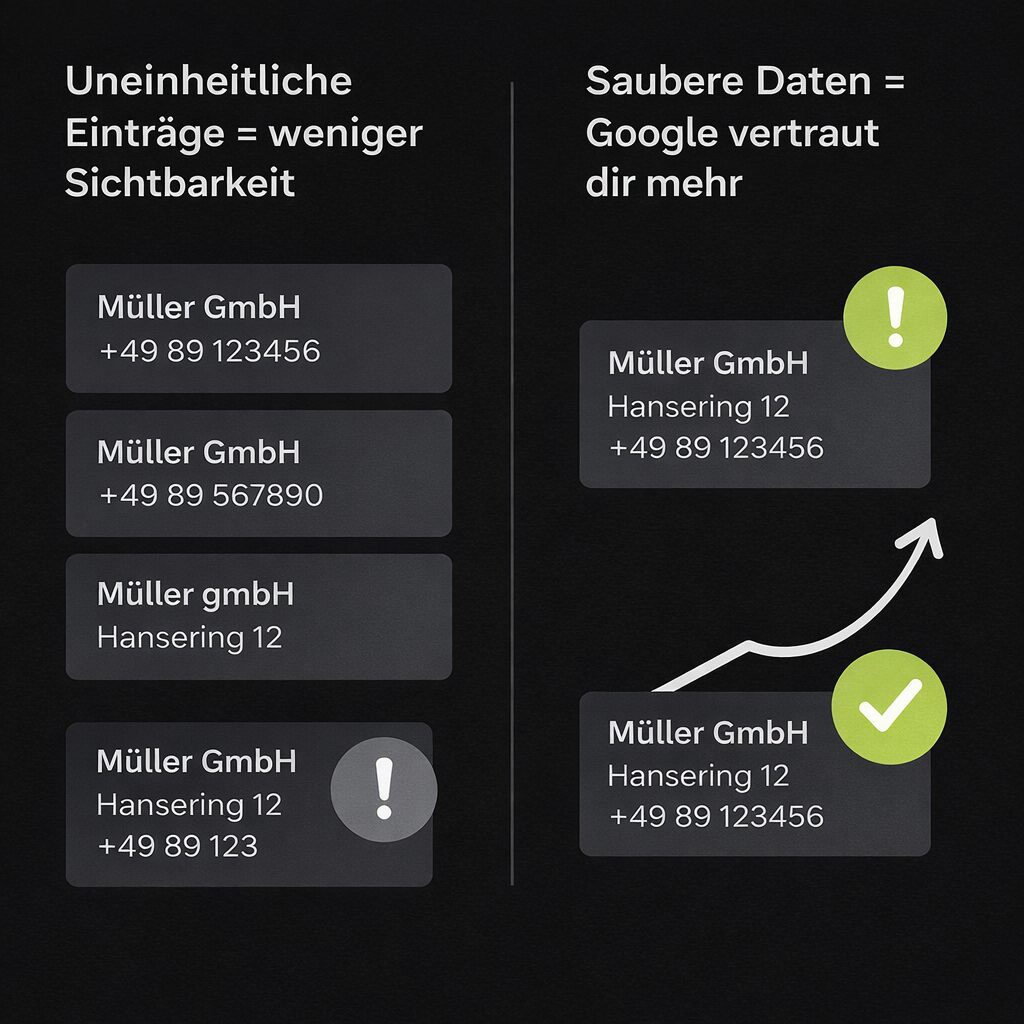
- NAP consistency: name, address and phone number should be identical across all platforms, without abbreviations, typos or variants.
- Title and meta description: integrate your city or your district into the title tag and the meta description in order to be more visible in local searches.
- Localised content and keywords: create dedicated pages about your region or city, for example “best tacos in Eichenwald”, in order to be found locally.
- Page speed and mobile friendliness: a fast, mobile-optimised website means a better user experience, and a better ranking.
Business directories and structured data
- Maintain listings: keep name, address and phone number exactly the same on Yelp, local business directories and other platforms.
- Use schema markup: add the LocalBusiness schema to your website so that Google better understands important information such as location, opening hours and contact details.
Ratings and reviews
For your Google Business Profile (GBP) the rule is: reviews are worth their weight in gold. But be careful, satisfied customers rarely leave a review on their own. People who are dissatisfied are more likely to write one. That is why you should actively ask for feedback.
- Collect customer feedback: use friendly follow-up emails or tools that automatically remind your customers to leave a review.
- Respond professionally: thank people for positive reviews, and respond to criticism in a friendly, solution-oriented way.
Advanced local SEO strategies
Once you have implemented all of this, the more advanced SEO strategies come next. The fact is: even with perfect on-page SEO, in most niches you will never rank first without off-page SEO. That is where link building comes in.
Local link building
Backlinks are essentially recommendations from trustworthy local sources, for instance from blogs, community pages or event platforms. They strengthen your credibility and help your ranking, both in the organic search results and on Google Maps.
Typical sources for local backlinks are, for example:
- Local blogs: recommendations on regional lifestyle, health or industry blogs.
- Community websites: mentions on city pages, event calendars or neighbourhood portals.
- Associations and networks: backlinks through memberships, sponsorships or local partnerships.
But how do you actually get hold of such backlinks? The best approach: use tools such as SEMrush or Ahrefs to look at which backlinks your competitors already have. You can approach many of these websites directly, with the proposal of writing a guest post for them.
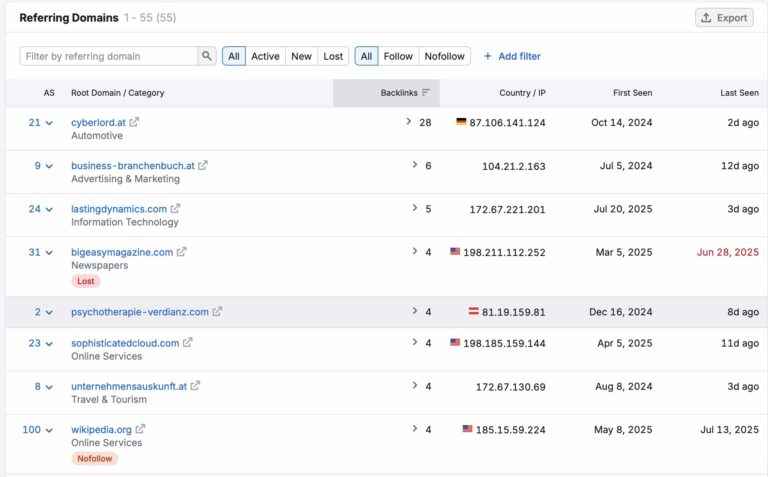
- Use a tool: analyse competitor links with SEMrush or Ahrefs.
- Identify websites: select relevant, thematically fitting or regional sites.
- Make contact: write to the site owners and offer a guest post.
But be warned: this process is without question the most laborious and at the same time the most difficult part of SEO. And to be completely transparent: most site owners charge money for a backlink.
Important points before you invest:
- Typical prices: depending on the site and its reach, between 250 € and 4,000 € per link.
- Check relevance: does the link fit your offering thematically and locally?
- Consider the ROI: is the backlink worthwhile economically as well, or only from an SEO perspective?
Indispensable tools for local SEO
With the right platforms, listing management, performance tracking and review monitoring become much easier.
For example: Moz Local for synchronising, SEMrush for ranking monitoring and ReviewTrackers for feedback. The right combination of tools speeds up your audit and strengthens your local presence.
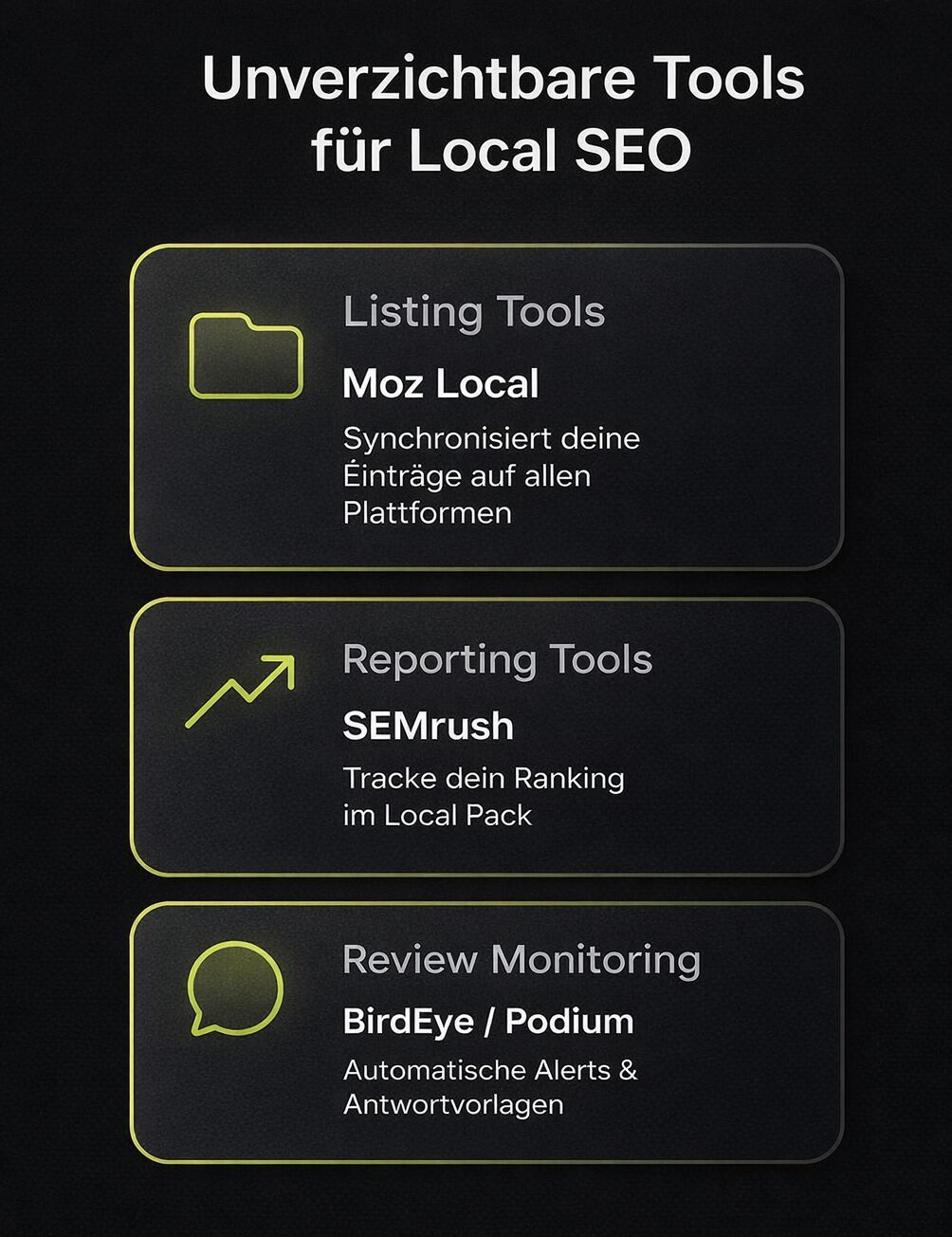
SE ranking and reporting tools
SEMrush Listing Management lets you manage your Google Business Profile and directory listings centrally.
Automatic updates warn you about inconsistent data and show your ranking in the local pack, so that you always know where you stand.
Conclusion: local SEO as a game changer
Local SEO is not a “nice to have”, it is a must for every local business.
Whether restaurant, medical practice, trade business or retail, anyone who wants to be found nearby has to be present on Google Maps and in the local pack.
With the right measures you achieve:
- More visibility among people who want to buy or call right now.
- More trust through reviews, photos and local mentions.
- Sustainable growth, without making yourself permanently dependent on ads.
If you are wondering whether local SEO makes sense for your business: just get in touch with us.
We will check your current visibility and show you which measures give you the greatest leverage.
Next steps
- Request a free analysis: have someone check how visible your business currently is.
- Optimise your Google Business Profile: unlock immediate ranking power.
- Start a local content strategy: reach customers in a targeted way with service pages and local content.
Bottom line: local SEO is not rocket science, but it is consistent work.
If you start today, you will have considerably more enquiries, calls and customers within a few months.
Ready for more revenue?
Book a free SEO and GEO audit

Find out in a free call how much revenue your website is leaving on the table, with no obligation and no agency waffle.