


Everything at a glance
- SEO is a long-term growth machine that usually needs 3 to 6 months. Heavily contested international niches take longer. The size of the budget plays a part here, and more really does help.
- Organic Google search brings the largest volume of highly qualified visitors, entirely without ongoing advertising costs.
- Your starting point, your budget and your resources, together with the competitive environment, determine how quickly you see progress.
- New sites need a marathon-like groundwork phase, while established sites can see results within just a few months.
- If you prioritise technical errors, targeted content and strategic link building, you speed up your SEO timeline.
“How long does SEO take?”
It is the question every marketer asks, and dreads. Not because there is no answer, but because the true answer is: it depends. But here is the thing: done right, SEO is not just a test of patience. SEO is a growth machine that works exponentially over time and outperforms every paid advert and every social post in your budget.
According to BrightEdge, 53 % of all website traffic comes from organic search. That is not a marketing tactic, that is a movement.
In this guide we clear away the noise and give you the truth about SEO timeframes. Whether you are launching a brand new website or scaling an established one, here you will learn exactly how to estimate the approximate duration better, which factors play a part, and how to recognise when it is simply taking too long.
So how long does SEO really take?
Before I just give you some number, let me briefly explain in a few sentences what SEO actually is.
If you want to dive deeper, feel free to look at my detailed article on the subject: What is SEO?
In short: when SEO is done properly, it brings you right to the top of the Google search results without any advertising.
This includes:
- SEO strategies
- Keyword analyses
- Content creation
- Landing page design (UX/UI)
- Building backlinks (digital PR)
- Continuous support
SEO depends heavily on your competition. That means you have to be better than your competitors in order to reach position 1. If your competition is very strong, it takes longer. If it is weak, it goes faster.
Picture the whole thing like a forest: you are a young tree and you want to reach sunlight. But all around you there are already large, strong trees, your competition. To rise above them you have to grow faster and have a little patience. But once you have made it to the top, you get more sun than everyone else. And with every ray of sun you grow stronger still, so success then becomes easier.
On top of that, the Google algorithm works quite differently from TikTok’s, for example. Another important factor is the age of your domain. The older and more established your website already is, the faster you can climb in search.
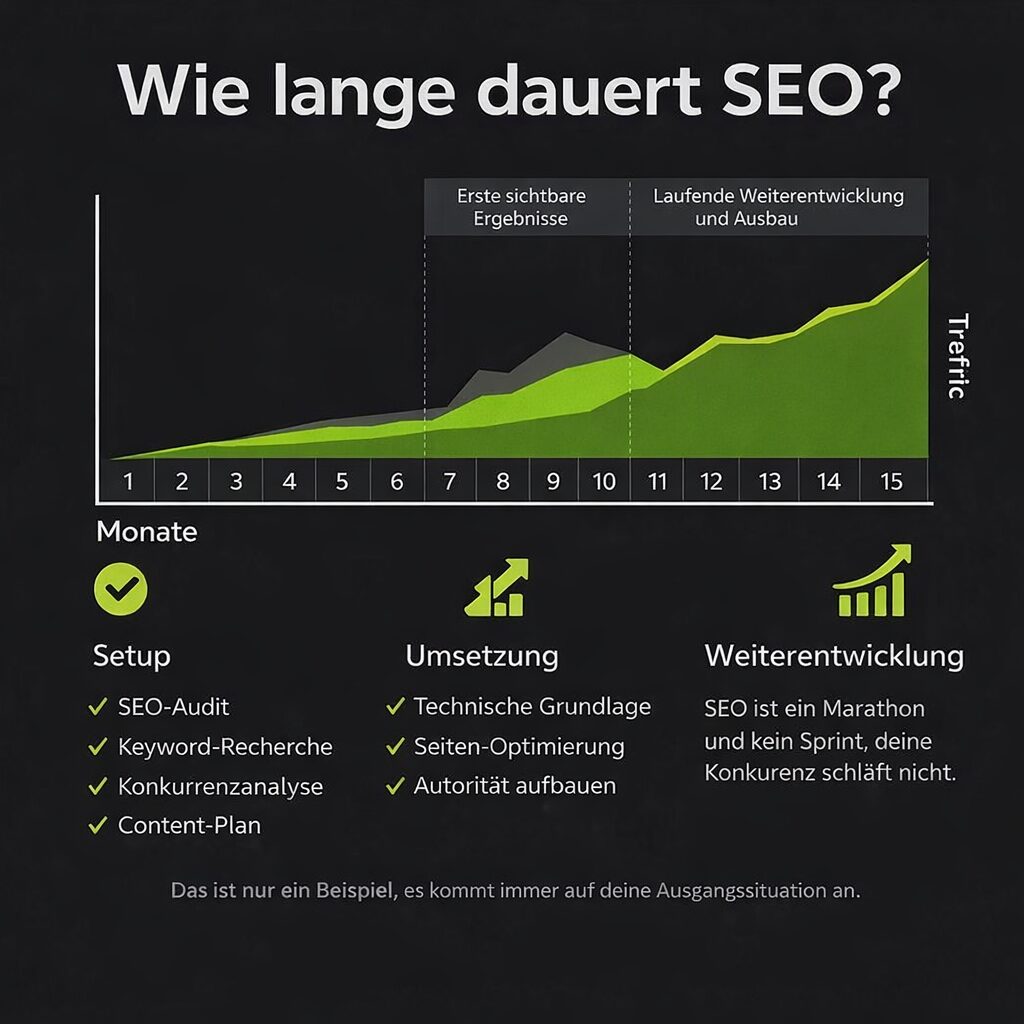
By now it is probably becoming clear why SEO takes time, simply because there is so much behind it.
You start with a well-considered strategy, carry out detailed keyword research, write content and integrate it cleanly into the website. That costs time, yes, even with ChatGPT.
And no, you cannot simply publish 100 pages at once, especially not at mediocre quality. That would be spam and can harm you more than help you with Google.
So SEO is not a quick fix, it is a long-term investment.
Expert tip
If you notice that you are ranking on Google faster than expected and are already perceived as an authority, then this is not the time to cut the budget.
Now is the moment to really step on the gas and dominate the search engine market.
Because position 1 on Google receives on average almost 20 % of the entire search volume as clicks. The more keywords you get to #1, the greater your traffic, and your growth.
Why does every company still need SEO?
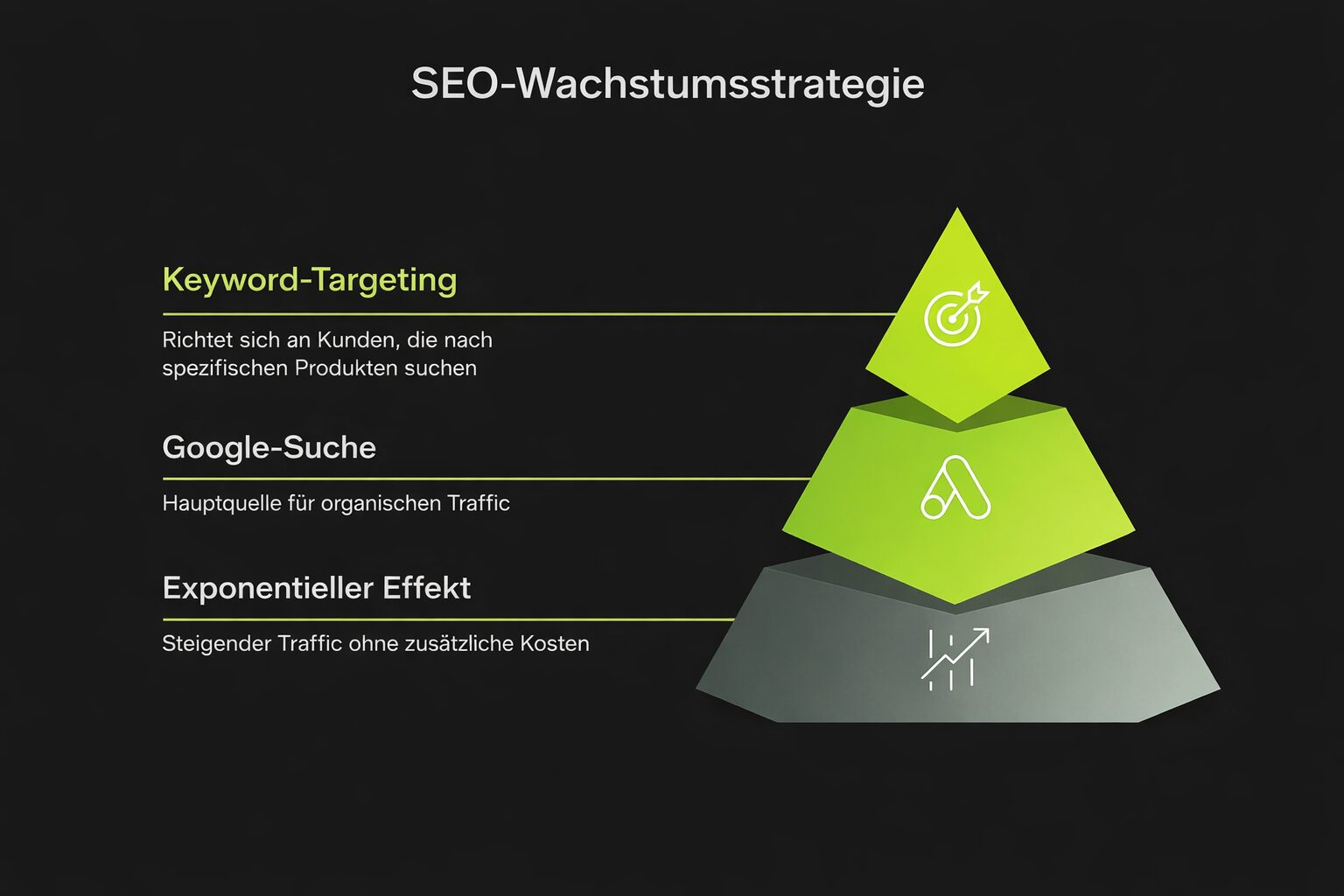
SEO delivers cumulative returns that no other channel can match, which makes it indispensable for long-term growth. By addressing the people who are already searching for your products or services, you win highly qualified traffic at costs that fall over time.
Why SEO? 8 reasons why your business should not do without it
The power of the exponential effect
When you invest in SEO, you have the same SEO costs every month. Over time, however, more and more people find your site entirely by themselves, without you spending additional budget.
Because more and more visitors come of their own accord, every click becomes cheaper and cheaper for you, even though you are not increasing your spending.
When these visitors become customers (“conversion”), the average cost per conversion falls further, because you achieve more conversions with the same budget.
Google search: your number 1 traffic source
Organic Google search means that people type terms or questions into Google and click through to your site without any advertising costs. It delivers more visitors than any other marketing method.
No other channel (such as social media or paid adverts) can keep up with the traffic that search engines bring you.
So if you want constant, high-volume traffic, there is above all one thing you need: to be easy to find on Google.
Worried that Google will soon no longer matter and that you will only appear in ChatGPT and the like? Good news: if you want to be visible in LLMs such as ChatGPT, 80 % of what you need is exactly the same as for classic SEO.
LLMs are “fed” with content, after all, and what they like is no mystery: good structure, relevant keywords, clean metadata, clear answers, understandable language. In other words, everything that has made good SEO for years.
Address exactly the customers who are looking for you
By optimising for the keywords your customers really use, you aim your marketing directly at people who know exactly what they want.
The best part: search engine visitors often know precisely what they are looking for. With the right search terms you lead these purchase-ready visitors straight to your site.
In short: the right keyword targeting is the most powerful lever for turning visitors into buyers.
Which factors influence how long SEO takes?
By now you know that your SEO timeline depends on three core variables: where you currently stand, which resources you can deploy and how strong your competition is. If you adapt realistic goals to these factors, you set the pace for your results.
Where does your website stand?
Consider where your site currently stands. Have you only just started with the basics, meaning usability, loading speed and user experience?
Or do you already have high authority, frequent brand searches, above-average user engagement and great content around the keywords that matter for your business?
Do not worry, we can check that.
First we check your technical setup, then we look at the pages you have created for your main keywords, and finally we compare your backlink profile with that of your competition.
Which resources do you have available?
Think about your budget and how much you want to invest in order to beat the competition. If you only spend 500 EUR on rudimentary SEO at a generic agency, you will never catch up, and you would then be better advised to put the money to use elsewhere.
But if you really want to win, get properly stuck in: find a top SEO agency and start with a realistic budget.
What does SEO really cost? All the facts and pricing models
Who are you up against?
Who you are up against. Do your competitors have a lot of power? Do they publish great content? Do they win new links from other websites every month?
In SEO, your success depends on how you perform in comparison. In a small local market with few competitors you can see results almost immediately. If you are chasing national rankings for heavily contested keywords, however, it can easily take a year or longer to really keep up.
There is no blanket answer, because every industry and every website is different. As a rule of thumb you should reckon with at least three to six months before you see initial effects.
When does SEO pay off?
You will usually see the first genuine SEO improvements in around three to six months, but sometimes it takes longer, up to a year or more for very contested terms. An exact timeframe is hard to give, because many factors can speed you up or slow you down.
- Competition: it is constantly moving. While you get better, so do your competitors.
- Google’s algorithm: it is a black box. You never see exactly how it evaluates changes.
- Rollout pace: it counts. The faster you publish updates, the sooner Google notices them.
- Topic focus: it pays off. Niche sites often rank faster for specific keywords.
- Earlier penalties: they hold you back. You only recover slowly from penalties and lose time.
For a new website
For a brand new site, SEO is a marathon, not a sprint. In the first year you concentrate on building a solid base: make sure everything runs smoothly, create pages around the terms your customers search for, and win links from other sites step by step.
Because you are starting from zero, you first achieve top placements only for the easy keywords. Everything else takes time, trust and continuous work.
For an established website
If your site already has a reputation, a good structure and high-quality backlinks, SEO feels more like a sprint.
You will often see new pages beginning to rank and bring traffic after just a month, and most gains are clearly visible within six months, provided you continuously refine your content and your optimisations.
Quick SEO wins? Here is what you can expect
Quick SEO wins are possible if your site already has power and you know exactly which levers to pull. For example:
- If you have already built strong domain authority and put all your energy into content that matches the search queries exactly, you see ranking boosts almost immediately.
- If you are regarded as the go-to resource in your niche, even small on-page adjustments or technical fixes can bear fruit quickly, because your reputation helps Google notice your updates.
- In a tiny niche with no real SEO competition, a few weeks of simple link building, content tweaks and page optimisations are enough to end up right at the top.
- And if you focus on a local region, local SEO basics such as directory listings, Google My Business optimisation and location-specific landing pages often lead to fast traffic gains.
How to speed up SEO for yourself
There are two things you have to concentrate on:
- First you identify the biggest opportunities in your project, for example optimising slow pages, adding targeted keywords or writing blog articles that answer real customer questions.
- Then you create a clear strategy that sets out what has to be done by when and by whom, whether that is technical fixes on Monday, new content on Wednesday or guest article enquiries on Friday.
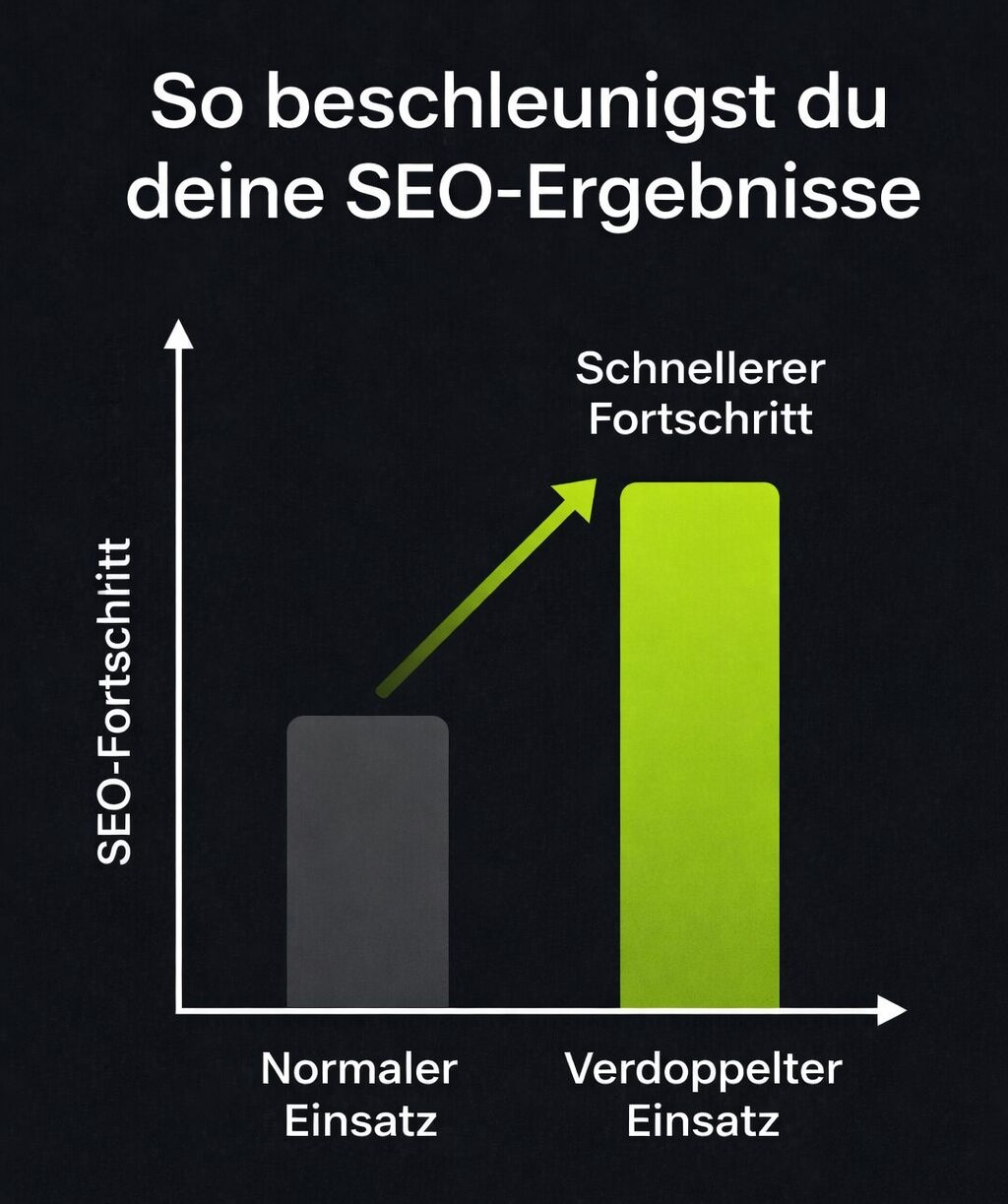
With this plan in place, there is only one way to pick up speed: invest more focused time and effort in your SEO work. If you double your weekly hours for performance, content updates and link building, for instance, that accelerates your progress considerably.
Beware of “quick win” tactics such as buying cheap link packages or dubious methods. They often end in penalties that cost you more time later on.
There is no magic trick and no cheap shortcut that replaces real, consistent effort. If you put resources into a smart SEO strategy, you will see faster improvements in traffic, rankings and revenue. Consistency pays off.
SEO duration illustrated by 2 case studies
Knowing the theory about SEO timeframes helps. But real results make it tangible. Here are 2 case studies of ours that show how long it normally takes and which steps make the difference:
Example 1: a dermatologist
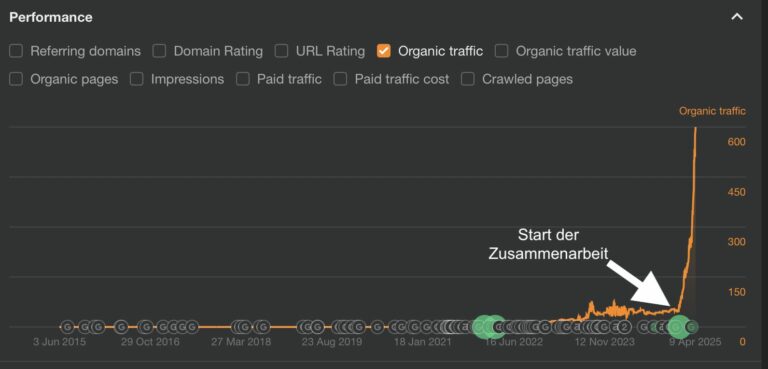
With this client everything went fairly quickly. We were able to achieve visible results as early as the first few months. The reason for that lay partly in the domain authority that already existed, and partly in the fact that the competition in this area was manageable.
We implemented a comprehensive UX/UI redesign and created specific service pages in a targeted way right from the start. The result speaks for itself, I would say.
👉 You can find the complete case study here: Dermatologist SEO case study
Example 2: an orthopaedist
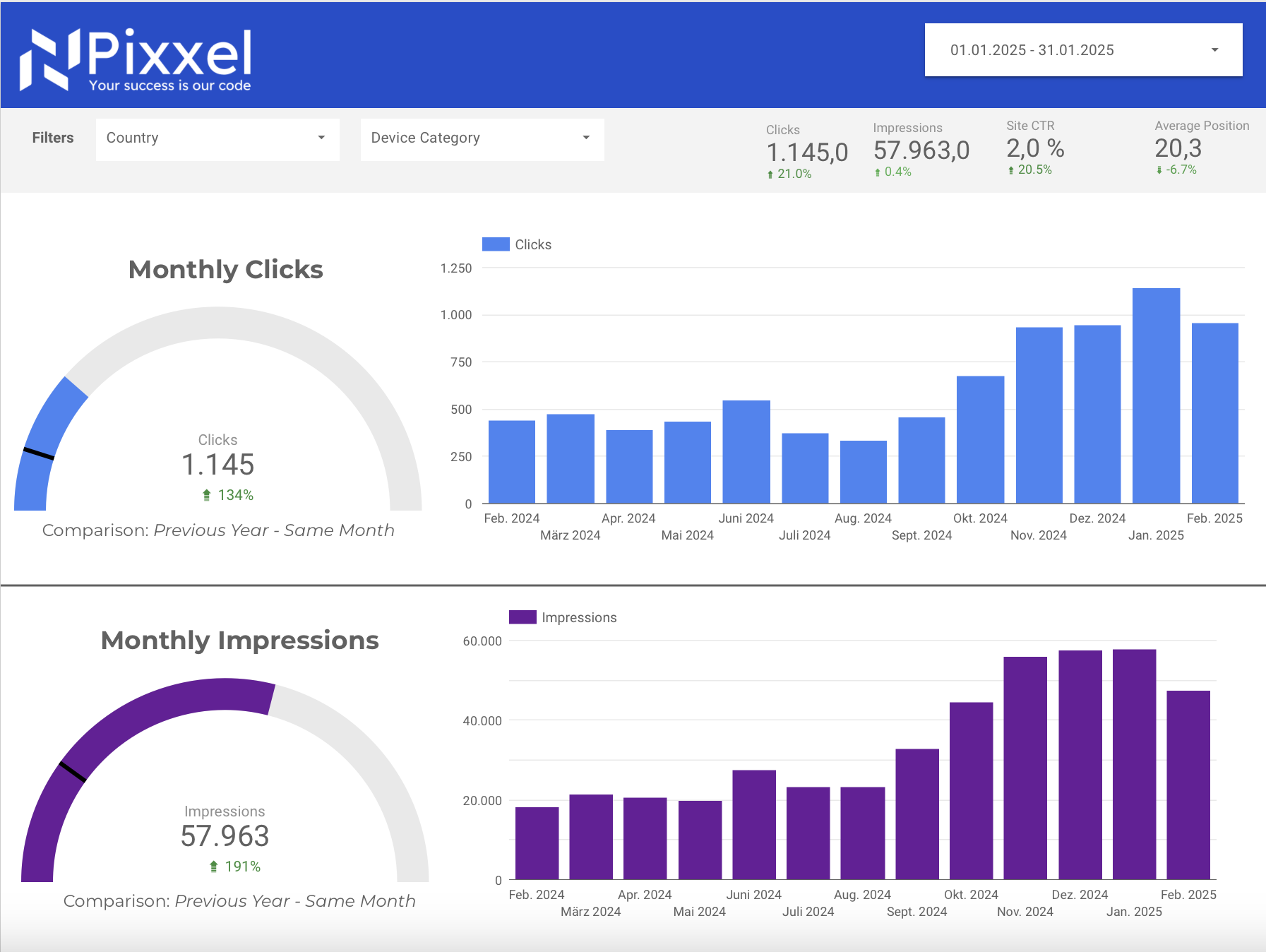
Here it took a certain amount of time before we really saw significantly more clicks: specifically only after around 3 to 4 months (we started in June). The reason: the content was strongly geared towards the entire DACH region, because the local search volume for this type of treatment is comparatively low, quite unlike a dermatologist with high local demand. As a result the competition was considerably stronger. Incidentally, this shows up very well in our individual monthly reports, which every one of our clients receives.
And in case you are wondering why February was weaker than March: SEO always depends on search volume as well, and that can fluctuate seasonally. If you are a ski brand, for example, you will naturally have considerably less traffic in summer than in winter.
Not to be forgotten: February simply has fewer days than March, and that affects the figures too. 😉
👉 You can find the complete case study here: Orthopaedist SEO case study
Ready for more revenue?
Book a free SEO and GEO audit

Find out in a free call how much revenue your website is leaving on the table, with no obligation and no agency waffle.