

Everything at a glance
- Search is not going away: it is spreading across text, voice and AI interfaces.
- Human expertise remains king: AI can help scale tasks, but authority and trust decide who succeeds.
- The data proves SEO’s lasting value: organic search still accounts for around a third of all web traffic.
- Adaptability is your advantage: use AI tools, but keep the user at the centre of your strategy.
- SEO is anything but dead: it is evolving. Those who innovate and integrate will be at the front.
Every time you blink, Google processes around 9.5 million search queries, and more than 13 per cent of them now show AI-generated “overviews” instead of the classic blue links Semrush. Headlines claim that chatbots are making websites redundant and that the SEO playbook belongs in the bin.
The argument goes: if everyone uses generative AI for answers, why optimise pages for search at all? But this narrative overlooks a simple truth: search engines and AI assistants still rely on carefully produced, well-founded content in order to deliver precise results.
In this guide you will learn why SEO remains indispensable in 2025, how to structure your content so that language models extract and present your best insights, and why genuine expertise, the E-E-A-T factor, will always beat generic AI blends. If you combine proven optimisation tactics with new AI-friendly methods, you will see why the “SEO is dead” myth simply does not hold, and how to make sure your pages keep ranking at the top.
Google’s unprecedented market dominance
Have you ever wondered whether Bing, with OpenAI’s help, could ever topple Google from its throne? Small spoiler: that is about as likely as a paper boat surviving a hurricane.
Google’s secret weapon is not just clever AI, but a huge treasure trove of user behaviour data that has been building up for more than twenty years.
Every click, every scroll, every “did you mean…” moment has quietly honed Google’s algorithm to razor sharpness and makes it as good as impossible for newcomers to keep up.
Core competitive advantages that keep Google at the top
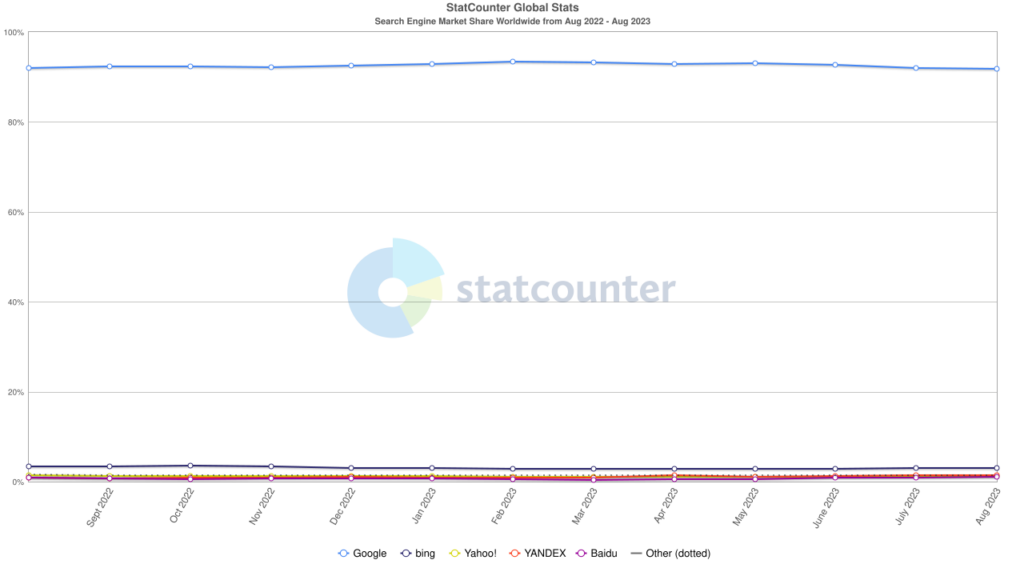
Google’s biggest advantage is not a single fancy feature, but the enormous reservoir of user data accumulated over more than twenty years. Every time someone searches, clicks or navigates, Google learns a little more about what works and what does not.
This data drives a continuous cycle: more users generate deeper insights, which improve the accuracy of the results, which in turn attracts even more users.
Competitors can license the same AI technology, but without this deep pool of historical behavioural data they will always lag behind.
Beyond sheer data volume, Google builds on:
- Trust and habit:
People “google” instinctively because they rely on consistent, relevant results. Breaking that habit is an enormous challenge for anyone else. - Service integration: from Gmail to Maps to YouTube, Google’s product suite feeds additional signals into search and thereby helps it understand user intent in entirely new ways.
Together, these factors create a protective boundary around Google’s search dominance. Without an equally extensive and interconnected data base, no challenger can catch up.
What the current data shows
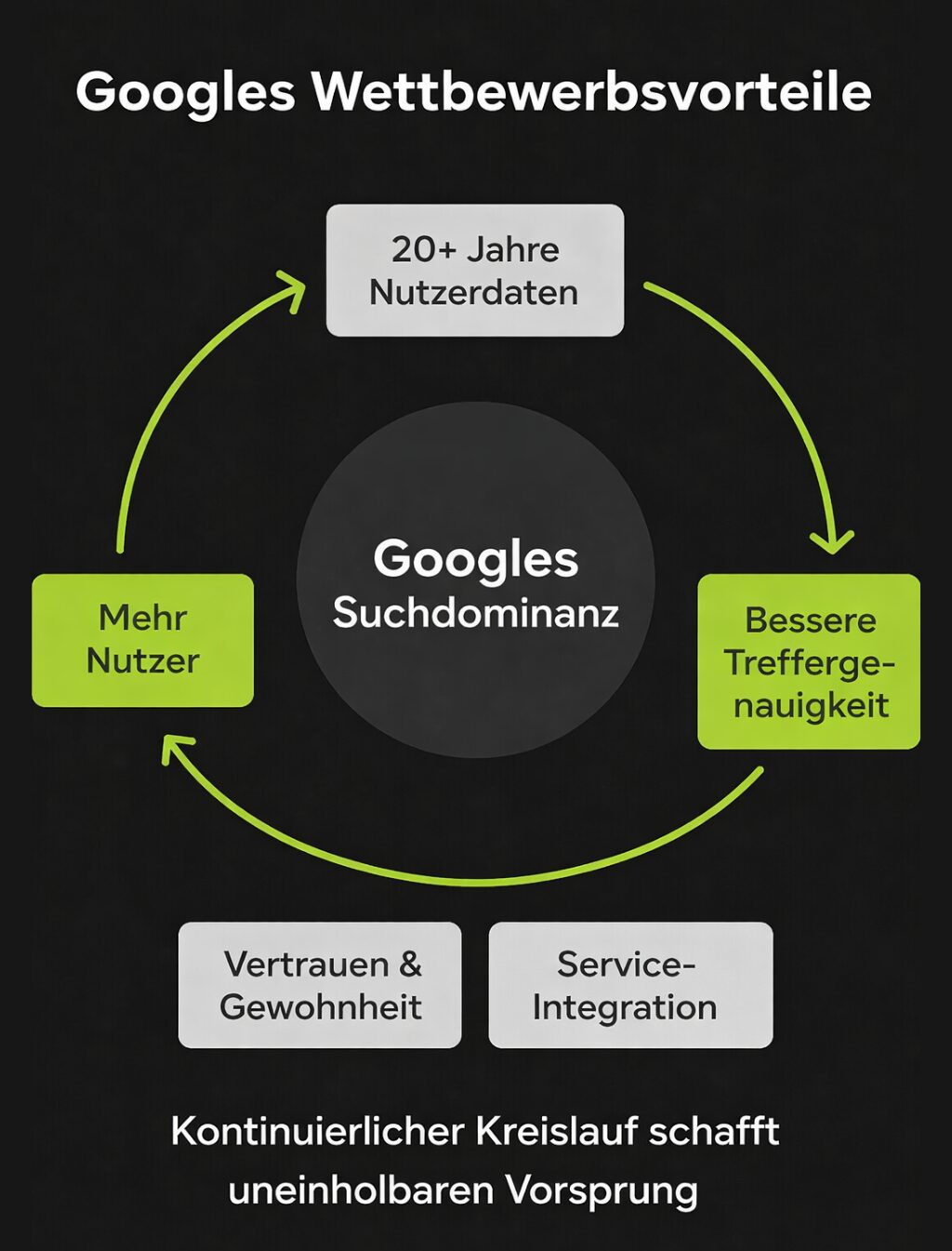
- 142.4 billion visits: to Google.com in August 2023 versus 3.17 billion for Bing. Google’s traffic was 45 times as high. Semrush
- Bing’s market share fell: from 3.34 % in August 2022 to 3.03 % in August 2023, even after the collaboration with GPT-4. StatCounter
- Search volume: Google processes over 99,000 queries per second, which adds up to almost 2 trillion search queries per year.
The conclusion? Google’s lead is no accident, it is a legend written in petabytes of data. And until someone digs up a similarly extensive store of search history, this moat remains impossible to cross.
AI and search: a complement, not a replacement
Many people ask: “Will generative AI make traditional search engines redundant?” The short answer is no, because they were designed for different tasks.
What exactly is a search engine? At its core, a search engine is a tool that crawls the web, catalogues pages in an index and retrieves the most relevant results when you type in a query.
Think of it as a huge library catalogue: you enter a keyword and it shows you the books (web pages) that match it.
And what is a large language model (LLM)? Generative AI tools such as ChatGPT are LLMs trained on enormous amounts of text. They do not maintain a live index of the current web.
Instead they learn patterns in language in order to produce or summarise text that sounds as if it were written by a human.
In short:
- • Search engines find and evaluate existing content.
- • LLMs generate or phrase content on the basis of learned patterns.
Because search engines maintain a real-time map of the web, they are unbeatable at finding the most current, most authoritative sources. LLMs, on the other hand, shine when you need quick explanations or want to brainstorm ideas in natural language.
Instead of seeing them as competitors, think of them as teammates: you run a search to gather facts, then feed those insights into the AI as a prompt in order to produce a polished article or social media post.
By combining the strengths of both, precise research through search engines and fluent text generation through AI, you get faster research and better copy without sacrificing accuracy.
Different technologies for different purposes
Search engines and LLMs play in different leagues because they are built for different tasks.
If you have a quick factual question such as “what is the capital of Brazil?”, a search engine is unbeatable. It searches its current index and gives you the official answer in seconds.
If you want to buy a new laptop, it shows you product pages, reviews and price comparisons side by side.
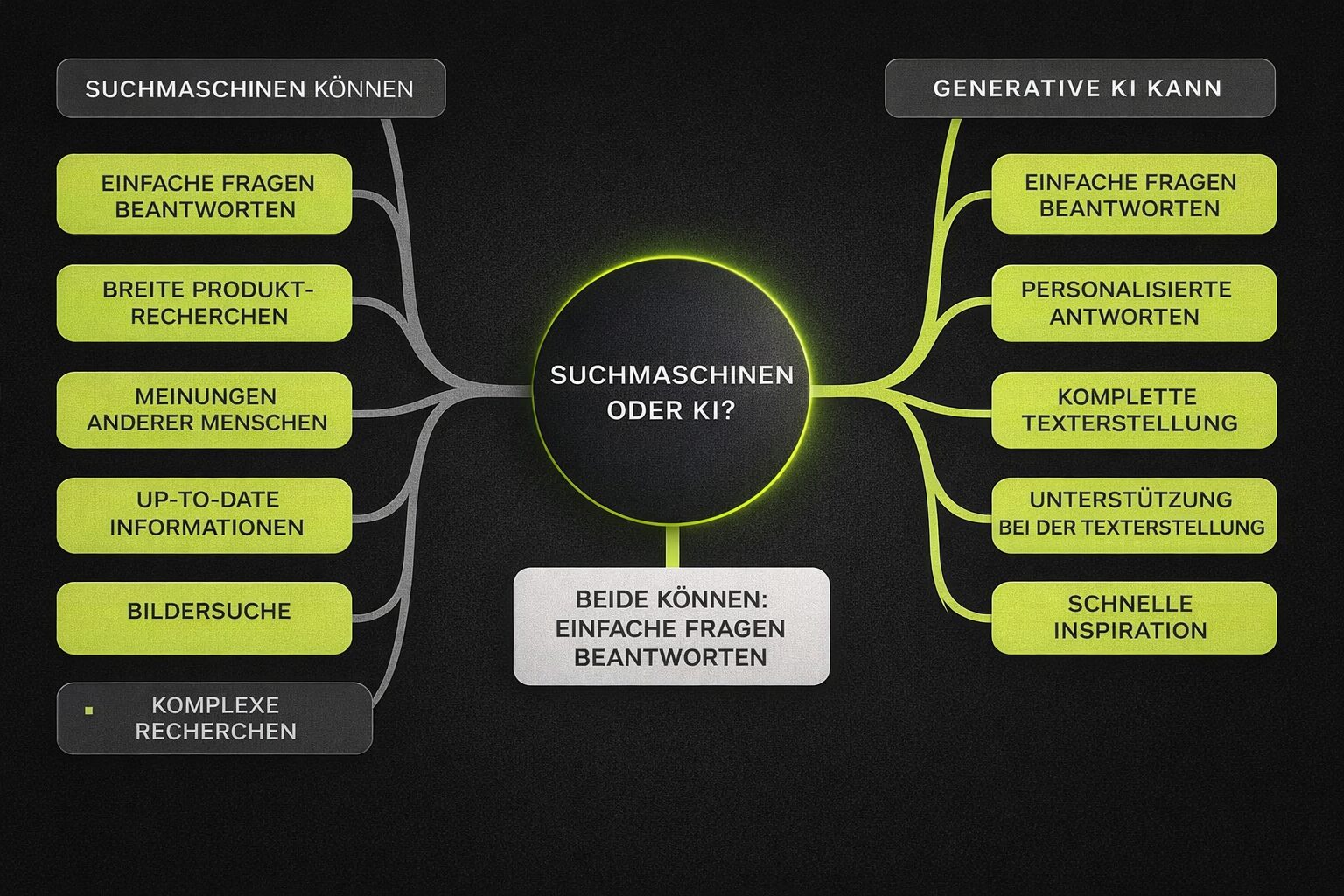
Generative AI tools such as ChatGPT, by contrast, do not fetch live data. They fall back on patterns they have learned from vast amounts of text in order to create or summarise content.
Ask an LLM to draft an email introducing yourself to a potential client and it will put together a natural-sounding message in seconds, complete with salutation, bullet points and sign-off.
Here is a quick example:
- • To find out today’s weather, you would type “Vienna weather” into Google and get the most up-to-date forecast.
- • To write a casual weather update email, you would ask ChatGPT: “write me a friendly note about today’s weather in Vienna”, and it delivers a finished paragraph.
In practice, professionals use both: they pull data from search and then let the AI handle the polish. That is how you work quickly and flexibly.
Google’s long-standing AI integration
Long before generative chatbots were in the spotlight, Google was quietly building AI into every corner of its search engine.
Take RankBrain from 2015: Google’s first publicly known machine learning component, which interpreted unclear or novel search queries using past search histories.
Instead of rigid keyword matching, RankBrain could infer intent and deliver more relevant pages, even when the exact words did not appear on the page.
Since then, Google has integrated further AI systems:
- • Spam detection: complex classifiers comb through link patterns and content signals in order to push manipulative or low-quality pages out of the rankings.
- • Natural language understanding: with updates such as BERT (2019), Google can “read” passages of text almost like a human, grasp context and nuance and thereby deliver better results for colloquial queries.
- • Personalisation engines: by analysing individual behaviour, previous clicks, location and device type, Google tailors the results precisely to your preferences and circumstances.
Imagine you type “best boba near me” on your phone. In the past you would have got a generic list of tea shops.
Today Google recognises, based on your surroundings, previous reviews and even current foot traffic, which shop is the best fit right now.
This seamless interlocking of several AI layers has been Google’s secret recipe for years, and it is what keeps search so reliable and precise.
Why generative search still needs human content
Imagine you are looking for tips on growing bonsai. A purely AI-driven system might spit out dull advice such as “water regularly” or “prune the branches”. Yawn.
An experienced gardener’s blog, on the other hand, delivers rich, detailed insights: “mist the leaves in spring when the air is dry”, or “check below the soil at night for tiny pests, they love to hide”. Only someone who has fought aphids at midnight shares details like these.
Google knows this. That is why there are features such as Perspectives, which place genuine expert opinions side by side. And updates such as Helpful Content and E-E-A-T (experience, expertise, authoritativeness, trustworthiness) reward real professionals rather than robot-written platitudes.
In short: generative search is the ultimate remix artist, but it needs real voices to produce hits. Deliver original expert knowledge and everyone benefits: you get richer answers, and the AI stays up to date.
What remains at the core of SEO
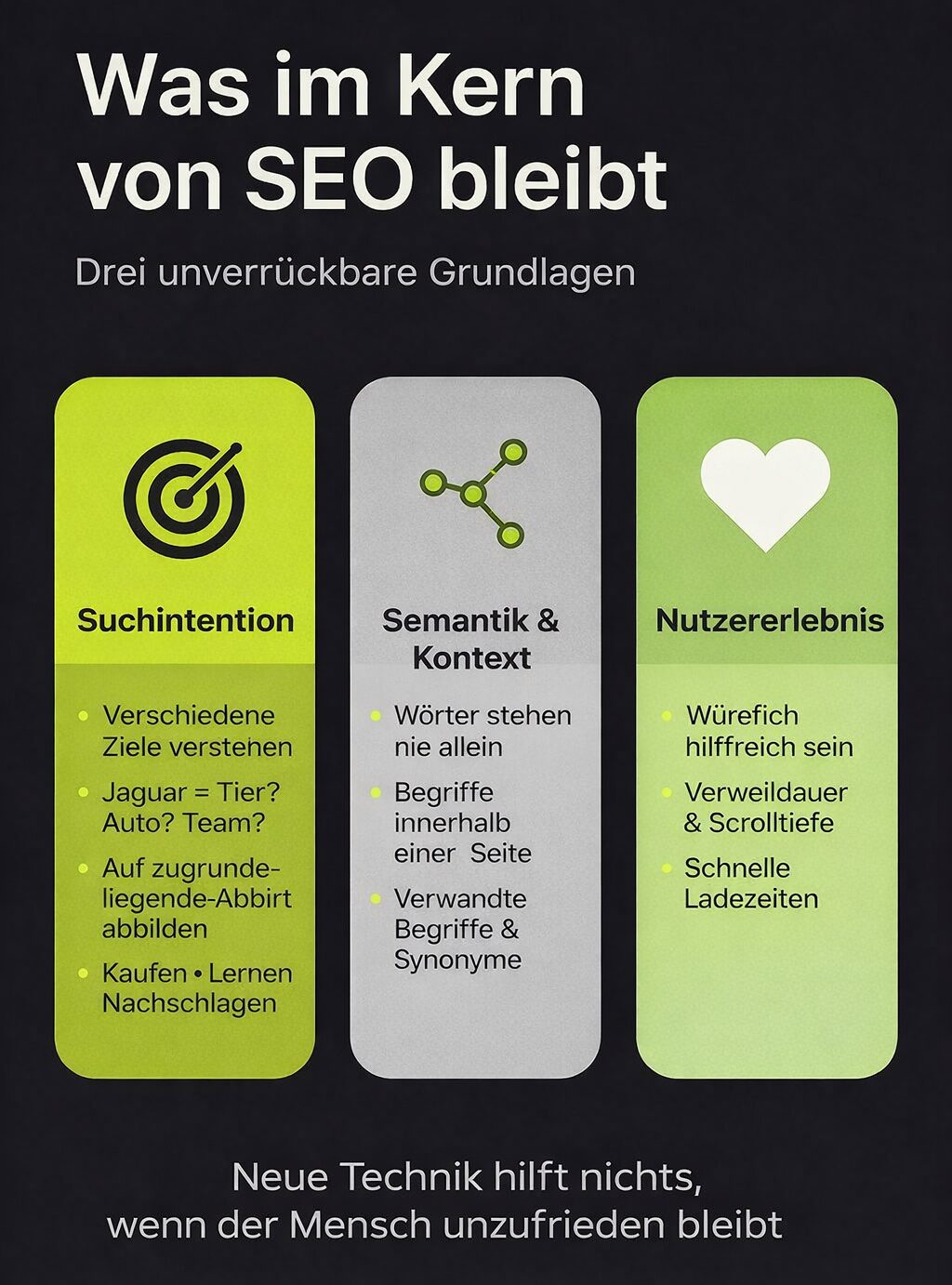
Even though AI and new interfaces are changing the way we search, three fundamentals remain unshakeable: understanding what users really want, grasping language in context and delivering an experience that is genuinely useful.
Search intent
Every search term can hide different goals. Someone typing “Jaguar” might mean the animal, the car or the football team.
SEO that only matches keywords misses the mark. Instead you have to map search queries to the underlying intent, whether that is buying, learning or quickly looking something up.
If you align your content precisely with that, you appear as the answer people are actually looking for.
Semantics and context
Words never stand alone. Search engines and AI now recognise how terms relate to each other within a page. “Jaguar” next to “engine” points to the car, next to “rainforest” it points to the animal.
This semantic understanding lets you rank not only for exact keywords, but also for related terms, synonyms and even questions your target audience may not ask explicitly.
User experience and usefulness
In the end, SEO rewards content that users find genuinely helpful. Engagement signals such as dwell time, scroll depth or click-through rate show search engines that you are providing added value.
Fast loading times, clear layouts and actionable insights keep users engaged and signal that your page deserves a top spot. Remember: new technology is of no use if the human on the other end remains dissatisfied.
Looking ahead: the SEO landscape
SEO is not disappearing; it is evolving towards more strategy and more user focus. As search experiences expand, from classic search boxes to voice assistants and AI chats, the mission stays the same: deliver genuine added value.
Companies that produce average, keyword-stuffed text will fall behind. The winners are those who integrate SEO into a comprehensive content ecosystem: blog posts, social snippets, video scripts and paid campaigns that all contribute to the same helpful goal.
Imagine someone discovers your brand in a podcast, reads your in-depth guide and then signs up for an interactive webinar, because all the formats carry the same clear message.
That is modern SEO: not trickery, but solving problems and building trust.
With the flood of AI-written text, search engines will rely more heavily on signals such as brand reputation, expert assessments and authentic user reviews in order to separate quality from noise. In niches where AI has little data, specialists with unique perspectives will shine the most.
So no, SEO is not dying, it is evolving. Anyone who bets on authenticity, connects their channels and makes use of new search formats such as voice and generative results will stay ahead and generate sustainable traffic.
Ready for more revenue?
Book a free SEO and GEO audit

Find out in a free call how much revenue your website is leaving on the table, with no obligation and no agency waffle.